
What Is Machine Learning? A First-Principles Explanation
Most people assume machine learning means teaching a computer to think like a human. It doesn't. It means showing a computer enough examples that it finds…

Key topics
Most people assume machine learning means teaching a computer to think like a human. It doesn't. It means showing a computer enough examples that it finds the pattern on its own.
Why Machine Learning Feels Like Magic (and Isn't)
Here's a common picture of machine learning: someone feeds a computer a mountain of data, the computer mysteriously "learns," and suddenly it can do things that look almost intelligent. It feels like magic because the interesting part happens out of sight.
Strip away the mystery and machine learning is refreshingly ordinary. A machine learning system finds patterns in examples. That's the whole trick. No hidden spark of intelligence, no computer that "understands" the world the way you do. Just pattern-finding at a scale and speed humans can't match.
Think about spam filters. Nobody sits down and writes a rule for every possible spam email. There are too many, and spammers change their tactics constantly. Instead, you show the filter thousands of emails you've already marked as spam or not spam. The filter studies those examples, finds the patterns that separate the two groups, and uses those patterns to judge emails it has never seen before.
That's what machine learning is: a way of building software that learns patterns from examples instead of following rules someone wrote by hand.
Ordinary Programming vs. Machine Learning
Traditional programming works like a recipe. You write step-by-step instructions, and the computer follows them exactly. If you want a program that calculates sales tax, you write the formula. If you want a program that sorts a list, you write the sorting logic. You are the one who figures out the rules, and the computer simply executes them.
Machine learning flips this arrangement. Instead of handing the computer rules, you hand it examples. The computer figures out the rules itself.
| Traditional Programming | Machine Learning | |
|---|---|---|
| What you provide | Explicit rules and instructions | Examples with known answers |
| What the computer does | Follows your rules exactly | Discovers patterns from your examples |
| When it works best | When you can describe the logic | When you can't describe the logic |
The difference becomes obvious when you try to solve a problem that resists hand-written rules. Consider recognizing handwritten digits. You could try to write rules: "If the shape has a loop at the top and a straight line down, it's a 9." But handwriting varies wildly between people. Some 9s have open loops. Some 7s have crosses through them. The number of edge cases is endless, and every rule you add creates new conflicts.
Machine learning sidesteps this entirely. Show the computer ten thousand labeled examples of handwritten digits—each one tagged with the number it represents—and let it find the distinguishing patterns. The computer doesn't need you to articulate what makes a 9 look like a 9. It just needs enough examples to figure it out.
This is the real motivation for machine learning. Some problems are genuinely impractical to solve with explicit rules because the patterns are too complex, too subtle, or too variable for a human to describe precisely. When you can't write the rules, you supply the examples instead.
Knowledge check
Check your understanding
Answer this question before you continue.
What a Model Actually Is
A machine learning model sounds abstract, but it's a simple idea: a model is the learned pattern that maps inputs to outputs.
When you train a model, you're adjusting it so its predictions match the known examples you gave it. The model starts with no useful pattern—just guesses. Each time it guesses wrong, it adjusts itself slightly. Repeat this thousands of times, and the adjustments accumulate into something useful: a pattern that connects inputs to correct outputs.
Here's what surprises most beginners: the model is not a copy of your data. It's a compressed summary of the pattern hidden inside your data. If you showed a model ten thousand photos of cats and dogs, it wouldn't memorize the photos. It would extract the visual differences that separate cats from dogs—the ear shapes, the face proportions, the fur textures—and discard everything else.
A good analogy is learning to recognize a friend's voice. You don't memorize every sentence your friend has ever spoken. You absorb the vocal qualities that make their voice distinct, and you can recognize them even when they say something completely new. The model does the same thing with patterns. It learns the underlying structure, not the specific examples.
And once trained, the model is reusable. You can feed it new, unseen inputs—a photo no one has shown it before, an email that just arrived—and it will apply the pattern it learned to make a prediction.
Knowledge check
Check your understanding
Answer this question before you continue.
The Learning Loop: Data, Training, Prediction
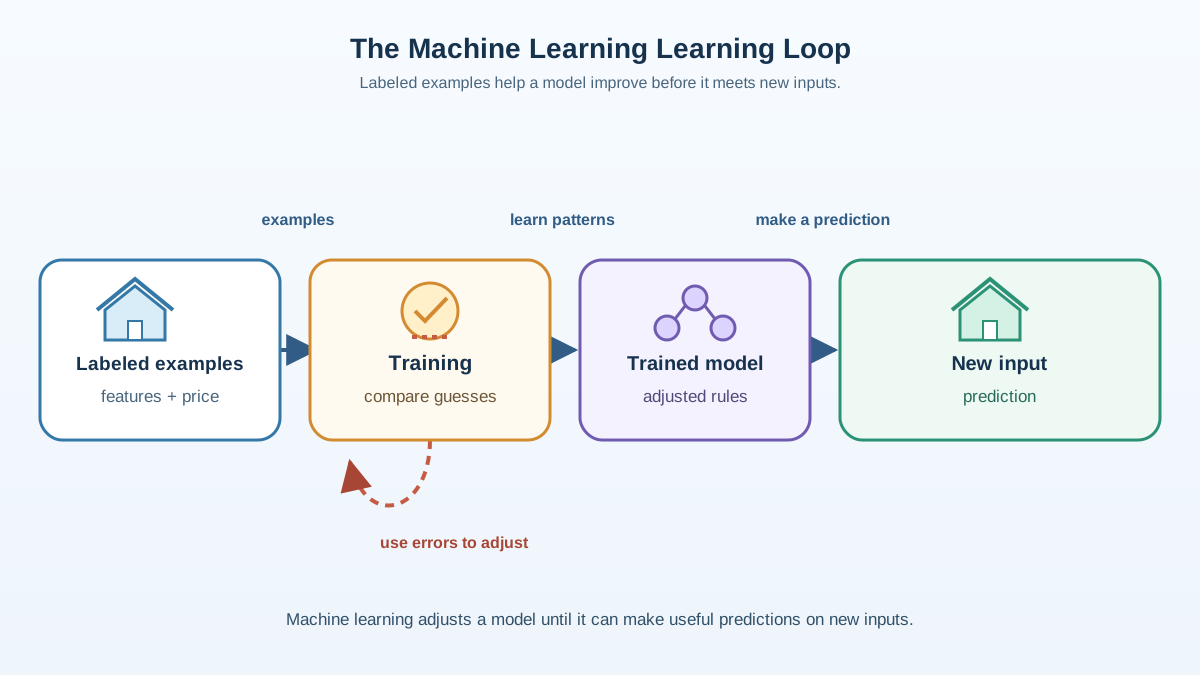
Let's make this concrete with one example we'll carry through the rest of the article: predicting house prices.
Every machine learning project starts with examples. In the house price case, each example is one house that has already sold. Each example has two parts:
- Features: the inputs you'll use to make a prediction, like square footage, number of bedrooms, and location.
- Label: the answer you want to predict, which is the price the house actually sold for.
Training is the process of showing the model many labeled examples and letting it adjust until its guesses match reality. You show the model a house with 1,800 square feet, three bedrooms, and a good school district. The model guesses $350,000. The actual sale price was $385,000. The model notes the gap and adjusts itself to be a little closer next time. Repeat this across thousands of houses, and the model gradually builds a reliable sense of how those features relate to price.
Prediction is what happens after training. You feed the model a house that hasn't sold yet—same features, but no label. The model applies the pattern it learned and gives you its best estimate of the price.
Data (labeled examples) → Training (model adjusts to match) → Prediction (model answers new questions)
That's the whole loop. Data goes in, the model learns from it, and the trained model answers questions about data it has never seen.
Knowledge check
Check your understanding
Answer this question before you continue.
Why We Hold Back Data: Generalization
Here's the trap that catches every beginner: a model that performs perfectly on its training data might be completely useless in the real world.
Imagine a student who memorizes the answer key instead of learning the subject. Give them the exact same questions from the practice exam, and they ace it. Give them slightly different questions on the same material, and they collapse. The student memorized the answers without understanding the underlying pattern.
Models can do the same thing. A model might memorize its training examples so thoroughly that it becomes an expert on those specific houses and nothing else. It would nail every prediction on the data it trained on, then fail miserably on new houses.
The goal of machine learning isn't memorization. It's generalization: the ability to perform well on data the model has never encountered. The model should learn the pattern, not just the examples.
This is why practitioners hold back some data. Instead of training the model on every example you have, you split the data into two groups:
- Training set: the examples the model learns from.
- Testing set: examples the model never sees during training.
After training, you test the model on the held-out data. If it performs well on houses it never studied, you have evidence that it learned a real pattern rather than memorizing specific answers. If it performs poorly, you know it memorized instead of learned.
This split is the practical way to check whether a model actually learned something useful. Later articles will cover evaluation in much more depth, but the core idea is simple: a model that only works on its training data hasn't learned anything worth keeping.
Knowledge check
Check your understanding
Answer this question before you continue.
Supervised vs. Unsupervised Learning
Not all machine learning looks like the house price example. The distinction comes down to one question: do your examples come with known answers?
Supervised learning is what we've been describing. Every example has a label—the known answer you want to predict. The model learns to map features to labels. Supervised learning splits into two common tasks:
- Classification: predicting a category. Is this email spam or not spam? Is this tumor benign or malignant? The answer comes from a fixed set of choices.
- Regression: predicting a number. What will this house sell for? How many minutes will this trip take? The answer is a continuous value.
Unsupervised learning works without labels. You have data, but no known answers. The goal is to find structure that's already hiding in the data. For example, a retailer might feed customer purchase histories into an unsupervised algorithm and discover that customers naturally fall into distinct groups—budget shoppers, luxury buyers, impulse purchasers. The algorithm found those groups without anyone telling it what the groups were.
Here's a simple decision rule to tell them apart: if you have known answers and want to predict answers for new data, it's supervised learning. If you're exploring data to find structure you didn't already know about, it's unsupervised learning.
This article focuses on the supervised loop because it's the most common starting point and the easiest to understand. But knowing that unsupervised learning exists helps you recognize it when you encounter it.
Is Your Problem a Machine Learning Problem?
Machine learning is a powerful tool, but it's not the right tool for everything. Before you dive into any project, run your idea through this checklist.
Machine learning is a good fit when:
- You have data. Not just a handful of examples, but enough that a pattern can emerge. The more relevant examples you have, the better.
- The pattern is learnable. There's a real relationship between your features and your label. If house prices were completely random, no amount of data would help you predict them.
- You can measure success. You need a way to tell whether the model's predictions are good. In the house price case, that means comparing predictions against actual sale prices.
Machine learning is the wrong tool when:
- You can write the rules easily. If a simple formula or a few if-then statements solve the problem, use them. Machine learning adds complexity without adding value.
- You lack data. Without enough examples, the model has nothing to learn from.
- You need guaranteed exact answers. Machine learning produces probabilities and estimates, not mathematical certainties. If your application requires perfection—like calculating the exact trajectory of a spacecraft—traditional programming is the right choice.
Consider the contrast. Predicting whether a customer will cancel their subscription is a good machine learning problem: you have years of customer data, the pattern is complex but real, and you can measure whether your predictions were right. Calculating the total cost of an order with a 10% discount is a terrible machine learning problem: you have the formula, and the answer must be exact.
Your Next Step
Take one problem you care about and run it through the checklist. Do you have data? Is there a learnable pattern? Can you measure success? If you answered yes to all three, you have a legitimate machine learning problem on your hands.
The natural next step is learning how to prepare your data and train a first model. Data almost never arrives in a usable form—it has missing values, inconsistent formats, and errors that need cleaning. And the first model you train will almost certainly need adjustment. Both of those challenges are normal, expected parts of the process.
Machine learning isn't magic. It's a practical way of building software when you can't write the rules yourself. The more clearly you understand that, the better you'll be at spotting the problems where it genuinely helps.
Knowledge check
Final check
Finish the article by checking the ideas you just learned.
References
Research updated Sep 8, 2026


