
Machine Learning vs Artificial Intelligence: What Is the Difference?
AI, machine learning, and deep learning are not rivals competing for the same title. They are nested categories, each living inside the next.

Key topics
AI, machine learning, and deep learning are not rivals competing for the same title. They are nested categories, each living inside the next.
If you have ever felt confused by headlines that use "AI" and "machine learning" as if they were the same thing, you are not alone. The terms appear everywhere—news articles, job postings, product marketing—and they are often blurred together so casually that it is natural to assume they mean the same thing.
They do not. And once you see how they fit together, you will never look at an AI headline the same way again.
Why the Terms Feel Interchangeable
Open any tech news site and you will find stories about "AI-powered" features that are actually powered by machine learning. Job descriptions ask for "machine learning engineers" to build "AI products." Marketing teams announce "AI breakthroughs" that are really incremental improvements to a recommendation system.
Part of the blur is marketing. "AI" sounds more impressive than "machine learning," so companies reach for the bigger word. But part of the blur is genuine: the terms genuinely overlap in scope, like "vehicle" and "car." Every car is a vehicle, but not every vehicle is a car.
The same relationship holds here. Every machine learning system is AI, but not all AI is machine learning.
Before we go further, a quick note: if you have not yet read about what machine learning actually is, the short version is that machine learning is the process of teaching a computer to find patterns in data instead of giving it explicit rules to follow. That one idea—learning from examples rather than following instructions—is the key to everything that follows.
Artificial Intelligence Is the Umbrella
Artificial intelligence is the broad field of building machines that can perform tasks that normally require human intelligence. That includes reasoning, problem-solving, understanding language, recognizing images, and making decisions.
Here is the part that surprises most beginners: AI does not have to learn from data.
Consider a chess program that uses a huge set of hand-written rules to evaluate board positions. A programmer wrote every rule by hand. The program does not learn anything. It simply follows its instructions faster and more carefully than any human could. That program is still AI, because it performs a task that normally requires human intelligence.
The same goes for a customer service system that routes your call based on a decision tree a human designed. No learning. Just logic. Still AI.
AI comes in two broad flavors. Narrow AI is what exists today: systems built to handle specific tasks like translation, face recognition, or playing chess. General AI—a machine that can perform any intellectual task a human can—remains a speculative idea, not a working technology.
Think of AI as the umbrella. Under it sits every approach to making machines behave intelligently. Machine learning is one of those approaches.
Knowledge check
Check your understanding
Answer this question before you continue.
Machine Learning Is One Approach Under the Umbrella
Machine learning is a specific subset of AI with a defining trait: the system learns patterns from data instead of receiving hand-written rules.
With rule-based AI, a programmer must anticipate every situation and write a rule for it. With machine learning, the programmer provides examples, and the system discovers the pattern on its own.
A spam filter makes this concrete. A rule-based approach would require someone to write rules like "emails containing the word 'lottery' are spam" and then update those rules every time spammers change their tactics. A machine learning approach works differently. You feed the system thousands of emails that humans have already labeled as spam or not spam. The system studies those examples and figures out which features—word patterns, sender behavior, phrasing quirks—predict spam. When a new email arrives, the system applies what it learned.
The same pattern powers music recommendations. A streaming service does not hand-code rules like "people who like artist A also like artist B." Instead, it analyzes millions of listening histories and lets the system discover the relationships in the data.
Here is the relationship stated plainly: all machine learning is AI, but not all AI is machine learning. Machine learning is one strategy for achieving AI, and it happens to be an extremely effective one.
Knowledge check
Check your understanding
Answer this question before you continue.
Deep Learning and Algorithms: Zooming In
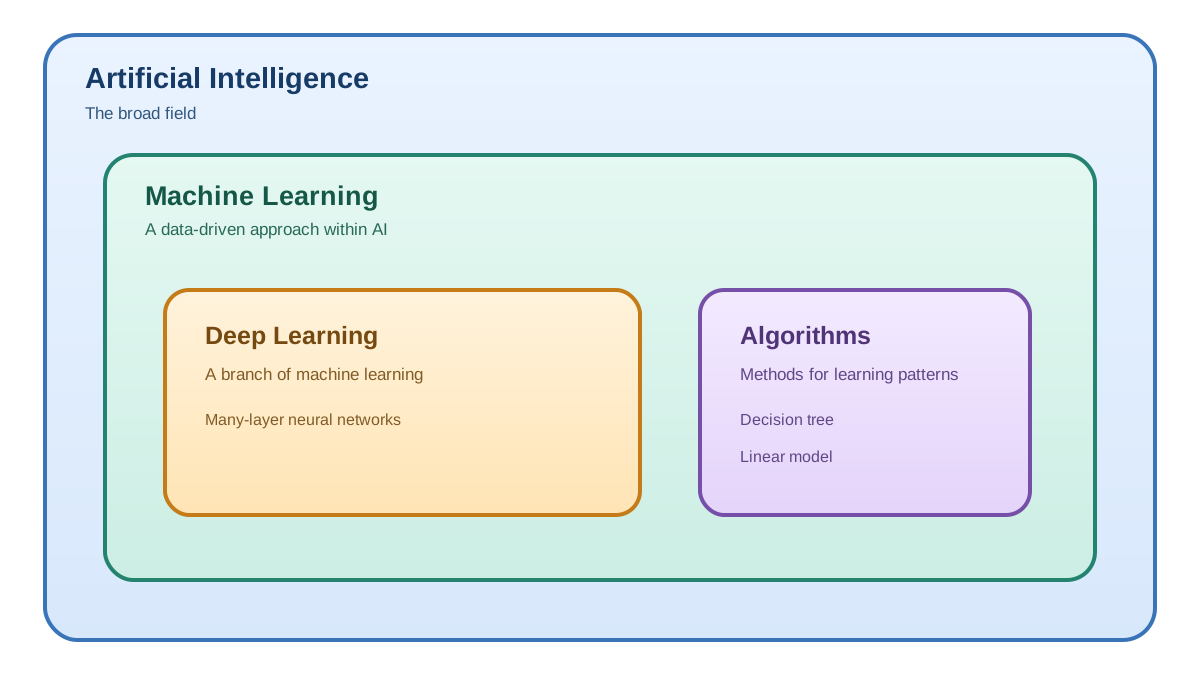
Now we zoom in one more level.
Deep learning is a subset of machine learning. It uses multi-layer neural networks—computational structures loosely inspired by the brain—to learn patterns, often from very large amounts of data. When you hear about systems that recognize faces in photos, transcribe speech, or generate images, you are almost certainly hearing about deep learning.
But deep learning is only one branch of machine learning. Many machine learning systems use far simpler methods. A decision tree, for example, learns a series of if-then rules from data. A linear model learns to draw a straight line through data points. These classical methods are still machine learning. They just do not use neural networks.
And at the very bottom of the stack sit algorithms. An algorithm is a single method—a decision tree, a linear model, a clustering technique—that a machine learning system uses to learn from data. When you train a model with scikit-learn, you are choosing an algorithm, feeding it data, and letting it learn.
The full picture looks like this:
- AI is the entire field of making machines behave intelligently.
- Machine learning is one approach within AI, defined by learning from data.
- Deep learning is one branch within machine learning, defined by multi-layer neural networks.
- Algorithms are the individual tools—decision trees, linear models, and so on—that machine learning systems use to learn.
Picture a set of nesting boxes. AI is the largest box. Machine learning fits inside it. Deep learning fits inside machine learning. Algorithms are the smallest tools inside that box.
Knowledge check
Check your understanding
Answer this question before you continue.
A Quick Comparison Table
| Term | Scope | What it does | Familiar example |
|---|---|---|---|
| Artificial intelligence | Broadest | Builds machines that perform tasks requiring human intelligence | A chess program using hand-written rules |
| Machine learning | Subset of AI | Learns patterns from data instead of following explicit rules | A spam filter trained on labeled emails |
| Deep learning | Subset of machine learning | Uses multi-layer neural networks to learn complex patterns | A system that recognizes faces in photos |
| Algorithm | Smallest unit | A single method a machine learning system uses to learn | A decision tree classifying loan applications |
When you hear a new term in the AI world, your first question should be: which layer does it belong to? That single question will save you more confusion than any definition you memorize.
Why the Distinction Matters for Learning Classical ML
This terminology clarity is not academic. It directly shapes what you should learn and when.
This site focuses on classical machine learning: the algorithms like decision trees, linear models, and clustering methods that run beautifully on structured, tabular data. This work sits in the machine learning layer. It does not require deep learning, and most of it does not use neural networks at all.
That is not a limitation. For many real-world problems, classical machine learning is the right tool. If you have a spreadsheet of customer data and you want to predict which customers will churn, a gradient-boosted tree will often outperform a deep neural network—while being faster to train, easier to interpret, and simpler to debug.
Deep learning shines on unstructured data: images, audio, and natural language, where the patterns are too complex for hand-crafted features. If your data is a folder of photos, deep learning is likely your answer. If your data is a table with rows and columns, start with classical methods.
My rule is simple: match the tool to the data. Classical machine learning for structured data. Deep learning for unstructured data. And remember that you do not need to master all of AI to build useful machine learning models. You need to understand one layer well enough to solve real problems with it.
Knowledge check
Check your understanding
Answer this question before you continue.
Common Mistakes to Avoid
Mistake 1: Treating AI and machine learning as competitors. They are not competing technologies. AI is the field; machine learning is one approach within it. Asking "AI or machine learning?" is like asking "vehicle or car?"
Mistake 2: Assuming every AI system learns from data. Rule-based AI still exists and still works. Many production systems use hand-written logic because it is predictable, explainable, and cheap to run.
Mistake 3: Equating machine learning with deep learning. Deep learning is one branch of machine learning. Most classical machine learning does not use neural networks at all, and that is fine.
Mistake 4: Assuming more data or a neural network is always better. On structured data, classical algorithms often match or beat deep learning with far less computational cost. Choose the tool based on your data, not on what sounds most impressive.
Here is your self-check for any AI term you encounter: ask what the system actually does. Does it follow rules a human wrote? That is rule-based AI. Does it learn patterns from data? That is machine learning. Does it use multi-layer neural networks? That is deep learning. Does it use a single method like a decision tree? That is an algorithm at work.
Once you can place a term in its layer, the fog clears. And with that clarity, you are ready for the next step: building your first classical machine learning model and seeing how these ideas come alive in code.
Knowledge check
Final check
Finish the article by checking the ideas you just learned.
References
Research updated Sep 8, 2026


