
A Practical Machine Learning Learning Roadmap Before Deep Learning
Most beginners treat machine learning as a collection of algorithms to memorize. They collect names like trading cards—logistic regression, random forest,…

Key topics
Most beginners treat machine learning as a collection of algorithms to memorize. They collect names like trading cards—logistic regression, random forest, support vector machine—and hope that knowing the names means knowing the field. Or they skip straight to neural networks because that is what sounds impressive.
That approach fails for a simple reason: machine learning is not a list of algorithms. It is a chain of capabilities where each stage unlocks the next. You cannot evaluate a model you cannot train. You cannot train a model on data you cannot load and clean. And you cannot judge whether a model is any good until you have a way to measure it honestly.
This roadmap is built on that dependency chain. Every stage exists so the next stage has something real to build on. If you already understand what machine learning is and how a trained model differs from ordinary code, you are ready to start here.
Why Most Machine Learning Roadmaps Fail Beginners
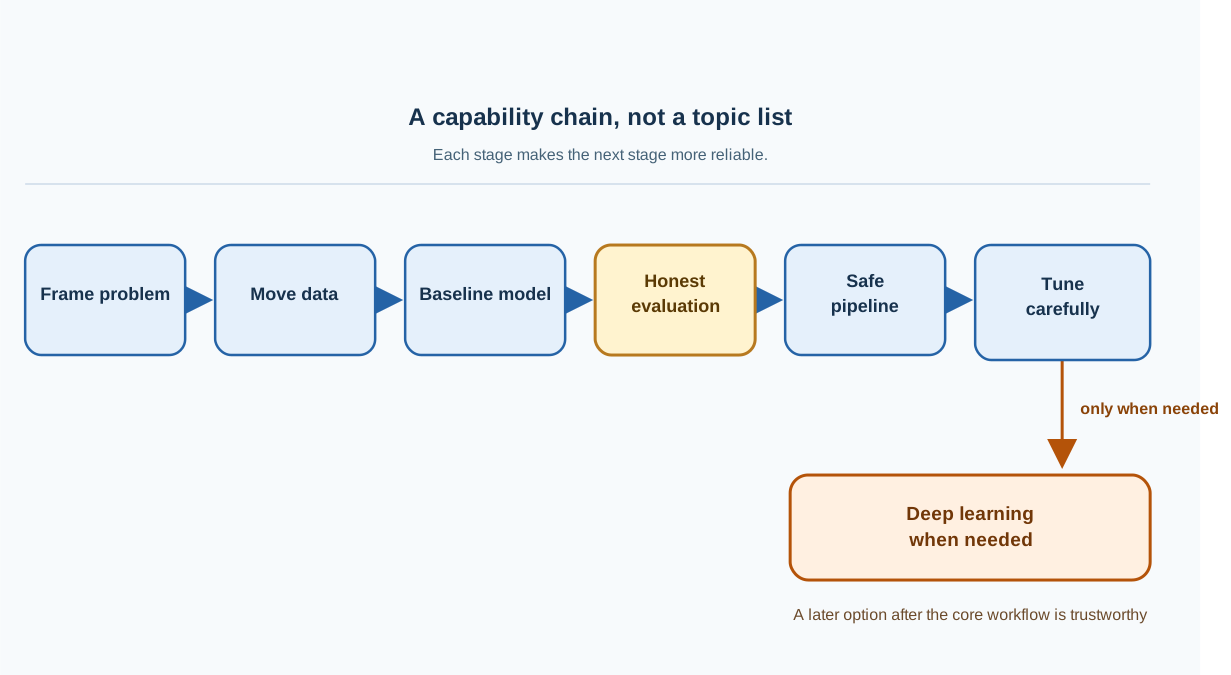
The weak model of learning machine learning sounds like this: learn Python, memorize some algorithm names, watch a video about neural networks, and call yourself done. The problem is that none of those steps produces a person who can actually solve a problem with data.
The stronger model treats machine learning as a sequence of capabilities. Each capability depends on the ones before it:
- You need to frame a problem before you can choose data.
- You need to move data before you can train anything.
- You need a baseline model before you can evaluate anything.
- You need honest evaluation before you can tune or improve anything.
When you reverse this chain, you get the order of study. That is what this roadmap provides: a dependency-aware path from problem framing through classical models and evaluation, with explicit reasons for the order.
Set your expectations now. This is a path measured in weeks and months of practice, not a checklist to finish in a weekend. The goal is not breadth across every algorithm. The goal is one working, repeatable workflow you actually understand.
Stage 1: Frame the Problem Before You Touch Code
The first skill in machine learning is not coding. It is deciding what question your data should answer.
Start by identifying whether your problem is supervised or unsupervised. In supervised learning, a target outcome exists—you have examples of past answers and want to predict future ones. In unsupervised learning, there is no target, only structure waiting to be found. If you need a refresher on this distinction, that is a natural place to pause before continuing.
Then check whether your problem has the raw material machine learning needs. Do you have enough examples? Is there a signal worth predicting? Can you actually obtain the data?
My rule is simple: if you cannot state what a correct answer looks like, you are not ready to train a model. The problem-framing stage feels like procrastination to beginners. It is not. It is the foundation everything else stands on.
Knowledge check
Check your understanding
Answer this question before you continue.
Stage 2: Get Comfortable Moving Data in Python
Classical machine learning tools like scikit-learn expect data in a rectangular table: rows of examples, columns of features. Pandas and NumPy are how you load, shape, and inspect those tables. A notebook environment—Jupyter or Google Colab—is where you will do most of your early experimentation.
The milestone here is not memorizing syntax. It is being able to load a CSV, look at missing values, summarize columns, and confirm the data looks the way you expect—without panic. Run a small load-and-inspect step. Observe the output. Verify your assumptions.
Keep the scope tight. Beginners do not need advanced pandas tricks yet. They need enough to prepare a clean table for a model. Visualization with Matplotlib or Seaborn earns its place at this stage because seeing a distribution beats guessing one.
Stage 3: Train Your First Baseline Model
With data handling under your belt, you can start training models with scikit-learn. But before you compare models or chase better scores, you need a minimal honest setup: split your data into training and test portions, train only on the training portion, and check the score on the held-out test portion.
Think of this as your first baseline. A baseline is a simple, honest model that gives you a number to beat. It does not need to be impressive. It needs to be trustworthy.
Start with linear models. They are the clearest window into how a model turns features into a prediction and how training adjusts parameters. You can see the mechanism.
Move to decision trees next. They introduce nonlinear boundaries and the idea that a model can split data into regions. Trees feel different from linear models, and that contrast teaches you something important: different models make different assumptions about your data.
Add ensembles—random forests, gradient boosting—only after trees make sense. An ensemble is just trees plus a strategy for combining many of them. If you do not understand the base learner, you cannot understand the ensemble.
Keep clustering and dimensionality reduction as a separate thread for later. Do not mix them into the supervised path yet.
Understand one model deeply enough to explain its mechanism before adding the next.
Knowledge check
Check your understanding
Answer this question before you continue.
Stage 4: Judge Your Model Honestly
A model that scores well on its training data can still fail on new data. Evaluation is about estimating performance on data the model has not seen.
Train/test splits and cross-validation are the tools that force this honest estimate. They hold out data the model never sees during training, then test the model against it.
Two traps will catch you here. Overfitting happens when the model memorizes noise instead of learning the real pattern. Data leakage happens when information from the future or the test set sneaks into training, making your results look better than they truly are.
This stage belongs before tuning because you cannot tune a model until you can measure it fairly. If your evaluation setup is dishonest, every tuning decision built on it is dishonest too.
Knowledge check
Check your understanding
Answer this question before you continue.
Stage 5: Prepare Data and Engineer Features Inside a Pipeline
Cleaning missing values, encoding categories, and scaling numeric features are the daily work of classical machine learning. They belong after you have a baseline and an honest evaluation setup, because that is when you can actually measure their effect.
Here is the key discipline: preprocessing must be learned from the training data only, then applied to the test data. If you scale or fill missing values using the whole dataset before splitting, test information leaks into training, and your evaluation lies to you.
Scikit-learn pipelines keep preprocessing and modeling in one repeatable flow. They also protect you from that subtle disaster by making the order of operations explicit.
Feature engineering is where domain judgment meets the model. A good feature can matter more than a fancier algorithm. The person who knows that a customer's time since last purchase predicts churn better than any generic transformation has an advantage no algorithm can replace.
This stage is the payoff of the earlier order. Now you can actually test whether a preprocessing choice helps or hurts. Change one thing at a time, and let your evaluation from Stage 4 tell you whether it worked.
Knowledge check
Check your understanding
Answer this question before you continue.
Stage 6: Tune Models Without Chasing Perfection
Hyperparameters are the knobs you set before training—tree depth, number of neighbors. They are distinct from the parameters the model learns from data during training.
Tuning belongs late because it only makes sense on top of honest evaluation and a working pipeline. A small, guided search over a few settings beats an endless hunt for a marginally better score.
Watch for one trap: it is possible to tune your way into overfitting the validation data. If you search long enough, you will find settings that look great on your validation set but fail on new data.
A slightly tuned, honest model beats a heavily tuned model you cannot trust.
When to Move Into Deep Learning
Classical methods remain the right starting point for tabular data, small-to-moderate datasets, and problems where interpretability matters. If you can explain why your model made a prediction, classical methods often serve you better than a neural network ever could.
Deep learning earns its keep when data is large and unstructured—images, text, audio—or when learned feature representations beat hand-built ones. The comparison between classical methods and deep learning deserves its own careful look before you decide.
The honest signal to switch is not a desire for something newer. It is hitting a real limit with classical methods on your data.
Classical machine learning is not a detour on the way to deep learning. It is the laboratory where you learn data, features, and evaluation—skills you will need no matter which models you eventually use.
A Realistic Pace and the Milestones That Prove Progress
Here is a rough sense of relative effort. Stage 1 is fast—days, not weeks. Stage 2 takes longer because you are building fluency with new tools. Stages 3 and 4 are where most beginners spend serious time. Stages 5 and 6 compound everything before them.
Define a concrete milestone for each stage:
- Load and inspect a dataset without panic.
- Train one baseline model with a train/test split and check its score.
- Build one honest pipeline that includes preprocessing and modeling.
- Tune one model without breaking your evaluation setup.
Getting stuck is normal. A confusing error or a bad score is evidence about what you do not understand yet, not a sign that you lack talent. Read the error. Trace the state. Fix the assumption.
Then build one small end-to-end project as your capstone. It forces every earlier stage to connect.
Your Next Move
Start Stage 1 today. Take one real problem you care about. State whether it is supervised or unsupervised. Confirm it has enough examples, a signal worth predicting, and data you can actually obtain.
Do this before writing any code.
This roadmap is a dependency chain, not a checklist. The fastest progress comes from building one honest end-to-end project, then another, then another. Each one will teach you more than a dozen tutorials ever could.
Knowledge check
Final check
Finish the article by checking the ideas you just learned.
References
Research updated Sep 8, 2026


