
Machine Learning Models vs Algorithms: The Terms Beginners Mix Up
You've said it yourself at least once: "The algorithm predicted the house price." Or maybe: "The model learned from the data." These sentences feel right.…

Key topics
You've said it yourself at least once: "The algorithm predicted the house price." Or maybe: "The model learned from the data." These sentences feel right. They also blur two very different things.
Here's the distinction that will save you hours of confusion: an algorithm is a reusable recipe, and a model is the finished dish that recipe produces. The recipe can be used a thousand times with different ingredients. The dish is what you actually serve.
Machine learning works the same way. An algorithm is a general procedure that learns from data. A model is the specific, trained result that makes predictions. Getting these straight isn't vocabulary pedantry—it's the difference between debugging effectively and guessing blindly.
Why These Words Keep Getting Mixed Up
When you're new to machine learning, the whole process can feel like one undifferentiated blob. Data goes in. Something happens. Predictions come out. In that blur, algorithm, model, training, and prediction all collapse into the same fuzzy idea: "the machine learning thing."
That weak mental model works fine until something goes wrong.
Imagine your model performs poorly on new data. Is the problem the algorithm you chose? The data you fed it? The way you configured the training? Without a clear picture of where one thing ends and another begins, you can't even ask the right question, let alone fix the problem.
The payoff for getting these terms straight is practical: you can debug intelligently, compare approaches honestly, and reuse work instead of starting over. And once you see the actual workflow, the vocabulary stops being jargon and starts being a map.
The Algorithm Is the Reusable Recipe
An algorithm in machine learning is a fixed, reusable procedure written to learn from data. It's a set of steps, a method, a piece of machinery designed to find patterns.
Think about a recipe for sourdough bread. The recipe doesn't contain any bread. It contains instructions: mix flour and water, add starter, knead, wait, shape, bake. Follow those steps with different flours, different temperatures, different timing, and you'll produce different loaves. The recipe stays the same. The loaves don't.
Machine learning algorithms work the same way. The linear regression algorithm is a procedure for finding the line that best fits a set of data points. That procedure is identical whether you run it on housing prices, student test scores, or ice cream sales. The algorithm itself contains no learned knowledge yet. It's the machinery, not the result.
This is the machine learning algorithm definition worth keeping: a general method for learning from data, reusable across many different problems and datasets.
Knowledge check
Check your understanding
Answer this question before you continue.
Training Turns Data Into a Model
Training—also called fitting—is the moment the algorithm actually does its work. You feed the algorithm a dataset, and it adjusts internal values to capture the patterns hidden in that data.
Those internal values have a name: parameters. They're the numbers the algorithm tunes during training, and they're the "learned" part of the whole process.
Here's a concrete example. Suppose you want to predict house prices from square footage. You feed the linear regression algorithm a dataset of past home sales. The algorithm finds the line that best fits those sales. That line has two parameters: a slope (how much the price increases per additional square foot) and an intercept (the baseline price).
The slope and intercept aren't chosen by you. They emerge from the data. Train the same algorithm on mansions in one city and starter homes in another, and you'll get different slopes and different intercepts. Same recipe. Different ingredients. Different dish.
This is why model training produces something specific: the algorithm is general, but the trained result is always tied to the particular data it learned from.
Knowledge check
Check your understanding
Answer this question before you continue.
The Model Is the Finished, Fitted Result
So what is a machine learning model? It's the concrete output of training: a snapshot of learned parameters plus the procedure for using those parameters to make predictions.
The model is the specific fitted line with its particular slope and intercept. It's the trained decision tree with its particular branches and leaves. It's the neural network with its particular weights.
One algorithm can produce countless models. Every dataset you run it on yields a different trained result. But each model is inseparable from the data that created it. That's the key contrast: the algorithm is the general method; the model is the specific artifact.
Carrying the recipe analogy through: the algorithm is the recipe, and the model is the finished dish you serve. You can critique the dish, compare it to other dishes, and decide whether the recipe needs adjustment for next time. But the dish itself is what people actually eat.
In practice, the model is what you save, load, and apply to new inputs later. The algorithm did its job during training. After that, you work with the model.
Knowledge check
Check your understanding
Answer this question before you continue.
Predictions Use the Model, Not the Training Algorithm
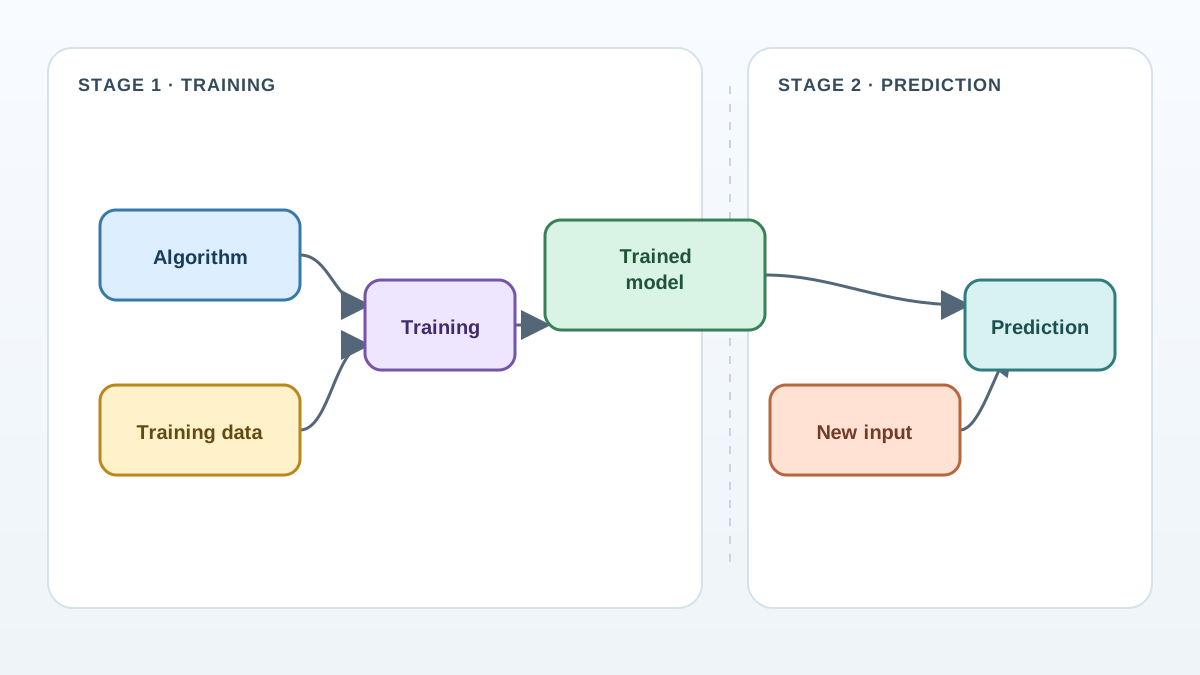
This is where the terms finally separate cleanly—but there's one nuance worth getting right. After training is complete, you don't feed new data back into the learning algorithm. You feed it into the model. The learning algorithm's job is done.
Prediction—also called inference—happens when the trained model applies its learned parameters to a new, unseen input. The model takes the slope and intercept it learned during training, plugs in the new house's square footage, and outputs a predicted price.
That house was never in the training data. The model has never "seen" it before. But because training captured the general relationship between square footage and price, the model can make a reasonable guess.
Here's the full loop, compressed into one line:
Algorithm + training data = model. Model + new input = prediction.
The algorithm is the reusable learning procedure. The model is the trained result you actually use. Predictions come from the model, not from the training algorithm.
One clarification so you don't walk away with the wrong mental model: the model isn't a passive object that predicts on its own. It packages the learned parameters together with a prediction procedure—the steps that interpret those parameters for a new input. In practice, you don't need to separate them. When you call predict on a fitted model, you're using both together. The key point is that the learning algorithm isn't involved anymore.
Knowledge check
Check your understanding
Answer this question before you continue.
A Simple Way to Keep Them Straight
When the terms start blurring again, ask yourself one question: "Am I describing the general method or the specific trained result?"
If you're talking about a procedure that could run on any dataset, you mean the algorithm. If you're talking about a fitted result that learned from particular data and now makes predictions, you mean the model.
One more note on where the recipe analogy stops being exact. A finished dish gets eaten. A model doesn't get consumed—it keeps making predictions, as many times as you ask. The recipe analogy is useful for understanding how training works, but a model is more like a tool you keep using than a meal you finish.
You'll see this distinction everywhere once you know to look for it. In scikit-learn, for example, you first create an instance of an algorithm—say, a linear regression object—and then you fit it on your data. That fit operation is the training step. After fitting, the object you hold is no longer just the algorithm. It's a trained model, ready to make predictions.
Watch for that moment in your next tutorial. The instant an algorithm gets fit on data, it becomes a model. Notice it happening, and the vocabulary will finally stick.
Knowledge check
Final check
Finish the article by checking the ideas you just learned.
References
Research updated Sep 8, 2026


