
Supervised vs Unsupervised Learning: How the Data Changes the Task
You have heard both terms. You can even recite rough definitions. Then you open your own dataset, stare at the columns, and freeze. Is this supervised or…

Key topics
You have heard both terms. You can even recite rough definitions. Then you open your own dataset, stare at the columns, and freeze. Is this supervised or unsupervised?
That freeze is not a sign that you are missing some deeper theory. It is a sign that you are using the wrong mental model. You have been trying to match your problem to memorized definitions when you should be reading your data for one signal.
Here is the signal: Does your data contain the answer you want to predict?
That question points you toward the right learning setup. If the answer is yes, you likely have a supervised learning problem. If the answer is no, you may be in unsupervised territory—but only if your actual goal is discovering structure. Before you write any code, before you pick an algorithm, before you import a single library, answer that question.
The Question That Points to the Task
Machine learning, at its core, is about teaching a program to find patterns in data so it can make decisions or predictions on new data it has never seen. But the kind of pattern you are looking for depends on what your data gives you to work with—and what you actually want to accomplish.
Think about a spreadsheet you might really have. Maybe it is customer records, housing listings, sensor readings, or support tickets. Look at the columns. Now ask yourself two questions in order:
- What outcome do I want to produce for new data?
- Is there a column that represents that outcome?
That column—the outcome, the answer, the thing you want to predict—is called a label. Data that includes labels is called labeled data. Data without labels is called unlabeled data.
The presence or absence of that label does not just change which algorithm you use. It changes the entire job. With a label, you are teaching a model to predict a known outcome. Without a label, you are asking a model to discover structure that nobody has named yet.
One is prediction. The other is exploration. They are different jobs, and your goal—not just your columns—tells you which one you have.
One caution before we go further: a column can exist without being a trustworthy target. Suppose your spreadsheet has a column called "customer segment" that someone filled in casually five years ago. That column is not automatically a valid label. A label is only useful if it reliably represents the outcome you genuinely care about. Missing labels are a problem. Unreliable labels are a bigger one.
Knowledge check
Check your understanding
Answer this question before you continue.
Supervised Learning: Learning With an Answer Key
Supervised learning is what most people picture when they hear "machine learning." You have a dataset where every example comes with a known answer, and you train a model to learn the relationship between the inputs and that answer.
The standard analogy is a teacher grading homework. You show the model a set of examples, each paired with the correct answer. The model makes a guess, checks it against the answer key, notices where it went wrong, and adjusts. Repeat that process thousands of times, and the model gets better at producing the right answer for examples it has never seen.
The analogy is useful, but it has a limit. A student eventually learns the material and no longer needs the answer key. A supervised model never truly "learns" in that sense. It finds statistical patterns that connect inputs to outputs, and it applies those patterns to new data. The answer key is not a teaching aid. It is the entire basis of the training process. Remove the labels, and supervised learning has nothing to learn from.
Supervised problems come in two flavors, and the distinction is about the kind of answer you are predicting:
- Classification predicts a category. Is this email spam or not spam? Is this transaction fraudulent or legitimate? Is this image a cat or a dog? The output is a discrete choice from a fixed set of possibilities.
- Regression predicts a number. What will this house sell for? How many kilowatt-hours will this building use next year? What will the temperature be tomorrow? The output is a continuous value.
Both flavors share the same structure: inputs paired with known outputs, and a model trained to map one to the other.
The practical advantage of supervised learning is that evaluation is straightforward. You hold back some labeled examples, let the model predict them, and compare its predictions against the known answers. Accuracy, error rates, precision—all of these measurements exist because you have ground truth to check against.
The hidden cost is the labels themselves. Someone has to create them. A human has to look at each transaction and mark it fraudulent or legitimate. Someone has to research what each house actually sold for. Labeling is manual, slow, and expensive. That effort is the real constraint on supervised learning, and it is why so much real-world data never gets used for supervised problems.
Knowledge check
Check your understanding
Answer this question before you continue.
Unsupervised Learning: Finding Structure Without an Answer Key
Unsupervised learning starts from a very different place. There is no answer key. There may not even be a question yet. You have a pile of data, and you want to know what is in it.
The model works with inputs alone. It looks for groupings, patterns, or relationships that exist in the data itself, without anyone telling it what to look for. You do not say, "find the customers who will churn." You say, "show me what groups of customers exist," and then you look at what the model found and decide what those groups mean.
The main beginner-facing example is clustering, which groups similar examples together. Give the algorithm a set of customer records with no labels, and it will sort those customers into clusters based on how similar their attributes are. Afterward, you get to name the groups. One cluster might turn out to be budget-conscious students. Another might be high-value repeat buyers. The algorithm did not know those categories existed. It found the structure, and you supplied the meaning.
Clustering is not the only unsupervised family. Dimensionality reduction, which compresses many columns into fewer ones while preserving important structure, is another common one. But clustering is the best place to start because it makes the core idea visible: the model discovers groupings that no one specified in advance.
The tradeoff is that evaluation becomes harder. With supervised learning, you can measure exactly how often the model is right against known answers. With unsupervised learning, there is no single known answer in the training data to check against. That does not mean evaluation is impossible—it means evaluation depends on the task. You can check whether the clusters are stable across runs, whether they separate cleanly when visualized, and most importantly, whether a domain expert looks at the groupings and says they make sense. The question shifts from "Is this correct?" to "Is this useful for what I am trying to understand?"
The payoff is that unsupervised learning works when labels are scarce, costly, or impossible to create. It also works when you are exploring data before you even know what questions to ask. Sometimes the most valuable thing a model can do is tell you that your data has structure you did not know was there.
Common mistake: Do not assume that clusters are meaningful just because an algorithm produced them. Clustering will always find groups, even in random noise. Treat clusters as a starting hypothesis, then check whether they hold up under inspection and whether they help you act.
Knowledge check
Check your understanding
Answer this question before you continue.
Supervised vs Unsupervised at a Glance
| Supervised Learning | Unsupervised Learning | |
|---|---|---|
| Data required | Labeled data: inputs paired with known outputs | Unlabeled data: inputs only |
| The question | What outcome does this example belong to? | What structure exists in this data? |
| Typical output | A prediction: a category or a number | A grouping or compressed representation |
| How you evaluate | Compare predictions against known answers | Check stability, inspect results, judge practical usefulness |
| Common examples | Spam detection, price prediction, fraud flagging | Customer segmentation, grouping similar items, exploring unknown data |
The whole table traces back to one fact: whether a trustworthy target outcome exists in your data. Everything else—the objective, the output, the way you measure success—follows from that.
How to Decide: A Simple Decision Rule
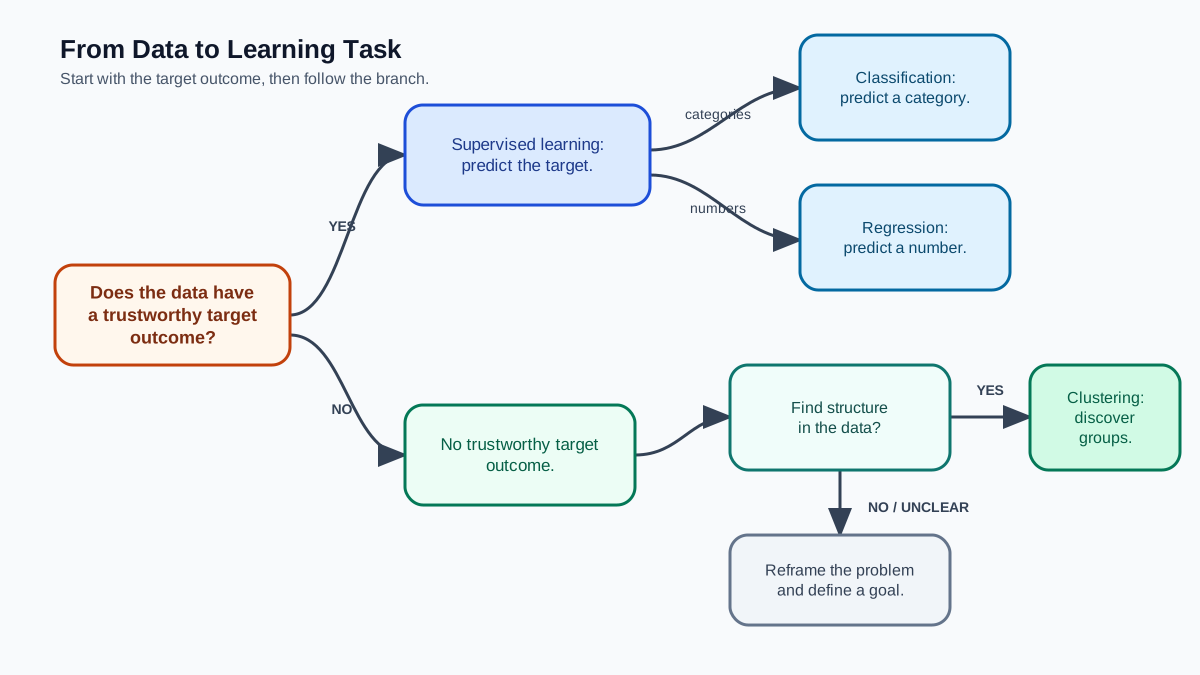
When you face a real problem, run this three-step rule:
Step 1: Do you have a target outcome you want to predict? Look at your columns. Is there one column that represents the answer you want the model to produce? If yes, you have a supervised learning problem. Move to step 2. If no, move to step 3.
Step 2: Is the target a category or a number? If the answer is a category—spam or not spam, fraud or legitimate, dog or cat—you have a classification problem. If the answer is a number—price, temperature, number of days until churn—you have a regression problem.
Step 3: What is your actual goal without a target? If you have no target column, stop and name what you are trying to accomplish. If your goal is to find groupings or structure that nobody has labeled yet, you have an unsupervised learning problem, and clustering is likely your starting point. If your goal is still unclear, do not pick an algorithm yet. Go back to problem framing: what decision will this analysis inform? What would a useful result look like? Choosing an algorithm before answering those questions is how beginners waste weeks.
Try the rule on a few scenarios:
- You have historical data on apartment rentals, including square footage, neighborhood, number of bedrooms, and the actual monthly rent each unit commanded. You want to estimate rent for a new listing. There is a clear target column—monthly rent—and it is a number. Supervised regression.
- You have a database of support tickets, and you want to group them by the type of issue so your team can spot recurring problems. There is no target column telling you what issue type each ticket represents. You want the model to find those groupings. Unsupervised clustering.
- You have customer records with a column indicating whether each customer canceled their subscription within the first year. You want to predict which new customers are at risk of canceling. The target column exists, and it is a category. Supervised classification.
One honest edge case: sometimes you have labels for only part of your data. Perhaps you have thousands of customer records but only a few hundred with a confirmed churn outcome. This situation points toward semi-supervised learning, which combines a small amount of labeled data with a larger pool of unlabeled data. It is a real approach, but do not reach for it until you have confirmed that your labeled subset is genuinely too small to train a supervised model on its own.
The bigger mistake beginners make is forcing a problem into supervised learning when no reliable target exists. If you do not have trustworthy labels, you cannot train a supervised model. No amount of algorithm choice fixes missing ground truth. Read the data honestly, and let it tell you which job you actually have.
Knowledge check
Check your understanding
Answer this question before you continue.
They Work Together More Often Than You Think
It is tempting to treat supervised and unsupervised learning as competing choices, like picking a side in a debate. In practice, they are tools that often appear in the same project.
Unsupervised exploration frequently comes first. Before you build a supervised model, you might cluster your data just to see what is there. Those clusters can reveal subgroups you did not anticipate, which then changes how you frame the supervised problem. Maybe your "customers" are really two different populations that deserve separate models.
Unsupervised methods can also prepare data for supervised training. Dimensionality reduction can compress hundreds of noisy columns into a smaller set, which can make a supervised model faster to train and easier to visualize. But treat this as an experiment, not a default win. Compressing the data can discard information the supervised target needs, so you have to check whether the compressed version actually improves your model's performance on held-out labeled examples. If it does not, keep the original columns.
The real skill is not picking a permanent side. It is reading your data, naming your goal, and choosing the tool that fits the job in front of you. Sometimes that job is prediction. Sometimes it is discovery. Often, it is both, in sequence.
Your Next Step
Take one real problem or dataset you care about. It can be a project at work, a dataset you have been meaning to explore, or even a question you are curious about. Run the three-step rule on it.
Does your data contain the answer you want to predict? If yes, name whether that answer is a category or a number. If no, say what kind of structure you are hoping to find—or admit that you need to clarify your goal before choosing anything.
That one decision—made before you write any code—will tell you which learning setup you need. The label decides the task. Everything else is execution.
From here, the natural next direction is to learn the concrete tools for whichever side you landed on. If your problem is supervised, start with classification or regression basics. If it is unsupervised, clustering is the place to begin. Either way, you now know which door to walk through.
Knowledge check
Final check
Finish the article by checking the ideas you just learned.
References
Research updated Sep 8, 2026


