
Classical Machine Learning vs Deep Learning: Choosing the Right Starting Point
You've seen the demos. A neural network identifies objects in photos, translates speech in real time, and writes fluent text. Meanwhile, someone keeps…

Key topics
You've seen the demos. A neural network identifies objects in photos, translates speech in real time, and writes fluent text. Meanwhile, someone keeps telling you to start with scikit-learn—a library that sounds about as exciting as a spreadsheet.
Here's the tension: deep learning looks like the destination, so why would a beginner take the scenic route through classical machine learning first?
The answer might surprise you. Deep learning isn't a separate, "better" technology sitting above classical machine learning. It's a subset of it—one powerful approach among many. And for most beginners, the classical path isn't a detour. It's the foundation that makes everything else click.
Why This Feels Like a Fork in the Road
When you're new to machine learning, the landscape looks like a choice between two worlds. On one side, neural networks promise to handle the impressive stuff: recognizing faces, understanding speech, generating images. On the other side, classical methods feel like homework—training models on tidy spreadsheets and tuning parameters you barely understand.
That framing is misleading. The real question isn't which approach is more advanced. It's which one teaches you durable, transferable fundamentals first.
Think of it this way: you wouldn't start learning carpentry by building a custom staircase. You'd first learn how wood behaves, how joints work, and how to measure twice and cut once. Classical machine learning is where you learn how data behaves, how features matter, and how to tell whether a model actually learned something useful.
The decision criteria come down to five practical questions: What does your data look like? How much of it do you have? Who decides which patterns matter? Do you need to explain your model's decisions? And what are you trying to learn?
The One-Line Distinction That Clears the Fog
Here's the cleanest way to separate the two approaches:
Classical machine learning: a human decides which features matter, and the model learns a mapping from those features to an outcome.
Deep learning: the network discovers its own features from raw data through many layers, at the cost of needing far more data and compute.
Let's make that concrete with a familiar example: classifying images of cats and dogs.
With classical machine learning, you'd need to tell the model what to look at. You might engineer features like ear shape, tail length, or nose proportions. You'd extract those measurements from each image and feed them to the model as a table of numbers. The model learns patterns in your features—which means it can only be as smart as your feature choices.
With deep learning, you'd feed the raw pixels directly into a neural network. The network's early layers learn to detect simple patterns like edges. Middle layers combine those edges into shapes. Later layers assemble shapes into recognizable objects. Nobody tells the network what a dog's ear looks like. It figures that out from data.
Both approaches learn from data. Both can generalize to new examples. The difference is where the intelligence lives: in the human's feature design or in the network's learned representations.
Data: Rows and Columns vs Pixels and Sound Waves
The single strongest signal for choosing between classical machine learning and deep learning is the shape of your data.
Classical methods shine on structured, tabular data—the kind that lives in rows and columns. Think transaction records, sensor readings, customer attributes, or financial metrics. Each row is an example, and each column is a feature you can name and understand. This is the natural habitat of scikit-learn.
Deep learning is built for unstructured data: images, audio, video, and raw text. When your input is a grid of pixels or a waveform, hand-crafting features is slow, expensive, and usually produces worse results than letting a network learn its own representations.
Data volume matters just as much as data type. Classical methods can perform well on hundreds to thousands of examples. Deep networks typically need thousands to millions—otherwise they risk memorizing training data instead of learning general patterns. A neural network has so many internal parameters to adjust that small datasets leave it with too much freedom and not enough evidence.
My rule of thumb: if your data lives in rows and columns, start with classical machine learning. If it's raw images or audio, deep learning is the realistic path.
Knowledge check
Check your understanding
Answer this question before you continue.
Features: Who Decides What Matters?
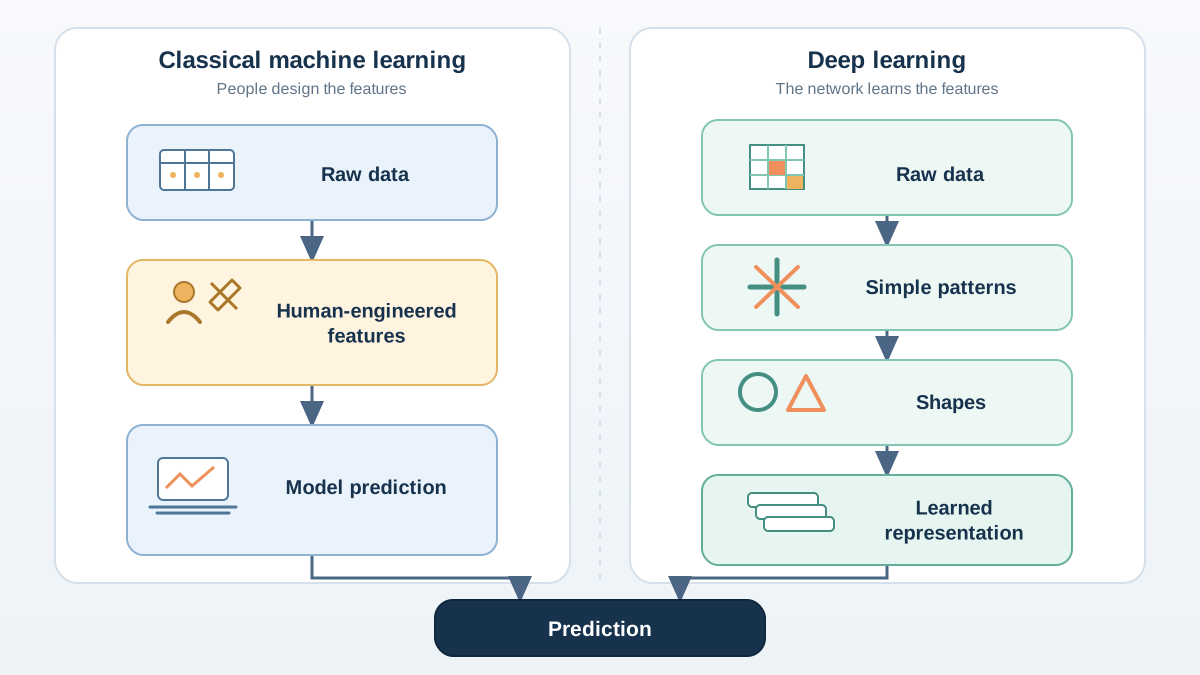
This is the deepest conceptual difference between the two approaches—and the one beginners most often miss.
Classical machine learning requires feature engineering. A human decides which variables the model should consider. Building a quality-control system for a factory line? Someone manually specifies that the model should look at surface texture, dimensional measurements, and color deviation. Those hand-picked variables determine what the model can and can't learn. Miss an important one, and the model has a permanent blind spot.
Deep learning automates feature extraction. Because of its many layers, it can analyze raw data directly and figure out what matters most. Early layers might detect edges in an image; later layers recognize objects. The network learns progressively abstract representations without a human specifying what to look for.
Here's the trade: hand-crafted features are interpretable and data-efficient, but they're bounded by human imagination. Learned features are powerful and flexible, but they're opaque and data-hungry.
This is also why classical machine learning is such a valuable laboratory. When you hand-engineer features, you're forced to think deliberately about what information actually predicts your outcome. That habit of thought—asking what matters in your data—transfers directly to deep learning, even though the network will eventually find its own features.
Knowledge check
Check your understanding
Answer this question before you continue.
Interpretability and Compute: The Hidden Costs
Deep-learning demos rarely show you the two costs hiding underneath the impressive results.
Interpretability. A classical model like a decision tree or logistic regression can show you exactly which features drove a prediction and how much weight each one carried. A deep network's reasoning is far harder to follow. Techniques exist to peek inside, but they offer partial insight at best.
This isn't a minor inconvenience. In regulated settings—credit decisions, insurance underwriting, medical diagnosis—you often need to explain why a model made a particular call. A loan officer can't tell a customer, "The neural network said no, and we can't fully explain why." Classical models give you auditability that deep networks struggle to match.
Compute. Classical models train quickly on a laptop CPU. Deep networks typically need GPUs or cloud resources, more memory, and longer training cycles. That's a real cost in both money and iteration speed.
For early prototypes, this matters more than beginners realize. Classical methods let you test ideas cheaply and quickly. You can try ten feature combinations in the time it takes to configure one neural-network training run. Fast iteration is how you build intuition about what works—and what doesn't.
Knowledge check
Check your understanding
Answer this question before you continue.
A Side-by-Side Comparison
| Classical Machine Learning | Deep Learning | |
|---|---|---|
| Data type | Structured, tabular data | Unstructured data: images, audio, text |
| Data volume | Works well with hundreds to thousands of examples | Typically needs thousands to millions |
| Feature representation | Human-engineered features | Automatically learned features |
| Interpretability | High—you can see which features drove predictions | Low—reasoning is hard to follow and audit |
| Compute needs | Trains on a laptop CPU | Usually requires GPUs or cloud resources |
| Typical use cases | Fraud detection, credit scoring, churn prediction | Image recognition, speech processing, language tasks |
Both approaches can handle classification, regression, and clustering. The difference isn't what tasks they can perform—it's which data shapes and constraints each fits best.
A Decision Rule for Your First Learning Path
Here's the practical guidance you came for.
Start with classical machine learning when:
- Your data is structured and tabular
- You have a limited dataset
- You need interpretable predictions
- You have limited compute resources
- You're building an early prototype and want fast iteration
Consider deep learning when:
- Your data is unstructured (images, audio, raw text)
- Manual feature design is impractical or impossible
- You have large datasets and the compute to support training
- Accuracy matters more than interpretability
But here's the learning-path argument that matters most for a beginner: deep learning builds on machine learning fundamentals. You can't evaluate a neural network's generalization without understanding what generalization means. You can't diagnose why a model fails without understanding features, overfitting, and validation. Those skills come from classical methods, where the concepts are visible and the models are simple enough to inspect.
Classical methods are your laboratory. They're where you learn to think about data, features, evaluation, and generalization—the four skills that transfer to any later deep-learning work. Starting there isn't a detour. It's the foundation.
I'll be honest about the boundary: if your goal is specifically computer vision or natural language processing from day one, you will eventually need deep learning. But you'll need the fundamentals first. The beginner who learns classical methods well will understand deep learning faster than the beginner who jumps straight into neural networks and hopes for the best.
Knowledge check
Check your understanding
Answer this question before you continue.
Common Mistakes Beginners Make
Mistake 1: Assuming deep learning is always more accurate. On structured data, a well-tuned classical model often matches or beats a neural network at a fraction of the cost. Deep learning isn't a power-up; it's a tool for specific data shapes and scales.
Mistake 2: Jumping to deep learning without learning to evaluate generalization. If you can't diagnose overfitting or spot data leakage, a neural network will quietly memorize your training data and fail on new examples—and you won't know why. Classical methods make these failure modes visible and teachable.
Mistake 3: Treating the choice as permanent. Many real systems combine classical pipelines with deep models. The skills transfer in both directions. Choosing classical methods now doesn't lock you out of deep learning later.
Your Next Step
Pick one small structured dataset—something with rows and columns, like a housing-price table or a customer-churn record. Train a simple classical model with scikit-learn. Then change the features and watch how the results shift. Split your data into training and test sets and observe how evaluation shapes your conclusions.
That exercise will teach you more about how machine learning actually works than any neural-network demo. And when you do move to deep learning—if you need to—you'll arrive with the judgment to use it well.
Knowledge check
Final check
Finish the article by checking the ideas you just learned.
References
Research updated Sep 8, 2026


