
Ordinal Classification Explained: Predict Categories That Have an Order
A rating scale looks like it should be either a multiclass problem or a regression problem. Both instincts quietly discard the information that matters…

Key topics
A rating scale looks like it should be either a multiclass problem or a regression problem. Both instincts quietly discard the information that matters most: the order. The fix is not a new algorithm. It is a new way of counting mistakes.
The Trap: Order Is Information You Are Throwing Away
Imagine you are building a model to predict customer satisfaction on a 1-to-5 scale. Or disease stage from early to late. Or credit risk from low to medium to high. What do you reach for first?
Most people pick one of two defaults. The first is multiclass classification: treat each rating as an unrelated bucket and let the model choose among five arbitrary categories. The second is regression: treat the ratings as numbers and fit a continuous line, then round the output.
Both defaults feel reasonable. Both quietly destroy the signal you care about.
Here is what multiclass classification does to your problem. A model trained on unordered buckets learns decision boundaries between "class 1" and "class 2" as if they were as unrelated as "cat" and "car." When it makes an error, the loss function counts every mistake the same. Predicting a 1 when the truth is a 5 costs exactly as much as predicting a 4 when the truth is a 5. But in your application, those errors are not remotely equal. A customer who actually hated your product and a customer who merely disliked it are different problems with different fixes.
Regression has the opposite flaw. It respects the order but invents something the data never gave you: equal spacing. A regression model assumes the gap between 1 and 2 is the same size as the gap between 4 and 5. It treats a satisfaction score of 4 as "four times as good" as a 1, which is nonsense. Worse, regression will happily predict values like 3.7 or 4.2 that do not exist in your label set, and rounding them back into categories smuggles in assumptions about where the boundaries should sit.
The middle ground is ordinal classification. It keeps the discrete categories of classification while respecting the ranking that regression would exploit. In statistics and machine learning, this problem is also called ordinal regression, and it sits deliberately between the two frames you already know.
Before we go further, a quick bridge: if you have not worked through multiclass framing or the regression-versus-classification distinction, those are the right prerequisites. This article assumes you can recognize a classification target and a regression target. The question here is what to do when your target is neither quite one nor the other.
Knowledge check
Check your understanding
Answer this question before you continue.
What Makes a Label Ordinal: Order Without Equal Spacing
An ordinal target has three properties. The labels can be sorted. The sorting is meaningful. And the distance between adjacent labels is unknown.
That last property is what separates ordinal from interval or ratio scales. Temperature in Celsius is interval: the gap between 10 and 20 degrees is the same as the gap between 30 and 40. Income in dollars is ratio: zero means none, and doubling the number doubles the quantity. Ordinal labels have none of that certainty. You know that "satisfied" ranks above "neutral," but you do not know by how much.
Consider a medical example. A biopsy might be graded as benign, pre-cancerous, or cancerous. The labels sort cleanly. But the jump from pre-cancerous to cancerous is not the same size as the jump between two benign grades. The first jump changes treatment entirely. The second might change nothing. If you encode those labels as 1, 2, 3 and feed them to a regression model, you are asserting that both jumps are identical. The model will treat a misclassification between benign grades as equally costly as missing a cancer diagnosis.
Here is a recognition test you can apply to any target in your own data. First, can you sort the labels into a defensible order? Second, in your application, does being wrong by two steps cost more than being wrong by one step? If both answers are yes, your target is ordinal, and every modeling choice you make should respect that fact.
A useful mental picture: lay your classes out on a number line from left to right. Nominal classes scatter across the line with no meaningful arrangement. Ordinal classes sit in a fixed left-to-right order, but the gaps between them are uneven, and you do not know where the unevenness lies.
Knowledge check
Check your understanding
Answer this question before you continue.
Why Not All Wrong Answers Are Equal
Here is the consequence that changes everything: in ordinal classification, the cost of an error depends on how far the prediction lands from the truth.
In nominal multiclass problems, a mistake is a mistake. Whether the model confused a husky with a malamute or a husky with a goldfish, the error is one unit. That simplicity is what makes accuracy a reasonable headline metric for nominal problems. Every wrong answer costs the same, so counting wrong answers tells you what you need to know.
Ordinal problems break that assumption. A two-step miss is worse than a one-step miss, and in many applications it is dramatically worse. Misdiagnosing an early-stage condition as one grade more advanced might trigger extra testing. Misdiagnosing it as the final stage might trigger aggressive treatment the patient never needed. Both are errors. They are not the same error.
This has a direct effect on evaluation. Plain accuracy hides the severity of mistakes because it counts every miss identically. Two models can have identical accuracy while one consistently lands one step off and the other scatters predictions across the full range of the scale. Accuracy will call them equal. Your application will not.
The fix is to make your evaluation distance-aware. Instead of asking only "was this prediction correct?", ask "how far from the truth did it land?" A confusion matrix read along the diagonal reveals the pattern immediately: do the errors cluster in the cells adjacent to the diagonal, or do they scatter into the far corners? Two confusion matrices with identical accuracy can look completely different once you weight errors by their distance from the truth.
Knowledge check
Check your understanding
Answer this question before you continue.
How Models Can Respect the Order
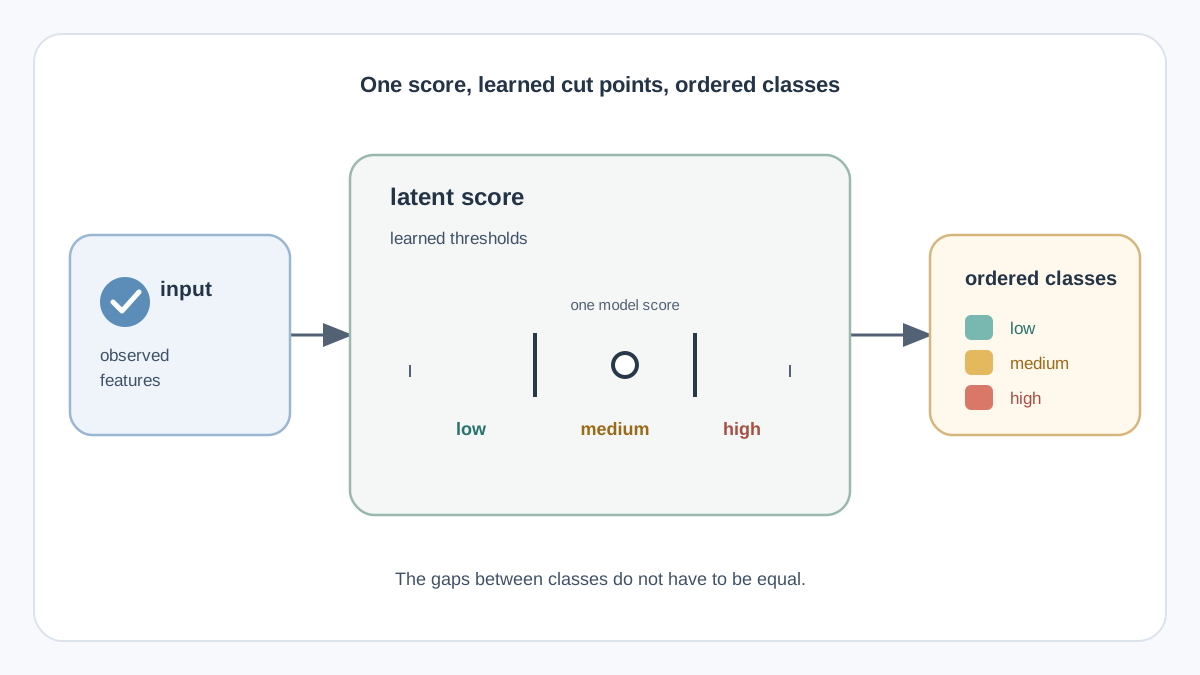
Once you recognize that order matters and that not all errors are equal, the modeling question becomes: how do you build a model that exploits that structure?
The dominant classical approach is the threshold method. The model learns a single latent score for each example, then places a set of ordered cut points along that score line. The cut points divide the line into bands, and each band maps to one of your ordered classes. A low score falls below the first threshold and lands in the lowest class. A higher score crosses one threshold and lands in the next class. The thresholds are learned from the data, which means the model never has to pretend the gaps between classes are equal. It discovers where the boundaries actually sit.
This is the mechanism behind ordered logit and ordered probit models, and it is why ordinal regression is sometimes described as a middle path: the model produces a continuous score like regression, but it converts that score into discrete ordered bands using learned thresholds rather than arbitrary rounding.
Contrast this with the two naive approaches. Fitting a regression and rounding assumes equal spacing that your data never promised. Treating classes as independent buckets ignores the ordering entirely. The threshold approach does neither. It respects the ranking without inventing distances.
A practical note for the classical machine learning toolkit: many standard estimators can be adapted to ordinal structure, and specialized ordinal methods exist in several libraries. But here is my honest judgment after years of building models: for many real problems, a well-tuned standard classifier combined with order-aware evaluation is a reasonable starting point. Reaching for a specialized ordinal method makes sense when the order is central to your error cost and you have enough data for the extra structure to pay off. Start by fixing your evaluation. Then consider whether your model needs to change.
Knowledge check
Check your understanding
Answer this question before you continue.
Choosing an Evaluation Frame That Matches the Cost
Your evaluation metric is where you declare what a mistake costs. If you evaluate with accuracy, you are declaring that every error costs the same. If that is not true in your application, your metric is lying to you.
For ordinal targets, distance-aware evaluation is the correction. The simplest form is measuring how far predictions land from the true class on the ordered scale. If your classes are 1 through 5, a prediction of 3 when the truth is 5 is an error of 2 steps. A prediction of 4 is an error of 1 step. Aggregating those distances across your validation set tells you something accuracy cannot: whether your model's mistakes are near misses or wild guesses.
The confusion matrix is your best diagnostic view. Read it along the diagonal. In a well-behaved ordinal model, the mass of predictions should concentrate near the diagonal, with errors tapering off as you move away from it. If you see errors scattered into the far corners, your model is treating your ordered labels as if they were unrelated buckets, and it will cost you in exactly the situations where being close matters.
Here is the decision rule I use: if a two-step miss is meaningfully worse than a one-step miss in your application, your evaluation should reflect that distance. That single choice will change how you compare models, which features you keep, and which modeling approach wins.
This connects to the broader evaluation-metrics picture you may already know from classification and regression work. The principle is the same: choose the score that matches the cost. Ordinal targets just make the mismatch between accuracy and real-world cost especially visible.
When Ordinal Framing Helps and When It Does Not
Ordinal framing is not always the right answer. Knowing when to skip it is part of using it well.
Use ordinal framing when your labels are genuinely sortable and error distance carries real cost. Customer satisfaction ratings, disease stages, proficiency levels, risk bands, and quality grades all qualify. In these problems, a near miss is genuinely better than a far miss, and your model and evaluation should reward closeness.
Do not force it when the order is cosmetic or when all errors cost the same. If your labels happen to be numbers but the categories are truly nominal, ordinal framing adds structure your data does not have. And be careful about assuming equal spacing even when you adopt an ordinal frame. Ordinal methods respect order; they do not invent distances that are not in the data.
One more warning: ordinal framing will not save a problem where the order is not actually represented in your features. If your data contains no signal that separates early-stage from late-stage cases, no amount of ordinal structure will manufacture it. The order has to live in your feature space for a model to exploit it.
My practical recommendation is to work in this order. First, check whether your evaluation already respects the order. If a two-step miss costs more than a one-step miss and your metric treats them the same, fix the metric before touching the model. Second, look at your confusion matrix and see whether your current model's errors cluster near the diagonal or scatter far from it. Third, only then consider whether a specialized ordinal model earns its complexity.
The Next Step on Your Own Data
Before you build anything else, run this test on your current target. Can you sort the labels into a meaningful order? Does being wrong by two steps cost more than being wrong by one? If the answer to both is yes, your problem is ordinal, and your evaluation should say so before your model does.
Take one dataset you are already working on. Write down your labels. Sort them. Ask yourself what a one-step miss costs versus a two-step miss in the real world. Then look at your current evaluation and ask whether it can tell the difference. If it cannot, that gap is your next problem to solve.
Knowledge check
Final check
Finish the article by checking the ideas you just learned.
References
Research updated Sep 8, 2026


