
Generative vs Discriminative Models: Model the Data or the Decision
Naive Bayes and logistic regression can classify the same dataset with nearly the same accuracy, yet they behave very differently on small samples, missing…

Key topics
Naive Bayes and logistic regression can classify the same dataset with nearly the same accuracy, yet they behave very differently on small samples, missing features, and outliers. The reason isn't hidden in their math—it's in what each model is trying to learn. One describes how each class produces its data. The other draws the line that separates classes. That single difference predicts how much data you need, what outputs you can get, and how each model fails.
Two Questions a Classifier Can Answer
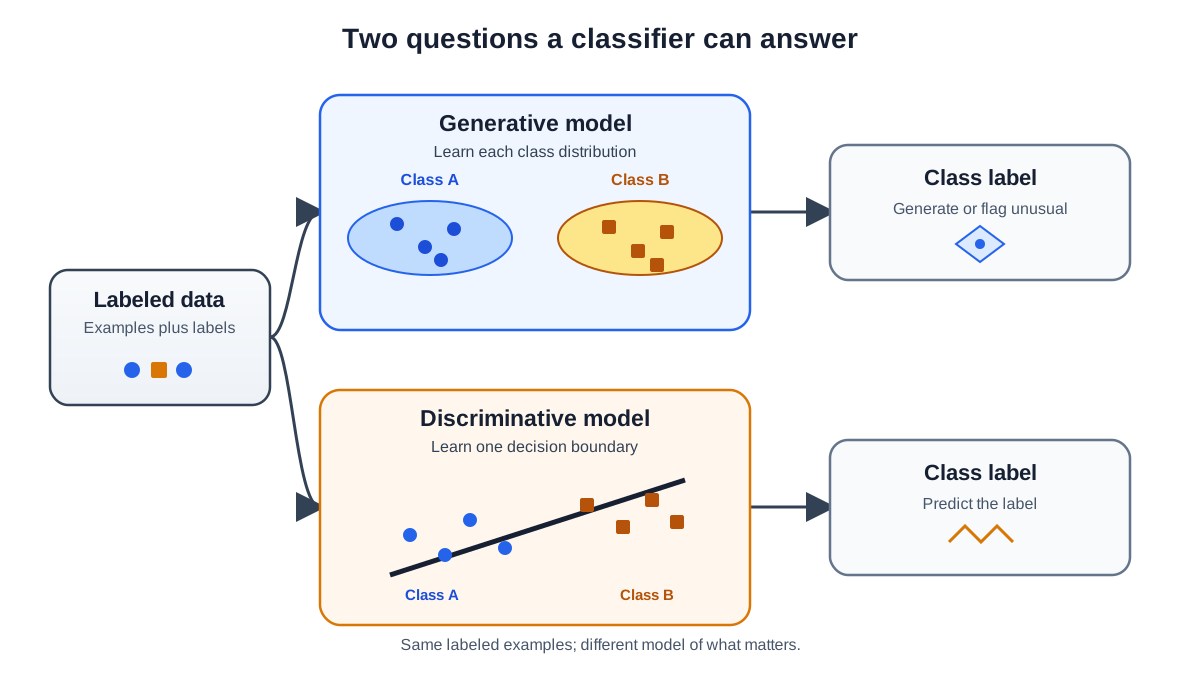
Every classifier answers one of two questions, and the one you choose changes everything downstream.
The first question: What does each class look like? Answer that, and you can describe the typical spam email, the typical legitimate one, and everything in between. You can even invent new examples that look like they came from either class.
The second question: Where does one class end and the other begin? Answer that, and you can label new examples correctly without ever understanding the shape of either class.
Both approaches produce a class label. That's why beginners conflate them. But the job each model performs is fundamentally different.
Think of it this way. A generative model learns the shape of each class's data—the cloud of points that belongs to "spam" and the cloud that belongs to "not spam." A discriminative model learns only the boundary between those clouds, the line that separates them. The discriminative model never asks what the clouds look like. It only cares where one ends and the other begins.
Knowledge check
Check your understanding
Answer this question before you continue.
The Formal Difference: Joint vs Conditional Probability
Once the intuition is in place, the precise framing is simple.
A generative model estimates the joint probability of features and labels, written as P(X, Y). In plain language: it models how the data was produced. It learns what each class looks like (P(X|Y)) and how common each class is (P(Y)), then combines them through Bayes' rule to make a decision.
A discriminative model estimates the conditional probability P(Y|X) directly. In plain language: given these features, what's the probability of each label? It never models the features themselves. It never asks how likely a particular input is, only which label applies to it.
The practical consequence is larger than it sounds. Because a generative model captures the full data distribution, it can answer questions a discriminative model cannot: How likely is this input? What does a typical example from this class look like? Is this point so unusual that it might not belong to any class at all?
A discriminative model is a specialist. It does one job—separating classes—and does it without the overhead of understanding how the data was generated.
Knowledge check
Check your understanding
Answer this question before you continue.
Naive Bayes vs Logistic Regression: The Same Data, Different Assumptions
You've already met the two clearest examples of this distinction in classical machine learning.
Naive Bayes is generative. It models P(class) and P(feature|class), then assumes conditional independence to make that tractable. The independence assumption isn't a convenience bolted onto the algorithm—it's the price of modeling the full data distribution. To describe how each class generates its features, you need a rule for how those features combine. Naive Bayes chooses the simplest rule: each feature contributes independently.
Logistic regression is discriminative. It models P(class|features) directly and never states how features are distributed within a class. It doesn't need to. To find the boundary between classes, it only needs to learn where that boundary sits.
Here's the tradeoff that follows. Naive Bayes inherits its independence assumption as a built-in constraint. When that assumption is wrong, the model pays for it. Logistic regression is free to capture feature dependencies—but freedom has a cost. It needs enough data to learn those dependencies reliably. On a small dataset, logistic regression can chase spurious patterns that don't really exist. Naive Bayes, constrained by its assumption, acts like a regularizer and resists overfitting.
That's why the comparison isn't settled by accuracy alone. On small datasets, the generative model often wins because its structure protects it. As data grows, the discriminative model catches up and typically overtakes it, because it can learn the true boundary without being shackled to a false assumption.
Knowledge check
Check your understanding
Answer this question before you continue.
What the Choice Predicts: Data, Outputs, and Failure Modes
The generative-versus-discriminative distinction is a predictive tool. Once you know which family a model belongs to, you can anticipate its behavior.
| Generative | Discriminative | |
|---|---|---|
| What it models | Joint distribution P(X, Y) | Conditional probability P(Y |
| Data needs | Can work well on small datasets; structure acts as regularization | Needs enough data to learn the boundary reliably |
| Outputs | Class probabilities, outlier scores, synthetic examples | Class probabilities or decision scores only |
| Core assumption | Distributional assumptions about each class | No assumption about feature distributions |
| Typical failure | Wrong distributional assumptions | Too little data to learn the boundary |
| Example models | Naive Bayes, Gaussian mixture models, hidden Markov models | Logistic regression, SVMs, decision trees |
The data-efficiency pattern deserves emphasis because it surprises people. Generative models impose structure, and structure is a form of prior knowledge. On a small dataset, that prior knowledge protects you from overfitting. Discriminative models impose less structure, which is an advantage when data is plentiful but a liability when it isn't.
The output difference matters in practice. A generative model can flag outliers because it knows what normal data looks like. A discriminative model cannot—it only knows the boundary between classes, not whether a point is unusual. Similarly, a generative model can generate synthetic examples by sampling from the learned distribution. A discriminative model has nothing to sample from.
Missing data and class imbalance also behave differently. A generative model's explicit description of each class makes it more natural to reason about what a missing feature would have looked like. Class imbalance is handled through the prior P(Y), which the model estimates explicitly. Discriminative models handle both situations too, but through different mechanisms—and often with more difficulty.
Knowledge check
Check your understanding
Answer this question before you continue.
When to Reach for Each Family
The choice isn't about which family is "better." It's about what you need from the model.
Choose a generative model when:
- You need outlier detection. The model knows what normal looks like, so it can flag what doesn't fit.
- You want to generate or inspect class-typical examples. This is useful for understanding what the model believes about each class.
- You have little labeled data. The structure imposed by the generative assumption protects you from overfitting.
- You want a fast, interpretable baseline. Naive Bayes trains in a single pass and is easy to explain.
Choose a discriminative model when:
- Your only goal is accurate classification.
- You have enough data to learn the boundary directly.
- You don't need outlier scores or synthetic examples.
- You suspect feature dependencies that a generative model's assumptions would miss.
The honest caveat: in classical supervised classification with adequate data, discriminative models usually win on accuracy. But "usually" is not "always," and raw accuracy isn't the only thing that matters. If you need to explain, inspect, or generate the data behind each class, the generative model's extra capabilities often outweigh a small accuracy gap.
A Note on the Modern Confusion: GANs and Generative AI
If you searched for "generative model" before reading this, you probably found content about GANs, image generation, and large language models. That's the modern confusion worth clearing up.
GANs and today's generative AI systems are deep-learning instances of the same core idea we've been discussing: model the data distribution well enough to produce new samples. When a GAN generates a convincing image of a handwritten digit, it's doing what a generative classifier does when it describes what "digit 1" looks like—just at a scale and complexity that classical methods can't reach.
In classical machine learning, "generative" does not mean "creates images." It means the model captures the joint distribution of features and labels. That's what makes generation possible. The capability is a consequence of the modeling choice, not a separate category of algorithm.
The Decision Rule
Before choosing a classifier, ask one question: What do I need from this model?
If you need only a label—the best guess for which class a new example belongs to—a discriminative model is usually the right tool. It focuses its capacity on the boundary and doesn't waste effort modeling data it doesn't care about.
If you need more—outlier detection, synthetic examples, an explanation of what each class looks like, or protection against a tiny dataset—a generative model earns its keep.
That single question predicts which family fits. The distinction between modeling the data and modeling the decision isn't academic taxonomy. It's the difference between a model that understands its classes and one that only knows where they end.
Knowledge check
Final check
Finish the article by checking the ideas you just learned.
References
Research updated Sep 8, 2026


