
Multiclass Classification Explained: Predict One of Many Classes
Most people assume multiclass classification is just binary classification with more labels. It is not. The real problem is that many classical models only…

Key topics
Most people assume multiclass classification is just binary classification with more labels. It is not. The real problem is that many classical models only know how to separate two things at a time, so predicting one label from many forces a design choice about how to combine several two-way decisions into one final answer.
Picture yourself sorting fruit on a conveyor belt. A binary model asks one question: "Is this an apple or not an apple?" A multiclass task asks a harder question: "Is this an apple, an orange, a pear, or a banana?" That difference changes how you build the model, how you read its predictions, and how you judge whether it is actually working.
What Makes a Task Multiclass (and What It Is Not)
A multiclass classification task has three or more possible labels, and each sample gets exactly one label. That last part matters more than beginners expect.
Consider sorting fruit images into four bins: apple, orange, pear, and banana. Every image belongs to exactly one bin. A fruit cannot be both an apple and a pear. That single-label constraint is what makes the task multiclass.
This is different from two related tasks you will meet:
- Binary classification has only two labels. "Is this fruit an apple or not?" is binary, even if the "not" category contains every other fruit in existence.
- Multi-label classification lets one sample carry several labels at once. A news article might be about both politics and finance. A fruit image in a multi-label setup could be tagged as both "apple" and "red."
The word "multiclass" describes the output structure, not the algorithm you happen to use. If you have a model that predicts one of three or more mutually exclusive labels, you are doing multiclass classification, regardless of which library or technique produced that model.
If you have worked with binary logistic regression, you already know the basic move: the model turns a score into a probability, and you decide where to draw the threshold. Multiclass asks what happens when there are more than two possible answers. The answer is not a bigger threshold. It is a strategy.
Knowledge check
Check your understanding
Answer this question before you continue.
Why Two-Class Models Need a Strategy for Many Classes
Some models handle many classes natively. Decision trees, random forests, and k-nearest neighbors can pick among any number of labels without special treatment. They do not care how many bins you have.
Other models are built as two-class separators. Logistic regression and linear support vector machines separate one thing from another. They draw a line between two groups. If you hand them four fruit types, they do not know what to do with the extra bins.
When a model only separates two things, you must decompose the many-class problem into several two-class problems. This is the core mental model: you are not training one model to pick among four fruits. You are deciding how to arrange several two-way questions so their answers combine into one final pick.
Think of it like a tournament. You cannot crown a champion among four players with a single match. You need a bracket. The same logic applies to classifiers that only know how to compare two opponents at a time.
Knowledge check
Check your understanding
Answer this question before you continue.
One-vs-Rest: Ask Each Class "Is It You?"
The one-vs-rest strategy, sometimes called one-vs-all, trains one binary classifier per class. Each classifier asks a single question: "Is this sample class X or not class X?"
For the fruit problem, you train four classifiers:
- "Is this an apple or not an apple?"
- "Is this an orange or not an orange?"
- "Is this a pear or not a pear?"
- "Is this a banana or not a banana?"
When a new fruit image arrives, every classifier gives its answer. The apple classifier says "apple with 0.8 confidence." The orange classifier says "orange with 0.2 confidence." The pear classifier says "pear with 0.6 confidence." The banana classifier says "banana with 0.1 confidence."
You combine these answers with a winner-takes-all rule: pick the class whose classifier is most confident. In this case, the apple classifier wins.
This approach is straightforward, and it is the default strategy for many linear models in scikit-learn. But it has a practical boundary. With many classes, you train many models, and each "rest" group can be large and imbalanced. The apple classifier must learn to distinguish apples from everything else combined, which means its training data is mostly "not apple." That imbalance can make each individual classifier's job harder than it looks.
Knowledge check
Check your understanding
Answer this question before you continue.
One-vs-One: Pair Every Class Against Every Other
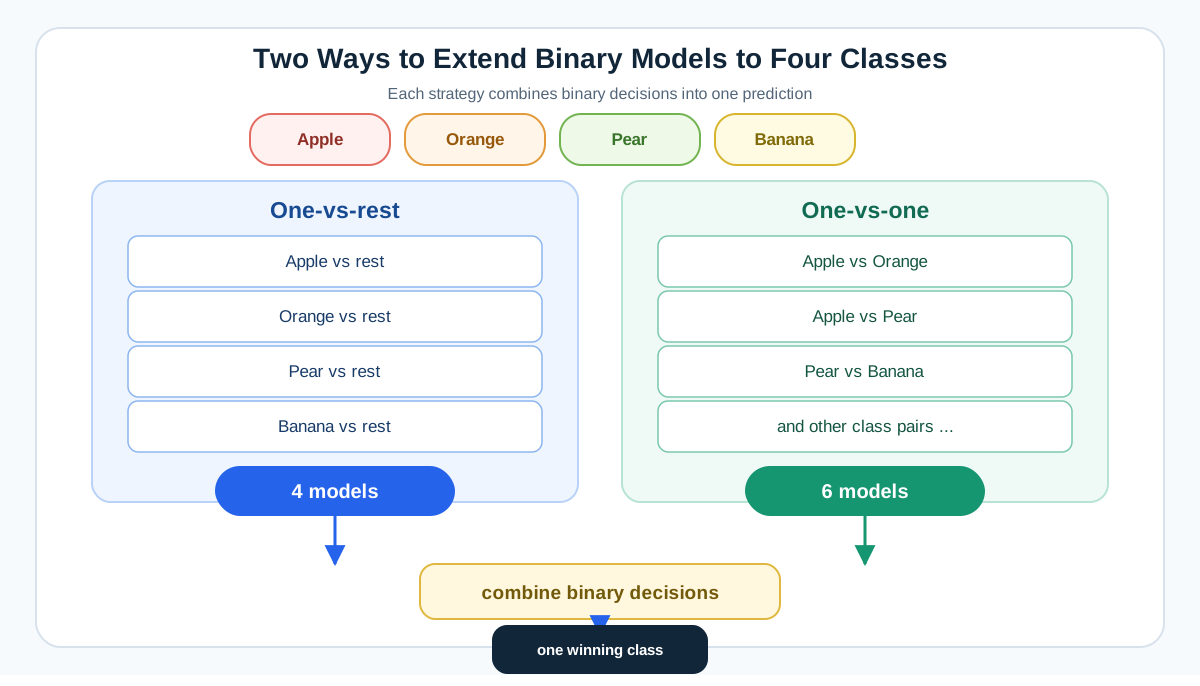
The one-vs-one strategy takes a different approach. Instead of asking each class to fight everyone else, you train one binary classifier for every pair of classes.
For four fruits, that means six classifiers:
- Apple vs. orange
- Apple vs. pear
- Apple vs. banana
- Orange vs. pear
- Orange vs. banana
- Pear vs. banana
Each classifier only ever sees two classes, so it faces a cleaner problem. When a new fruit arrives, every classifier votes for one of its two classes. The class with the most votes wins.
The tradeoff between the two strategies is a matter of scale versus clarity:
| Strategy | Number of models | Each model's problem |
|---|---|---|
| One-vs-rest | One per class | Large, imbalanced "rest" group |
| One-vs-one | One per pair of classes | Clean two-class separation |
One-vs-rest trains fewer models, but each faces an imbalanced opponent. One-vs-one trains more models, but each sees a balanced two-class problem.
Here is a plain decision rule: one-vs-rest is the common default for linear models in scikit-learn, while one-vs-one is the native choice for support vector machines. Many libraries hide this choice entirely, and you often do not need to pick manually. But understanding the difference explains why the same data can behave differently across models, and it helps you make an informed choice when you do need to override the default.
Note: Some models handle many classes natively and need no decomposition at all. Decision trees and k-nearest neighbors do not care how many bins you have. The decomposition strategies exist to extend models that were built as two-class separators.
Knowledge check
Check your understanding
Answer this question before you continue.
Reading Class Scores Instead of Just the Winner
A multiclass prediction is not just a label. It is a set of scores, one per class, and the label is whichever score is highest.
This distinction matters more than it seems. Consider two predictions from the fruit model:
- Confident: apple 0.85, orange 0.05, pear 0.07, banana 0.03
- Uncertain: apple 0.30, orange 0.28, pear 0.24, banana 0.18
Both predictions output "apple" as the winning label, but they mean very different things. The first model is sure. The second model is guessing, and the top score barely edged out the others.
The full score list reveals when the model is unsure, which classes it confuses, and where a human review step might help. If your fruit-sorting system routes low-confidence predictions to a human inspector, you need those scores, not just the winning label.
This is especially useful when some classes look similar. If the model frequently gives orange and pear close scores, that pattern tells you where the model struggles. The winning label hides that information. The score list exposes it.
Why Accuracy Hides Per-Class Failures
Here is the evaluation trap that catches most beginners: with many classes, overall accuracy can look fine while one specific class fails almost every time.
Imagine a fruit-sorting model that handles four fruit types, but bananas are rare, appearing in only 5 percent of the images. The model could completely fail on every banana and still achieve 95 percent accuracy. That single number looks impressive. The model is actually broken for one entire category.
This is why multiclass evaluation demands a per-class view, not just a blended score. Three tools matter:
- Confusion matrix: A grid showing which pairs of classes get confused. You can see at a glance whether the model mistakes pears for apples, or oranges for bananas.
- Per-class precision: For each class, of the times the model predicted that class, how often was it right?
- Per-class recall: For each class, of the actual samples in that class, how many did the model catch?
If you already know that evaluation metrics matter, the new point here is that multiclass makes the per-class view essential, not optional. A single accuracy number cannot tell you which class is failing. The confusion matrix can.
Common mistake: Reporting only overall accuracy on a multiclass problem with imbalanced classes. A model that ignores a rare class entirely can still score high. Always check the confusion matrix before trusting the headline number.
When to Reach for Multiclass (and When Not To)
Use a multiclass framing when each sample truly belongs to exactly one of several known labels. Sorting fruit images, routing support tickets to departments, or diagnosing which plant disease appears in a photo are all genuine multiclass tasks.
Do not use multiclass framing in two situations:
- Multi-label tasks: When a sample can carry several labels at once, such as tagging an article with multiple topics, you need multi-label methods, not multiclass.
- Binary tasks: When the real question is just two-way, such as "is this email spam or not," multiclass framing adds unnecessary complexity.
There is also a practical boundary worth knowing. As the number of classes grows, data per class thins out, and decomposition strategies get more expensive. One-vs-rest with a thousand classes means a thousand models. One-vs-one with a thousand classes means nearly half a million pairwise models. Classical methods have real limits here, and that is part of why deep learning approaches become relevant for problems with enormous class counts.
For the problems you will meet early in your machine learning journey, the recipe is simple: name the task correctly, know whether your model handles many classes natively or needs a decomposition strategy, and always look at the confusion matrix before trusting a single accuracy number.
Your Next Step
Take a problem you already understand in binary form and ask what changes when a third class appears. If you have built a spam detector that separates "spam" from "not spam," what happens when you add a third category like "newsletter"? Which decomposition strategy would your model use? Where would you expect confusion to appear, and how would you spot it in a confusion matrix?
You do not need new code to test this. You need the right frame: one label among many, a strategy for combining two-way decisions, and a per-class view of failures. Run that mental experiment on a familiar problem, and multiclass classification stops being a new topic. It becomes a sharper way of seeing the problems you already know.
Knowledge check
Final check
Finish the article by checking the ideas you just learned.
References
Research updated Sep 8, 2026


