
K-Nearest Neighbors vs Linear Models: Local Examples or Global Rules?
Two models trained on the same data can look at a new point and give you sharply different answers. Neither one is broken. Each is answering a different…

Key topics
Two models trained on the same data can look at a new point and give you sharply different answers. Neither one is broken. Each is answering a different question, because each learned a different idea of what the data looks like.
Beginners often assume every model extracts "the pattern" from a dataset, so when predictions diverge, it feels like one model must be wrong. That mental model is the real problem. Every machine learning model carries an inductive bias—an assumption about the shape of the relationship before it ever sees your data. The useful question is not which model is smarter. It is where each model looks for its answer: at nearby examples, or at a rule that spans the whole space.
That local-versus-global distinction is the frame that makes KNN vs linear regression comparisons click.
Why Two Models Disagree on the Same Data
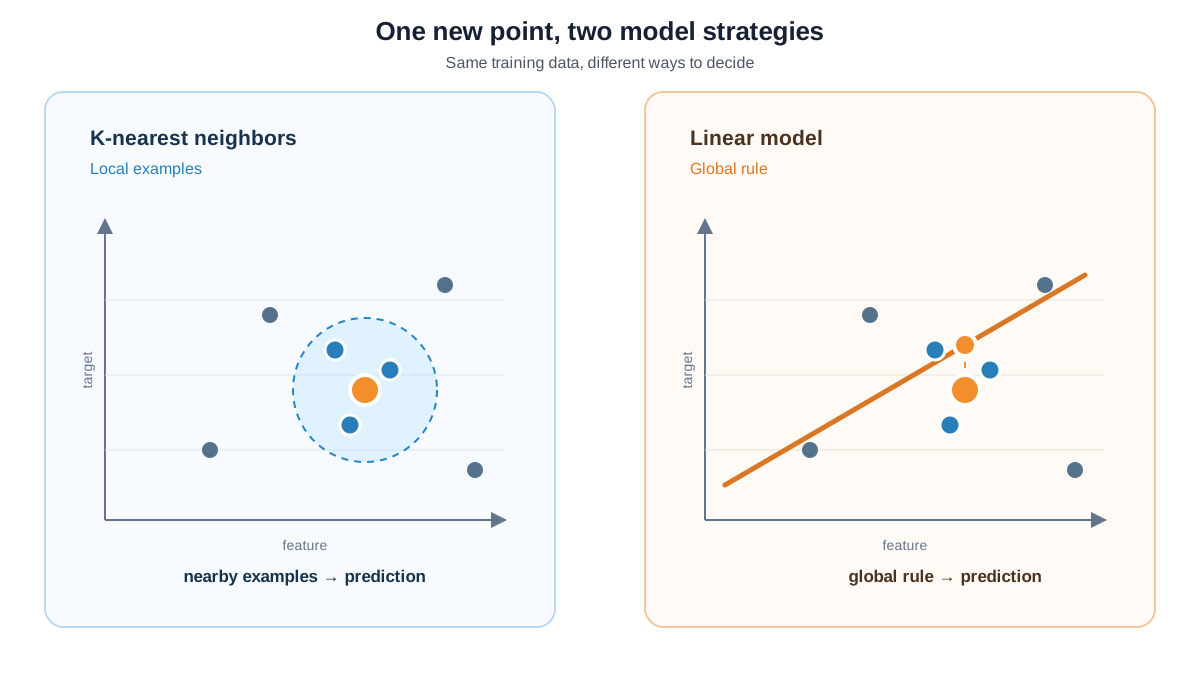
Imagine you fit a K-nearest neighbors model and a linear regression on the same training set, with the same train/test split. You hand both models a new point. KNN predicts 42. The linear model predicts 67. Which one is right?
The honest answer: it depends on what the true relationship looks like—and neither model knows that in advance.
A linear model assumes the relationship between features and target can be captured by one set of coefficients that applies everywhere. KNN assumes the opposite: that the target value at any point resembles the target values of nearby training examples. Both assumptions are bets about the shape of reality. When the data is roughly straight, the linear model's bet pays off. When the data curves, bends, or clusters in irregular ways, KNN's local bet has a chance.
This is why model comparison is really geometry comparison. You are not asking which algorithm is better in the abstract. You are asking which assumption about the shape of your data is more likely to hold.
The same logic applies whether you are predicting a number or a category. KNeighborsRegressor versus LinearRegression for continuous targets, KNeighborsClassifier versus LogisticRegression for classes—the mechanism differs, but the local-versus-global geometry is identical.
Knowledge check
Check your understanding
Answer this question before you continue.
KNN: The Model That Keeps the Training Data
K-nearest neighbors is the most literal learning algorithm you will meet. It does not learn a rule at all. It stores the training set, and when a new point arrives, it finds the k closest stored points and lets them vote.
For regression, that means averaging the targets of the neighbors. For classification, it means a majority vote among the neighbors' classes. In scikit-learn, these are KNeighborsRegressor and KNeighborsClassifier, and the mechanism is identical under the hood: find the neighbors, combine their targets, return the answer.
Because there is no fitted equation, KNN is called a lazy or instance-based method. Training is nearly instant—the model barely does anything. The real work happens at prediction time, when every new query requires a distance calculation against every stored point. That cost grows with your dataset, which is the opposite of most models you will use.
KNN is also non-parametric. There is no fixed functional form, no predetermined shape that the decision boundary must take. The boundary is whatever the local density of points dictates. If your data forms a crescent moon, KNN can trace that crescent. A linear model cannot.
The k parameter is your bias-variance dial. A small k (say, 1 or 3) hugs the training data tightly and will chase noise. A large k smooths aggressively, pulling predictions toward the global average until the model becomes too blunt to capture local structure. There is no universal best k; it depends on how noisy your data is and how much of the local structure is real signal.
Knowledge check
Check your understanding
Answer this question before you continue.
Linear Models: One Rule for the Whole Space
A linear model takes the opposite strategy. It compresses the entire training set into a fixed set of coefficients, then discards the data. Every future prediction uses the same rule: multiply each feature by its learned weight, add them up, and you have your answer.
This is a parametric model. The parameters are the coefficients, and once they are fit, the training data has done its job. You could delete the dataset and the model would keep predicting exactly as before. KNN cannot do that—delete its training data and you delete the model itself.
The inductive bias here is a straight-line (or hyperplane) relationship. Linear regression predicts continuous values with that rule. Logistic regression feeds the same linear score through a sigmoid to produce class probabilities. Both share the same global geometry: one boundary, learned from all the data, applied uniformly across the feature space.
That global rule has a major payoff: interpretability. Each coefficient tells you the expected change in the target for a one-unit change in that feature, holding everything else constant. KNN cannot offer anything like this. You can inspect a KNN model's neighbors, but you cannot read its "logic" the way you read a coefficient.
The cost is structural rigidity. If the true relationship is curved, clustered, or periodic, a linear model is limited by its form. You can sometimes engineer your way out—adding polynomial features, interactions, or transformed targets—but the raw model will not adapt on its own.
Knowledge check
Check your understanding
Answer this question before you continue.
The Local-versus-Global Tradeoff in Practice
The local-versus-global frame is not just a conceptual nicety. It predicts concrete behavior across four practical dimensions.
Small data. With few observations per feature, a linear model's strong assumption is an advantage. It can estimate a global rule from modest evidence. KNN needs nearby examples to make good predictions, and with sparse data, "nearby" is often empty or misleading. Parametric models tend to win in this regime.
Dimensionality. As features grow, KNN degrades faster than linear models. Distances in high-dimensional space become less meaningful—points spread out, and the nearest neighbor may not be genuinely close. This is part of the curse of dimensionality, and it hits distance-based methods hardest.
Dataset size. More data helps KNN directly: more neighbors to average, denser local structure to exploit. A linear model's capacity is fixed by its parameters, so beyond a certain point, extra data stops improving it much.
Prediction cost. Linear models predict in constant time regardless of dataset size. KNN prediction cost grows with every training point you add.
| KNN | Linear Models | |
|---|---|---|
| Locality | Local: neighbors decide | Global: one rule everywhere |
| Assumption | Nearby points have similar targets | Relationship is roughly linear |
| Training cost | Near-instant (lazy) | Fast, one-time fit |
| Prediction cost | Grows with dataset size | Constant |
| Interpretability | Weak: no coefficients to read | Strong: per-feature effects |
| Scaling sensitivity | Critical | Minimal (unless regularized) |
| Handles nonlinearity | Naturally | Only with engineered features |
The decision rule that falls out of this: if the relationship is smooth and roughly linear, use a linear model—it will generalize better with less data. If the relationship is irregular and you have dense, well-sampled data, KNN can adapt locally in ways a linear model cannot.
Scaling, Distance, and the Trap Beginners Miss
Here is the most common beginner mistake with KNN, and it follows directly from the mechanism.
KNN decides by distance. Distance is computed across features, and features with larger numeric ranges dominate the calculation. If one feature spans 0 to 1 and another spans 0 to 1000, the wide feature effectively decides who the neighbors are. The narrow feature becomes noise, no matter how predictive it actually is.
This is why feature scaling is not optional for KNN. Standardize or normalize your features before fitting, or you are silently telling the model that some features matter more than others based purely on their units.
Linear models are different. A linear model is scale-invariant in prediction—multiply a feature by 1000 and the coefficient shrinks by 1000 to compensate. Scaling still matters for regularization and for interpreting coefficients, but it does not change the model's predictions the way it changes KNN's.
The trap is assuming that because scaling is optional for linear models, it is optional everywhere. Run KNN on unscaled data, watch it perform terribly, and you might conclude KNN is weak. The model was not weak. The distance metric was lying to it.
Common mistake: Fitting KNN on raw features with wildly different scales, then blaming the algorithm when it underperforms. Scale your features first. This is the clearest practical consequence of KNN's distance-based mechanism.
Knowledge check
Check your understanding
Answer this question before you continue.
When to Reach for Each Model
Reach for a linear model when you need interpretable coefficients, when you have modest data, when you expect a roughly linear relationship, or when you need fast predictions at scale. If a stakeholder asks "what drives this outcome?", a linear model gives you a defensible answer.
Reach for KNN when the relationship is irregular, when you have enough dense data to populate local neighborhoods, and when you can afford prediction-time cost. KNN shines on problems where the decision boundary is complicated but the data is plentiful.
Avoid KNN when you have many features, sparse data, or strict latency requirements. Avoid linear models when the relationship is strongly nonlinear and you cannot engineer features to capture the shape.
Here is the part beginners often miss: both models are baselines. Neither is usually the final answer. But comparing them teaches you something about your data that no single model will. If KNN and a linear model disagree sharply on a region of your feature space, that disagreement is information. It tells you the relationship there is not smooth and linear—it is locally irregular, and you need a model that can handle that shape.
My rule is simple: fit both on a small dataset, find the points where they diverge, and let the disagreement teach you the geometry of your problem. You will learn more about your data from that one experiment than from a month of reading model documentation.
The reusable mental tool is not "KNN" or "linear regression." It is the question of whether your problem needs a local answer or a global rule. Get that frame right, and every model comparison you do from here on gets clearer.
Knowledge check
Final check
Finish the article by checking the ideas you just learned.
References
Research updated Sep 8, 2026


