
Nested Cross-Validation Explained: Evaluate the Whole Selection Process
You run a grid search, watch the cross-validation score climb, and feel good about the model you are about to ship. Then the model lands on real data and…

Key topics
You run a grid search, watch the cross-validation score climb, and feel good about the model you are about to ship. Then the model lands on real data and quietly underperforms everything the validation promised.
This is not bad luck. It is a measurement problem—one that nested cross-validation exists to solve.
Why Your Tuned Model's Score Lies to You
Here is the uncomfortable truth about tuning with cross-validation: the moment you use validation folds to pick hyperparameters, those folds stop being neutral judges. They have influenced your decision. When you then report the score from those same folds as an estimate of future performance, you are grading your own homework.
The mechanism is subtle but worth naming precisely. Every time you select the hyperparameter combination that scored best on the validation folds, you are fitting your selection process to those specific folds. The model itself never saw that data during training, but your choice of model did. Information leaks across the evaluation boundary, and the reported score becomes optimistically biased.
This bias has a name: model selection bias. You will also hear it called double dipping or circularity, because the same data is doing two jobs at once—selecting the model and then vouching for it.
How much does this matter? The magnitude depends mostly on two things: the size of your dataset and the stability of your model. Small datasets give the selection process more room to chase noise. Flexible models with many hyperparameter combinations give it more chances to find a configuration that happens to look great on your particular folds. Put those together, and the gap between your cross-validation score and real-world performance can be substantial.
If you have worked through hyperparameter tuning, you already know that tuning can overfit validation data. And if you have thought carefully about train, validation, and test splits, you know that repeated use of the same data leaks information. Nested cross-validation is what happens when you take both lessons seriously at once.
The Mental Model: Two Loops, Two Jobs
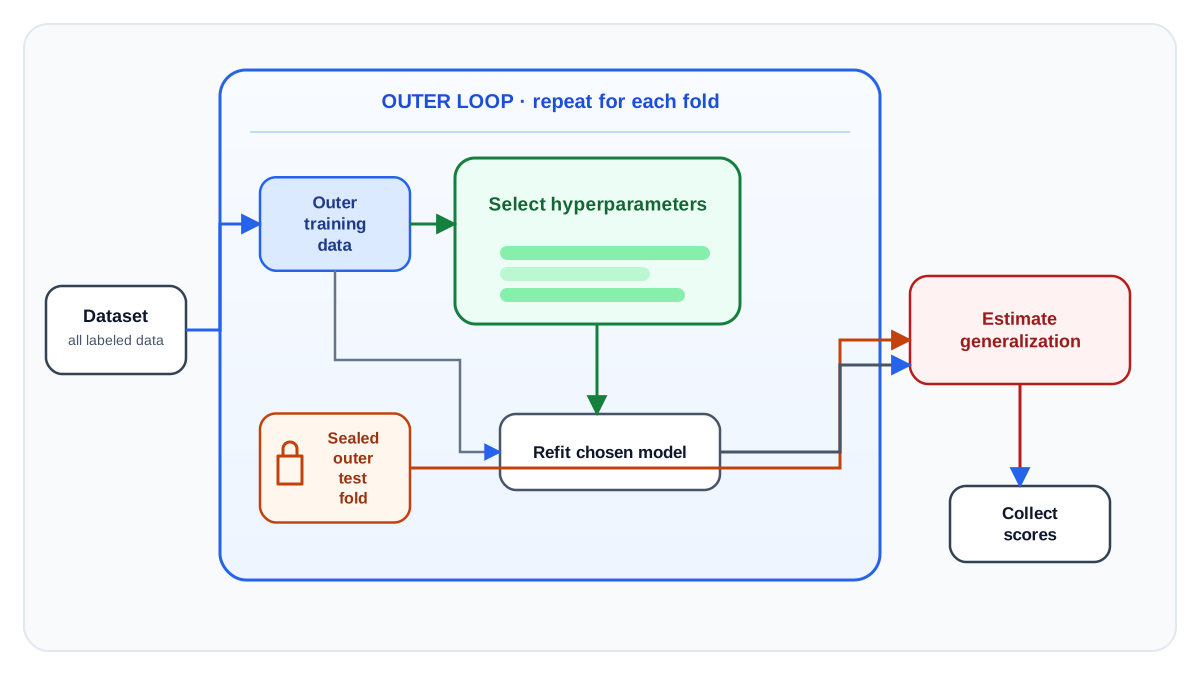
Nested cross-validation gives tuning and evaluation separate data by running two cross-validation loops stacked inside each other.
The outer loop splits your data into folds, just like ordinary cross-validation. Each outer fold holds out a test portion. But here is the crucial difference: the outer test fold is never touched during tuning. It stays sealed until the very end of that fold's workflow.
The inner loop lives entirely inside each outer training fold. When you reach an outer training fold, you split that data again into inner folds. You run your hyperparameter search—grid search, random search, whatever you would normally do—entirely within these inner folds. The inner loop picks the best hyperparameters. Then, and only then, do you train a model with those hyperparameters on the full outer training fold and score it against the outer test fold.
Think of each outer fold as a fresh project. You do not carry a tuned model from one project to the next. You re-run your entire tuning workflow from scratch on each outer training fold, then evaluate on data that played no role in any tuning decision.
One consequence surprises people at first: the winning hyperparameters can differ across outer folds. That is expected, not a bug. Each outer training fold is a different sample of your data, and the tuning process may settle on different configurations for each. The point is not to find one universal best configuration. The point is to test whether your whole selection workflow—including the part where you search for hyperparameters—produces models that generalize.
A diagram helps here. Picture your full dataset split into five outer folds. Take outer fold one: its training portion splits again into five inner folds. The inner folds shuffle through tuning duty while outer fold one's test portion sits off to the side, untouched. Then outer fold two gets the same treatment, with its own fresh inner split. The inner folds are always nested inside the outer training data, never touching the outer test fold.
Knowledge check
Check your understanding
Answer this question before you continue.
What Nested CV Actually Estimates
Beginners often ask what nested cross-validation is for, and the honest answer requires separating two questions that ordinary cross-validation tends to blur together.
The first question: Which hyperparameters are best? That is a selection problem, and the inner loop answers it.
The second question: How well will my entire selection process generalize? That is an estimation problem, and the outer loop answers it.
Nested cross-validation estimates the second. The outer-loop score tells you what you can expect when you run your full tuning workflow on new data—not the performance of one particular tuned model, but the performance of the process that produces tuned models.
This distinction matters because of a follow-up question that trips up almost everyone: after nested cross-validation, which model do you deploy?
The answer: you still refit your chosen model on the full dataset. Nested cross-validation does not hand you a model. It hands you an honest estimate of what your selection process is worth. You run your tuning workflow one final time on all your data, train the winning configuration on everything, and ship that model. The nested estimate tells you what to expect from that workflow. It is not a guarantee for the specific refit model.
Treating the outer-loop score as a promise about your final model is a category error. The score describes the procedure, not the artifact.
Knowledge check
Check your understanding
Answer this question before you continue.
Nested vs. Ordinary Cross-Validation: What Changes
The structural difference between flat and nested cross-validation is simple to state: ordinary cross-validation tunes and evaluates on the same folds; nested cross-validation gives each job its own data.
| Ordinary (flat) CV | Nested CV | |
|---|---|---|
| Inner loop | None—tuning happens once on the same folds used for evaluation | Hyperparameter search runs inside each outer training fold |
| Outer loop | Evaluates the tuned model | Evaluates the whole tuning-plus-training process |
| Data seen by tuning | The same folds that later report the score | Only inner folds, never the outer test fold |
| What it reports | Score of one tuned model | Generalization estimate of the selection procedure |
| Main failure mode | Optimistically biased score after tuning | High computational cost |
Here is a useful diagnostic: run both on the same data and search space, then compare the scores. The gap between them is a rough measure of how much selection bias your tuning introduced. A large gap means your flat cross-validation score was flattering your workflow. A small gap means your model is stable and your data is large enough that the bias is minor.
But do not read a small gap as a reason to skip nested cross-validation. The small gap is the finding. Nested cross-validation's real value is that it tells you whether your selection bias is a problem, instead of leaving you to discover the hard way.
Knowledge check
Check your understanding
Answer this question before you continue.
When Nested CV Is Worth the Cost
Let me be direct about the price tag: nested cross-validation multiplies your model fits dramatically. With five outer folds and five inner folds, each outer fold runs a full tuning search on its training data. The total complexity lands somewhere around the number of outer folds times the number of inner folds, and if you repeat the whole procedure to estimate variance, the fits compound further.
That cost is why nested cross-validation is not a universal ritual. It earns its keep in specific situations:
- Small datasets, where selection bias is most severe because the tuning process can more easily chase noise.
- Flexible models with large hyperparameter spaces, where the risk of selecting a configuration that flatters your folds is highest.
- High-dimensional problems with feature selection, where every feature choice adds another layer of selection bias.
- High-stakes reporting, such as research papers, model comparisons, or decisions where you must defend your generalization estimate.
There is also a legitimate research position that nested cross-validation is overzealous for routine classifier selection on large, stable problems. When your dataset is big and your models are well-behaved, the selection bias may be negligible, and a disciplined single holdout or ordinary cross-validation may serve you fine.
My decision rule: if you will report a number as "how well this approach generalizes," use nested cross-validation. If you only need to pick a working model for a large dataset and you have a clean holdout set, a simpler evaluation is defensible. Know which question you are answering, and let that choose your procedure.
Knowledge check
Check your understanding
Answer this question before you continue.
Common Mistakes and How to Avoid Them
The mistakes beginners make with nested cross-validation all share one root cause: letting a step that uses the target leak across the evaluation boundary.
Tuning once on the whole dataset, then wrapping that tuned model in cross-validation. This is the most common error. You run your grid search on all the data, find the best hyperparameters, then cross-validate a model with those fixed hyperparameters. The tuning still saw everything, so the leak is still there. The cross-validation is just adding ceremony to a biased estimate.
Reading the outer-loop score as the performance of your final deployed model. The outer loop estimates your selection procedure, not a specific model. After nested cross-validation, you still refit on the full dataset, and that refit model's true performance will vary around the nested estimate.
Leaving preprocessing and feature selection outside the inner loop. If you scale features, select variables, or engineer features before the inner loop runs, those steps have seen the outer training fold's data—and potentially the outer test fold's data if you did them on the full dataset. Every preprocessing choice is part of your model. It belongs inside the inner loop.
Using the same random seed everywhere and mistaking one run for a stable estimate. A single nested cross-validation run is one sample of the procedure's behavior. Repeat the whole nested procedure several times with different seeds to see how much the estimate varies.
Each of these mistakes is a symptom of the same disease: treating the evaluation boundary as a line you can redraw after the fact. The boundary only works if every decision that uses your target variable happens on the correct side of it.
Your Next Step: Run One Honest Comparison
The fastest way to make this concrete is to measure your own selection bias.
Take a small dataset—the iris dataset works fine for a first pass. Run ordinary cross-validation with a grid search and record the score. Then run nested cross-validation with the same search space and record that score. Compare them.
If the flat score is meaningfully higher, you have just watched model selection bias in action. You did not change your data, your model, or your search space. You only changed where the tuning was allowed to look, and the estimate moved.
Scikit-learn's documentation includes a nested cross-validation example that shows this exact comparison using GridSearchCV inside cross_val_score. That pattern—an inner grid search nested inside an outer cross-validation loop—is the practical template you want.
The durable takeaway is this: nested cross-validation does not pick your model. It tells you whether your whole selection process can be trusted. Run the comparison once, watch the gap appear, and you will never again report a tuned model's cross-validation score without wondering what the selection process cost you.
Knowledge check
Final check
Finish the article by checking the ideas you just learned.
References
Research updated Sep 8, 2026


