
Hyperparameter Tuning Explained: Search Without Fooling Yourself
Your best tuning score is not your model's true performance. It is the score of the luckiest experiment you ran.

Key topics
Your best tuning score is not your model's true performance. It is the score of the luckiest experiment you ran.
That sounds harsh, but it is the most important idea in hyperparameter tuning. Every candidate configuration you try is a hypothesis tested against the same validation folds. Pick the winner, and you have not discovered the best model—you have discovered the configuration that got luckiest on data it was allowed to see. The real skill is bounding that search and keeping one untouched holdout for the final evaluation.
If you have worked through train/validation/test splits and cross-validation, you already know the boundary discipline. Tuning is where that discipline gets tested hardest, because the search itself becomes part of the fitting process.
Why Your Best Tuning Score Is a Lie (and Which Lie It Is)
Here is the beginner mental model: tune until the validation score looks great, then report that number as expected performance. It feels like measurement. It is actually selection.
Each hyperparameter candidate you evaluate is a small bet placed on the same validation folds. Try fifty configurations, and one of them will look better than the rest partly because it genuinely fits the underlying pattern—and partly because it happened to catch noise in those particular folds. When you pick the best of fifty, you are selecting for that luck.
The mechanism is selection bias. The wider your search space and the smaller your dataset, the more chances you give noise to masquerade as signal. The best_score_ from a search overestimates true generalization, sometimes by a lot.
Think of tuning as spending trust in your data. Every trial spends a little. A narrow, thoughtful search spends little. A giant grid spends a fortune, and the winning score is partly paid for with borrowed confidence.
Knowledge check
Check your understanding
Answer this question before you continue.
Parameters vs. Hyperparameters: What the Model Learns vs. What You Decide
Before you search, you need to know what is searchable.
Parameters are learned from data during fitting. The coefficients in linear regression, the split thresholds in a decision tree, the cluster centers in k-means—these emerge from the training process. You never set them by hand.
Hyperparameters are set before training and control the learning process or model structure. For a decision tree, that means max_depth and min_samples_leaf. For an SVM, it is C and the kernel choice. For a gradient-boosted model, n_estimators and learning_rate.
A hyperparameter is not wrong in isolation. It is a knob that trades off capacity, regularization, and training cost. Each combination you choose produces a different set of learned parameters. You can only search over hyperparameters; the model handles the rest.
Knowledge check
Check your understanding
Answer this question before you continue.
Designing a Bounded Search Space Before You Search
The search space is the set of hyperparameter values you allow. It is the real experiment design decision, and most beginners treat it as an afterthought.
Start from defaults and domain sense, not from a grab-bag of values. If you have no idea whether max_depth should be 3 or 30, you have not understood your model or your data well enough to tune it yet. Narrow ranges around plausible regions first.
It also helps to sort your hyperparameters by role. Which ones are you genuinely trying to optimize? Which ones do you tune just to keep the comparison fair? Which ones can you fix and ignore? Tuning every available knob is not thoroughness; it is how you burn compute and find fluke winners.
My rule: tune a few knobs that matter most for your model and data size. A small, deliberate search beats an enormous grid every time.
Knowledge check
Check your understanding
Answer this question before you continue.
GridSearchCV vs. RandomizedSearchCV: Brute Force vs. Smart Sampling
Scikit-learn gives you two workhorse search strategies, and the choice comes down to three conditions: how many combinations your grid would produce, how many fits your budget allows, and whether you can specify useful sampling distributions.
GridSearchCV exhaustively tries every combination in your grid. It is deterministic and complete. It also scales terribly: add one hyperparameter with ten values, and you multiply the total number of fits by ten. With three or four knobs, the grid explodes into hundreds of cross-validated fits.
RandomizedSearchCV samples a fixed number of combinations from distributions you define. Each trial costs the same, regardless of how many hyperparameters you include. When some knobs matter more than others—which is almost always the case—random search finds good regions faster because it does not waste trials marching through a dense grid of unimportant dimensions.
Here is the decision rule: use grid search for a small, deliberate set of candidate values where you can afford every combination. Use randomized search when the full grid is too large for your fit budget, or when you are unsure which knobs matter and need to sample widely across the space. Both use cross-validation internally to score each candidate, so both inherit the selection-bias caveat from the opening.
One caveat: random search is only as good as the distributions you define. A wide space sampled with poorly chosen distributions can waste your budget as surely as an oversized grid.
Knowledge check
Check your understanding
Answer this question before you continue.
The Nested Evaluation Trap: Why You Need a Held-Out Test Set
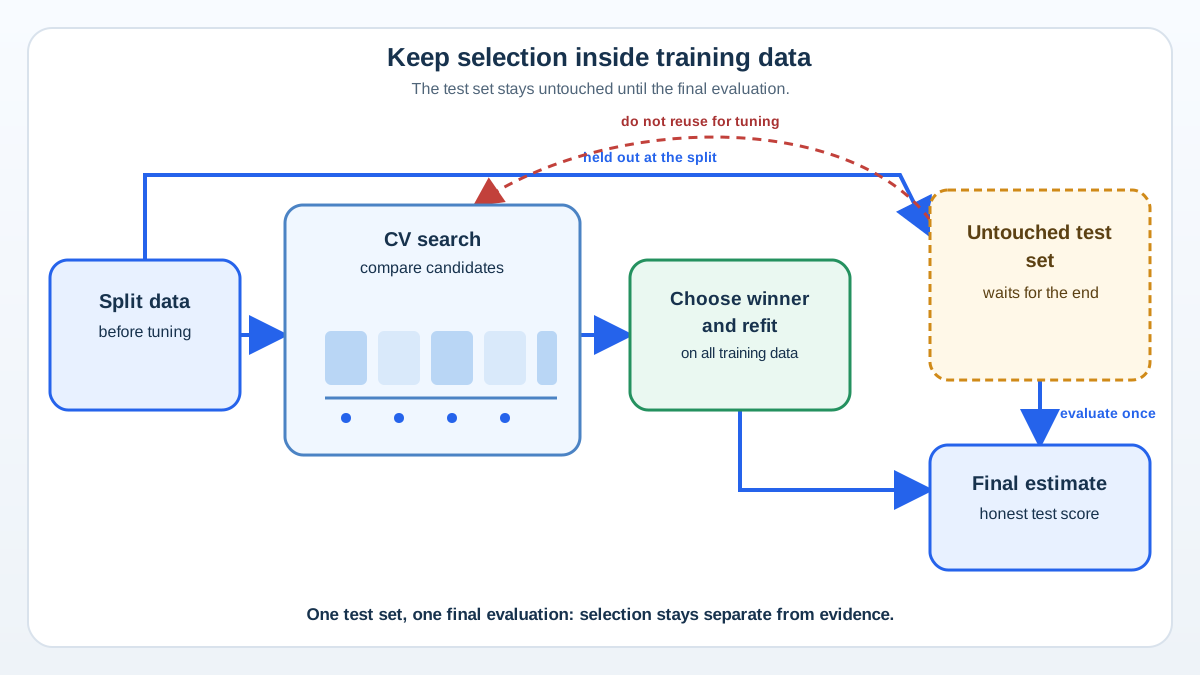
After tuning, the chosen hyperparameters are themselves a product of the data. Reporting the tuning score double-counts the validation signal. You selected the configuration because it looked good on those folds; of course it looks good on those folds.
The fix is a test set that never touches the search. Split your data once. Tune inside the training portion with cross-validation. Then fit the chosen configuration on the full training data and evaluate exactly once on the untouched test set.
If your data is too small to spare a test set, nested cross-validation gives you an estimate of the tuned pipeline's performance. The idea is two layers of folds: inner folds select hyperparameters, and outer folds evaluate the whole selection procedure as one step. The result is still an estimate, not a guarantee, but it does not reuse the same data for both jobs.
One warning matters more than any other: using the test set repeatedly to re-tune turns it into a second validation set. The boundary erodes, and your honest final number quietly becomes another selection signal.
A Disciplined Tuning Workflow You Can Reuse
Here is the sequence I use for any scikit-learn model:
- Hold out a test set first. Do not touch it until the end.
- Choose a small set of hyperparameters that plausibly matter for your model and data.
- Define a bounded search space with sensible ranges, then pick grid or randomized search based on your grid size and fit budget.
- Run the search with cross-validation inside the training data. Inspect the results table, not just the best score.
- Refit the best configuration on the full training set and evaluate once on the held-out test set.
- Record the experiment: search space, random seed, folds, metric. Reproducibility is what turns tuning from a ritual into evidence.
The common mistakes are consistent: tuning too many knobs at once, comparing models on the tuning score, and reusing the test set. Each one quietly corrupts the conclusion.
Common mistake: Reading
best_score_from a search and reporting it as expected performance. That number is a selection signal, not a performance promise. Only the held-out test evaluation tells you what to expect.
Reading the Results Table Like Someone Who Understands Tuning
When you inspect the full results from a search, you are looking for three patterns:
A cluster of near-ties. If many configurations score within a hair of the winner, the exact best choice is not very meaningful. Pick the simplest or most stable one in the cluster rather than chasing the top of a plateau.
High fold variability. If the same configuration swings wildly across folds, your estimate is shaky. The winner may be riding one lucky fold. Consider whether your data or your validation strategy is the problem before trusting the result.
A winner at the edge of your search range. If the best value sits at the boundary of what you allowed, your search space was probably too narrow. Expand the range in that direction and search again rather than declaring victory.
These patterns tell you whether your search was well designed. A single winning score, pulled out of context, tells you almost nothing.
When Tuning Is Worth It (and When It Is Not)
Tuning is leverage, not a ritual. It pays off most when you have a solid baseline and enough data that the search can distinguish real gains from noise.
Skip heavy tuning when you have a tiny dataset, when you are running a quick sanity check, or when a simple model with defaults already meets your goal. A strong baseline beats a badly tuned complex model every time. Tune after you have confirmed the model family is worth the effort, not before.
Tuning compounds when it applies across many models or repeated retraining. For a single throwaway fit, defaults are often the right call.
Your Next Experiment
Run one small, bounded tuning experiment on a dataset you know well. Pick a model, choose two or three hyperparameters that matter, define a narrow search space, and run GridSearchCV or RandomizedSearchCV inside your training data.
Then do the part that separates people who understand tuning from people who just run it: inspect the full results table. Look for plateaus, unstable scores, and winners sitting at the edge of your search range. Each pattern tells you something about whether your search was well designed.
Finally, refit the chosen model on the full training set and evaluate it once on your held-out test set. Compare that number to the tuning score. Some gap is the price of selection, but some is ordinary sampling variability—one test score is an estimate, not a proof. If the decision is high-stakes, treat that single number as a useful check, not a final verdict.
From here, the natural next step is comparing tuned models fairly. The same discipline applies: bounded search, honest evaluation, and knowing when to stop.
Knowledge check
Final check
Finish the article by checking the ideas you just learned.
References
Research updated Sep 8, 2026


