
Grouped and Time-Based Cross-Validation: Split Data Without Leaking the Future
You train a model. Cross-validation gives you a confident accuracy score. You deploy. The model underperforms in ways your validation never hinted at.

Key topics
You train a model. Cross-validation gives you a confident accuracy score. You deploy. The model underperforms in ways your validation never hinted at.
The problem is rarely the model. It is the split.
Random k-fold cross-validation carries a quiet contract: every row is independent. That contract holds on tidy classroom datasets and breaks the moment your data contains repeated customers, grouped measurements, or time order. When it breaks, your validation stops measuring the model and starts measuring how well the split let the model cheat.
The fix is not a fancier model. It is choosing a split that simulates the conditions your model will actually meet at deployment.
Why Your Cross-Validation Score Can Lie
Standard k-fold cross-validation shuffles all rows and divides them into folds. Each fold gets used as a test set once, with the model trained on the remaining folds. The logic is clean and the estimate is honest—under one assumption: every row is sampled independently from the same distribution.
That assumption is the i.i.d. contract: independent and identically distributed. Most introductions to cross-validation inherit it without saying so.
Real data frequently breaks it. Consider a dataset of customer purchase records. Several rows belong to the same customer. When random folds split those rows across the train/test boundary, the model trains on some purchases from a customer and is tested on other purchases from that same customer. The test rows are near-duplicates of what the model already saw. The score inflates because the model is being evaluated on people it has already met.
The same failure appears with time-ordered data. Randomly shuffling daily sales records lets the model train on future observations and test on past ones. Your validation score says the model can forecast. In reality, it has simply read tomorrow's newspaper during training.
The visible symptom is consistent: a great cross-validation score and a disappointing deployment. The hidden cause is that the split did not respect the structure of the data.
Two Ways Dependence Sneaks Into Your Data
Before choosing a split strategy, diagnose your dataset with two questions: what is the unit of dependence, and what is the direction of dependence?
Grouped dependence means rows are not independent because they share a source. The same customer, patient, sensor, or geographic region produces multiple rows. The unit of dependence is the entity that repeats. If you deploy a model that predicts whether a new customer will churn, your validation should test on customers the model has never seen—not on new rows from customers it already knows.
Temporal dependence means rows are ordered in time and nearby observations correlate. This is autocorrelation: today's value resembles yesterday's more than it resembles a value from six months ago. The direction of dependence matters because future rows depend on past ones. If you deploy a model that forecasts next month's demand, your validation must never let training data come from after the test period.
The two can overlap. A dataset of hospital visits has grouped structure (multiple visits per patient) and temporal structure (visits arrive in time order). A dataset of daily sales across stores has both as well. Naming both dimensions is the first step toward choosing a split that respects them.
Knowledge check
Check your understanding
Answer this question before you continue.
Grouped Cross-Validation: Keep the Source Together
Grouped cross-validation answers one deployment question: can this model generalize to a new source it has never encountered?
The mechanics are simple. Instead of shuffling individual rows, you assign all rows from one source to the same fold. Training never sees a partial view of a test entity. If customer 42 has twenty purchase records, all twenty stay together—either in training or in testing, never split across the boundary.
scikit-learn provides the iterators you need: GroupKFold, LeaveOneGroupOut, and LeavePGroupsOut. You pass a groups array alongside your features and target, identifying which source each row belongs to.
from sklearn.model_selection import GroupKFold

group_kfold = GroupKFold(n_splits=5)
for train_idx, test_idx in group_kfold.split(X, y, groups=customer_ids):
    # train_idx and test_idx never contain the same customer
    ...
Reach for grouped validation whenever your real prediction target is a new source: a new customer, a new patient, a new device, a new store, or a new spatial region. Species distribution models, for example, often use spatial block cross-validation because nearby observations are correlated—observations from the same region are not independent evidence.
The common mistake is using plain KFold on grouped data out of habit. The inflated score is not telling you the model is good. It is telling you the model memorized familiar sources and the split let those sources appear on both sides of the boundary.
Knowledge check
Check your understanding
Answer this question before you continue.
Time-Based Splits: Never Train on the Future
Time-based validation answers a different deployment question: can this model predict what happens next from what has already happened?
The core principle is that no future observation may influence training. scikit-learn's TimeSeriesSplit implements this as a variation of k-fold that respects chronological order. The first training set contains the earliest observations, the test set always trails behind, and each successive training set is a superset of the one before—training data grows forward as new information arrives.
from sklearn.model_selection import TimeSeriesSplit

tscv = TimeSeriesSplit(n_splits=5)
for train_idx, test_idx in tscv.split(X):
    # max(train_idx) < min(test_idx) in time order
    ...
This walk-forward logic mirrors how forecasting actually works in production. You train on everything available up to time T, forecast the next horizon, then retrain as new data arrives. The validation procedure should simulate that rhythm.
Before you reach for TimeSeriesSplit, make the deployment contract explicit. Name the prediction timestamp: when will the model make its forecast? Name the forecast horizon: how far ahead does it need to predict? Name the retraining cadence: how often will fresh data arrive? And check for an information-delay gap: if some features are only published days after the events they describe, your training data must respect that lag too. TimeSeriesSplit is a solid default for ordered samples, but it is not a complete simulation of every forecasting workflow—it is a tool that respects order, and you still have to define what order means for your problem.
Two practical details matter. First, match your validation horizon to your real forecast horizon. If production needs twelve-step-ahead forecasts, validating on one-step-ahead predictions will flatter your model. Second, keep folds comparable in duration so metrics across folds mean the same thing.
The classic mistake is applying random KFold to time-ordered data. The score looks fine because the model trains on future observations and tests on the past—a form of leakage that is invisible unless you inspect which rows landed where.
Knowledge check
Check your understanding
Answer this question before you continue.
When Grouped and Temporal Dependence Overlap
Real datasets often carry both kinds of dependence at once. A clinic has repeated visits per patient, and those visits arrive in time order. A retailer has daily sales per store. The right split depends entirely on what your model will face at deployment, so ask the question precisely: what is the new thing being predicted?
New entity, any time. If you deploy a model to screen a patient who has never visited before, the test boundary is the patient. Group by patient. Time order matters less because every row in the test group belongs to someone the model has not met.
Future observation for a known entity. If you deploy a model that predicts tomorrow's risk for a patient already in your system, the test boundary is time. The model has seen this patient's history; what it has not seen is the future. Split by time, and keep each patient's rows in chronological order within the folds.
New entity in the future. If you deploy a model that must assess a brand-new patient next month, both boundaries matter. The test set must contain patients who never appeared in training, and those patients must come from a period after the training data ends.
The last case is the hardest because no single scikit-learn splitter handles both constraints out of the box. GroupKFold ignores time; TimeSeriesSplit ignores groups. When both boundaries matter, design the split around the deployment event rather than hoping one iterator covers it. A practical pattern is to hold out entire entities from the most recent time window as your test set, train on all other entities from earlier periods, and repeat the process by sliding the window backward. That may mean building a custom splitter or using PredefinedSplit with manually assigned folds. It is more work, but it is the only way to answer the question you actually face.
Common mistake: Treating a grouped problem as purely temporal, or vice versa. A split that respects only one kind of dependence will quietly leak through the other.
Knowledge check
Check your understanding
Answer this question before you continue.
Which Split Answers Your Deployment Question?
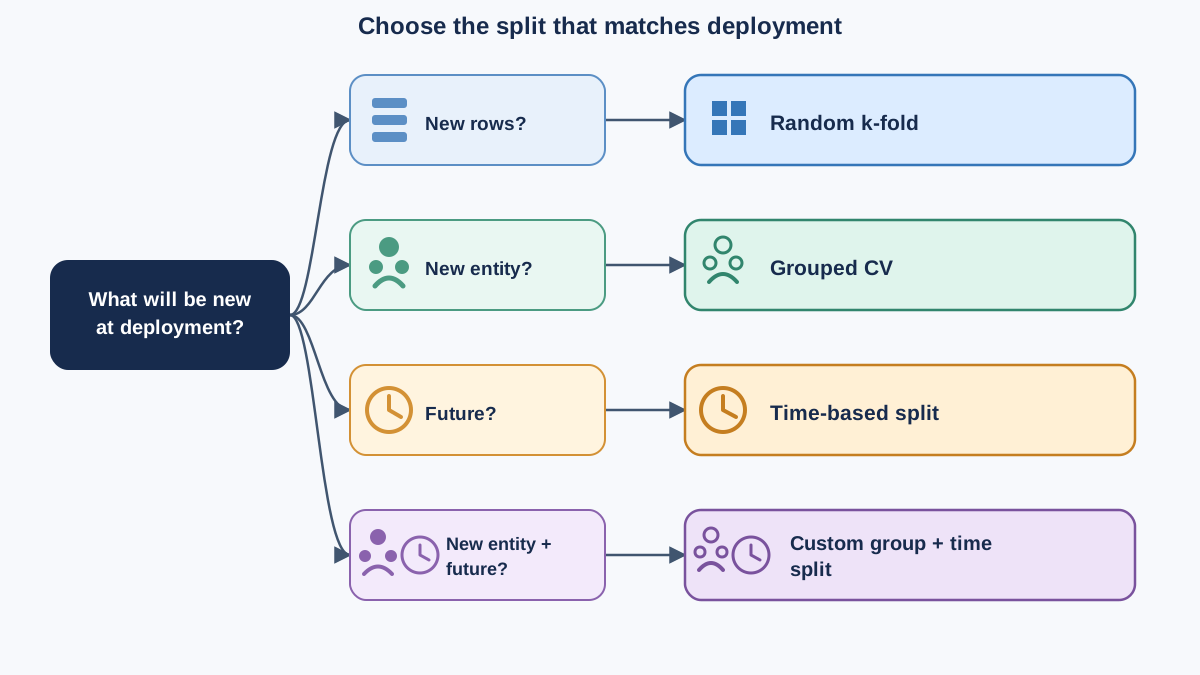
The decision rule reduces to one question: what new thing will the model predict at deployment?
| Random k-fold | Grouped CV | Time-based split | |
|---|---|---|---|
| Assumes | Rows are independent | Rows share a source | Rows are time-ordered |
| Estimates | Performance on new rows from the same distribution | Performance on new sources | Performance on the future |
| Deployment match | New rows, same population | New customer, patient, device, region | Next time period |
| scikit-learn tool | KFold | GroupKFold, LeaveOneGroupOut | TimeSeriesSplit |
Random k-fold is fine when rows are truly independent and deployment draws new rows from the same distribution. Once rows share a source, use grouped validation. Once order matters, use a time-based split. When both apply, name the deployment event first—new entity, future moment, or both—and build the split around that answer.
Common Mistakes That Quietly Leak the Future
The most damaging leakage often happens outside the split itself.
Scaling before splitting. Fitting a scaler or imputer on the full dataset before splitting lets preprocessing statistics from test rows influence training. Fit preprocessing on training folds only, then transform the test fold. This rule applies to grouped and time-based splits exactly as it does to random ones.
Random folds on structured data. Reaching for KFold by default is the most common error. The score is not wrong—it is answering a question you did not ask. It estimates performance on new rows from known sources, not on new sources or future moments.
Validating at the wrong horizon. One-step-ahead validation on a model that must forecast twelve steps ahead will overstate capability. Test the horizon you actually need.
Too few folds on short series. A short time series cannot support many splits. With limited data, you may get only two or three folds, which produces an unstable estimate. Acknowledge the limitation rather than pretending the score is precise.
Each mistake shares the same signature: an inflated score that reflects the split's generosity, not the model's skill.
Run the Diagnosis on Your Own Data
Before your next modeling session, run a short ritual on your dataset. Name the unit of dependence: which entity repeats across rows? Name the direction of dependence: does order matter for the prediction task? Then choose the split that simulates the real deployment question.
If deployment means a new customer, group by customer. If deployment means next month, split by time. If both, respect both.
Pick a dataset you already have—something with repeated users or dated records. Inspect it. Identify whether rows repeat by source or march in time order. Run the matching split, then run a plain KFold on the same data as a deliberately naive diagnostic. The gap between those two numbers tells you how much the easier boundary was flattering the model. Treat that gap as a warning sign, not a second opinion: the deployment-matched split is the estimate you report and act on, while the random score exists only to reveal how much the split choice mattered. If the gap is large, your model may be leaning on familiar sources or future information instead of learning patterns that transfer. That is exactly what you need to know before you trust the model in production.
Knowledge check
Final check
Finish the article by checking the ideas you just learned.
References
Research updated Sep 8, 2026


