
A Reliable Model Selection Workflow: From Baseline to Final Test
Here is the trap I see beginners fall into constantly: they try five algorithms, compare the scores, keep the winner, then tweak it, compare again, and…

Key topics
Here is the trap I see beginners fall into constantly: they try five algorithms, compare the scores, keep the winner, then tweak it, compare again, and repeat until one model finally "wins." It feels like model selection. It is actually just a best-score contest with the test set as the referee—and the referee has been bribed.
The problem is not that you compared models. The problem is what evidence you used to compare them. If you consult the test set repeatedly, each peek leaks information into your decisions. Your test score stops measuring how well the model generalizes and starts measuring how well you memorized the test set.
Model selection is not a single contest. It is a disciplined sequence of stages, and each stage is allowed to see only certain evidence. The test set is spent exactly once, at the very end, and it never informs a choice. That single rule, enforced across the whole workflow, is what makes your final model choice defensible.
This article walks through that model selection workflow stage by stage: framing the task, building a baseline, comparing candidates with honest validation, tuning within bounds, diagnosing errors, and finally touching the test set once.
Why Picking the Best Score Is Not Model Selection
Let's name the default workflow precisely, because most of us have done it:
- Split the data into training and test sets.
- Train a few algorithms on the training set.
- Evaluate each on the test set.
- Keep whichever scores best.
- Tweak the winner, re-run the test, and repeat until satisfied.
Step 5 is where the workflow quietly corrupts itself. Every time you adjust a model because of a test-set score, you are using information from the test set to make a decision. The model is no longer being judged on unseen data. It is being fitted to data you pretended was unseen.
The scikit-learn documentation states the risk plainly: when you evaluate different hyperparameter settings, there is a risk of overfitting on the test set because the parameters can be tweaked until the estimator performs optimally. Knowledge about the test set leaks into the model, and evaluation metrics no longer report on generalization performance.
The fix is not to avoid testing. The fix is to build a model selection workflow where the test set has exactly one job, performed at exactly one moment. Every earlier stage uses a different source of evidence: validation folds, cross-validation scores, and error analysis. By the time the test set is touched, no decision is left for it to influence.
Step 1: Frame the Task Before You Touch a Model
Model selection starts before any algorithm is chosen. It starts with three decisions that determine what "good" even means.
Decide what the model must predict. Is this a supervised problem, where you have labeled examples to learn from? Or unsupervised, where you are looking for structure without labels? If supervised, is the target a category (classification) or a number (regression)? This sounds basic, but fuzzy framing produces fuzzy comparisons later.
Choose the evaluation metric from the real cost of mistakes. Do not default to accuracy because it is familiar. If a missed fraud alert costs far more than a false alarm, accuracy hides the cost you actually care about. If a house-price prediction that is off by 30% is disastrous but one off by 5% is fine, mean absolute error and squared error tell different stories. The metric should come from the consequence of errors in your actual use case, not from habit.
Identify the unit of prediction and whether your data are independent. This decision determines which validation scheme is even valid. If rows are independent—one customer, one transaction, one image—ordinary random splits work. If rows are grouped (multiple visits from the same patient) or temporal (stock prices across days), random splits leak information across the boundary you care about. A model trained on early time points and validated on random interleaved points looks better than it will in deployment, where it must predict the future.
The practical payoff of Step 1: a metric and validation scheme chosen up front keep every later comparison honest. You are not choosing the metric after seeing which one flatters which model.
Knowledge check
Check your understanding
Answer this question before you continue.
Step 2: Build a Baseline You Must Beat
The baseline is the first entry in your model comparison, not a throwaway. It is the simplest prediction that requires almost no learning: predict the most common class, predict the mean of the target, or use a trivial rule of thumb.
The baseline sets the floor. Any candidate model must justify its added complexity by beating this floor by a meaningful margin. If your fancy gradient-boosted tree barely outperforms "always predict the majority class," the complexity is not earning its place. The gap between a candidate and the baseline tells you whether the model is actually capturing signal in the data or just adding noise.
Treat the baseline as a permanent reference point. Every candidate you evaluate later should be compared not only against other candidates but against the baseline. A model that wins the candidate contest but barely clears the baseline is a warning sign, not a victory.
Knowledge check
Check your understanding
Answer this question before you continue.
Step 3: Compare Candidates With Cross-Validation, Not a Single Split
A single train-test split can reward luck. The one split you chose might happen to put easy examples in the test set, or hard ones, or an unrepresentative mix. Cross-validation solves this by repeating the train-evaluate cycle across multiple folds and averaging the results. The average across folds is a stabler estimate of how the model will behave on unseen data.
But cross-validation only keeps the comparison honest if the comparison is fair. Three rules matter:
Every candidate must see the same folds. If model A is evaluated on folds 1–5 and model B on folds 2–6, you are not comparing models. You are comparing models plus different data. Use the same cross-validation splitter for every candidate.
Preprocessing must be learned inside each fold. If you scale features or impute missing values on the full dataset before splitting, information from the validation folds has already leaked into the training folds. The preprocessing steps must be fitted on the training portion of each fold only, then applied to the validation portion.
The split strategy must match the deployment boundary. Ordinary k-fold assumes rows are independent. If your data are grouped or temporal, use grouped or time-aware splits. Otherwise the cross-validation score estimates the wrong thing: performance on random gaps in the past rather than performance on the future or on new groups.
Cross-validation mechanics are worth knowing well, but for this workflow the key point is simpler: candidates are compared on validation folds, using identical folds and identical preprocessing, and the average score is the evidence for the comparison.
Knowledge check
Check your understanding
Answer this question before you continue.
Step 4: Tune Within Bounds
Hyperparameter tuning is not the same as model selection, though beginners often blur them. Model selection chooses between model families: does a random forest beat a logistic regression here? Tuning searches within one family: which value of the regularization strength or tree depth serves this random forest best?
Tuning has its own failure mode. A wide, unbounded search—try thousands of combinations, keep whatever scores best on validation—can overfit the validation folds. The more configurations you try, the more likely one of them will look great on validation by luck. The search itself becomes a kind of training, and the validation score becomes an optimistic estimate.
The honest pattern has three parts:
- Set the search space and budget before looking at results. Decide which hyperparameters matter, what range is reasonable, and how many configurations you can afford to try. Write it down. Then run the search.
- Tune on validation folds. The search uses cross-validation scores to guide its choices.
- Carry the chosen configuration forward. The tuning search produces a choice. The score attached to that choice is part of the selection process—it helped you pick a configuration, so it is not a fresh estimate of how that configuration will perform.
The distinction matters: the tuning search produces a choice, and the choice still needs an honest evaluation. That evaluation comes in Step 6, on data the search never saw.
Knowledge check
Check your understanding
Answer this question before you continue.
Step 5: Diagnose Errors Before You Declare a Winner
The best average score can still hide systematic failures. A model might nail 95% of cases and fail catastrophically on the 5% that matter most. If your metric from Step 1 was chosen to reflect the real cost of mistakes, the average score matters. But the average alone does not tell you where the mistakes are.
Look at the error patterns. For classification, inspect the confusion matrix: which actual classes get confused with which predicted classes? A model that confuses two rare but costly classes may look fine in aggregate and be dangerous in practice. For regression, plot residuals against the predicted values or against individual features. If errors grow as the target grows, or cluster in one region of the input space, the model has a systematic blind spot.
Diagnosis connects back to the metric chosen in Step 1. The score only matters if it reflects the real cost of errors. If the leading candidate's errors land exactly where they are cheapest, the average score is telling the truth. If they land where they are most expensive, the average is hiding the problem.
This gives you a decision rule: accept the candidate if its error patterns match what the metric was designed to measure. Revisit the framing if the errors reveal that the metric was wrong for the task. Return to an earlier stage if the errors reveal a solvable modeling problem—a missing feature, a bad preprocessing choice, or a candidate that deserved better tuning.
Step 6: Refit the Chosen Model, Then Touch the Test Set Once
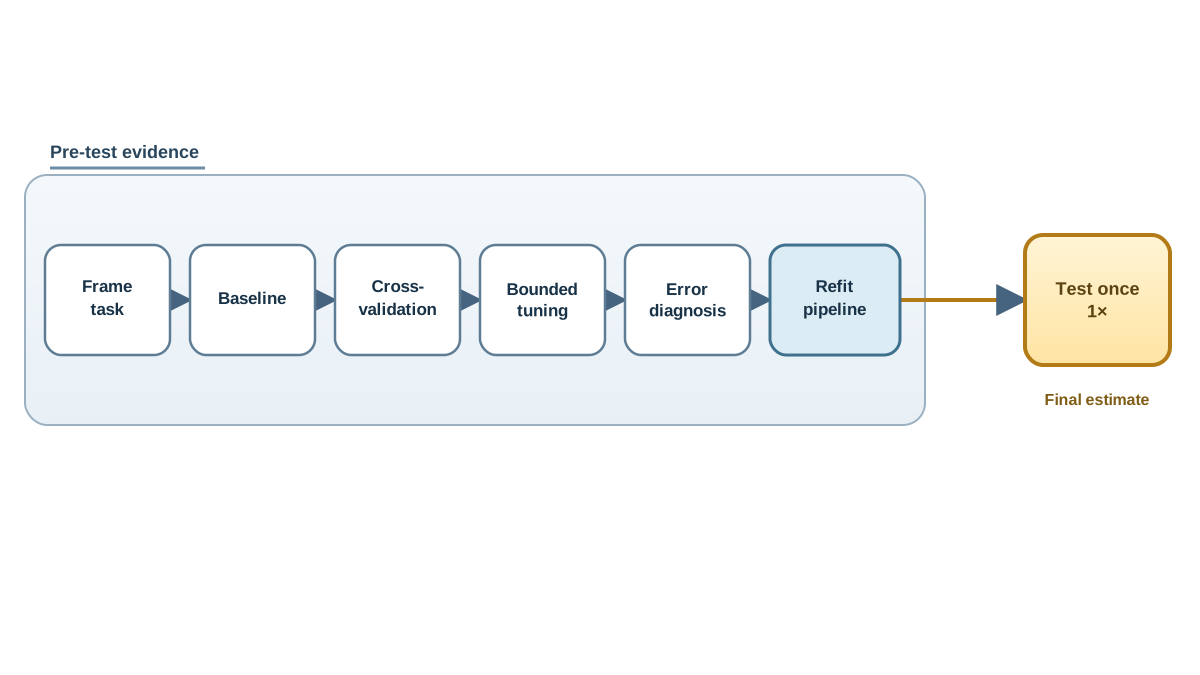
After selection and tuning, the workflow reaches its final stage. Before the test set is touched, one operational step matters: refit the chosen pipeline on all the data that are allowed before the test.
Here is what that means in practice. During cross-validation, each model was trained on a subset of the data—one fold at a time. The winning configuration was never trained on the full pre-test dataset. So before the final evaluation, take the exact model type, hyperparameters, and preprocessing steps you selected, and fit that complete pipeline on all the data except the test set. Then, and only then, evaluate once on the test set.
The test set is used exactly once, to report an honest estimate of generalization. This is the score you can defend to yourself and to anyone else who asks.
Two rules protect this final measurement:
The test split must respect the same boundary you chose in Step 1. If your data are grouped or temporal, the held-out test set must be grouped or time-aware too. A random final split after grouped cross-validation answers a different deployment question than the one you spent the whole workflow investigating.
A disappointing test result means review, not tweaking. If you change the model after seeing the test score and run the test again, you have turned the test set into a validation set. Its value is destroyed. The score no longer estimates generalization; it estimates how well you fit the test set.
Here is the compact mental model of the entire workflow:
| Stage | Allowed evidence | Decision made |
|---|---|---|
| Frame the task | Problem context, cost of errors | Metric, validation scheme |
| Build a baseline | Training data | Floor for acceptable performance |
| Compare candidates | Cross-validation folds | Which model family to carry forward |
| Tune within bounds | Validation folds, bounded search | Which hyperparameter configuration to use |
| Diagnose errors | Validation predictions, error patterns | Whether the candidate is acceptable |
| Refit, then test once | All pre-test data, then the test set | Final honest estimate of generalization |
Each stage sees only the evidence it needs. No stage reaches forward to borrow evidence from a later one.
Common Mistakes That Break the Workflow
These failure modes are normal. Every practitioner has hit at least one. The fix is recognizing the symptom and returning to the correct stage.
Using the test set for tuning. Symptom: your test score keeps improving as you tweak the model, and you feel great about it. Fix: stop. The test set is spent. The score is no longer trustworthy. Rebuild the workflow with a clean test set or accept that your reported number is optimistic.
Fitting preprocessing on all data before splitting. Symptom: cross-validation scores look suspiciously high, and the model degrades noticeably in deployment. Fix: move preprocessing inside the cross-validation loop so each fold learns its own preprocessing parameters.
Comparing models on different splits. Symptom: model A wins, but you changed the random seed or the fold structure between runs. Fix: use the same splitter for every candidate. The comparison is only valid if the data partitions are identical.
Running unbounded tuning searches. Symptom: the validation score keeps climbing as you widen the search, and the final test score drops sharply. Fix: set the search space and budget before running, and remember that the validation score from the search is a selection signal, not a final estimate.
Testing a model that was never refit. Symptom: you selected a configuration through cross-validation but evaluated the test set using a model trained on only one fold. Fix: refit the chosen pipeline on all pre-test data before the final evaluation.
None of these mistakes make you a bad practitioner. They make you a normal one. The workflow exists because these leaks are easy to create and hard to notice from inside.
Your Next Step
Run this sequence on one small dataset of your own. Pick a problem you care about, frame it deliberately, build a baseline, compare a few candidates with cross-validation, tune within bounds, diagnose the errors, refit the winner, and resist the urge to peek at the test set until the final step.
The discipline feels unnatural at first. The test set sits there, labeled, promising a quick answer. But the quick answer is the trap. A disciplined sequence, not a best-score contest, is what makes a model choice defensible. The test set is spent once. Spend it when it counts.
Knowledge check
Final check
Finish the article by checking the ideas you just learned.
References
Research updated Sep 8, 2026


