
Multilabel Classification Explained: When One Example Has Several Answers
Most classification tutorials teach you to pick one answer. A news article is politics or finance. A movie is action or comedy. A support ticket is billing…

Key topics
Most classification tutorials teach you to pick one answer. A news article is politics or finance. A movie is action or comedy. A support ticket is billing or technical. The model scores every class, and the highest score wins.
That mental model breaks the moment a record legitimately carries several labels at once. A news article about a new tax law affecting banks is politics and finance. A movie like Guardians of the Galaxy is action and comedy. A support ticket that says "my invoice is wrong and your site won't load" is billing and technical.
Force that example into a single class and you throw away real information. The model isn't wrong—your framing is. Multilabel classification is not a harder version of multiclass. It is a different output contract, and that contract changes how you structure data, train models, and measure success.
The Multiclass Habit That Breaks on Real Data
The multiclass contract fits in one sentence: each example belongs to exactly one class, and the model's probabilities sum to one across all classes.
That contract is elegant and useful. It is also wrong for a large slice of real-world problems. When you classify a news article as "politics" and stop, you have decided the article has nothing to say about finance, education, or international relations. For many articles, that is a lie.
The core shift in multilabel classification is simple: instead of asking "which one of these classes?", you ask "which of these classes apply?" Each label becomes a separate yes/no question. Is this article about politics? Yes or no. Is it about finance? Yes or no. Is it about sports? Yes or no.
One clarification matters before we go further. "Separate" does not mean "independent." Nonexclusive labels can still be strongly related—articles about banking regulation often mention politics. The target treats each label as its own binary outcome, but the model may still learn from the relationships between labels. Keep that distinction in mind; it will matter when we compare modeling strategies.
Knowledge check
Check your understanding
Answer this question before you continue.
What Multilabel Classification Actually Predicts
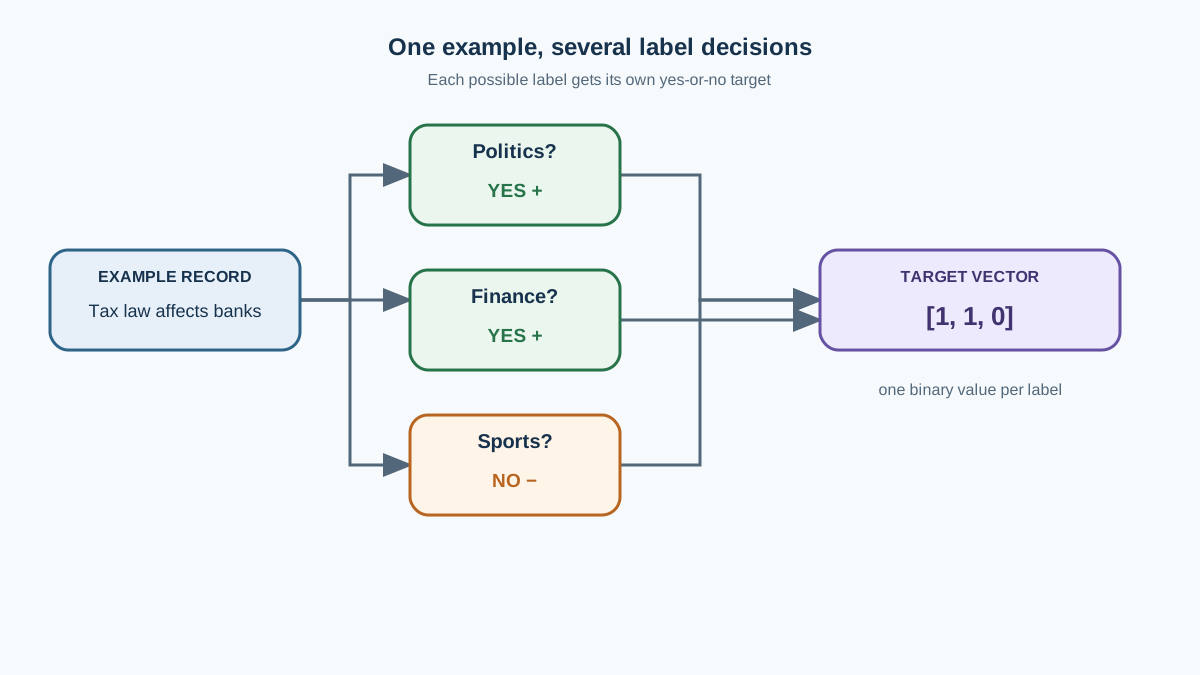
Formally, multilabel classification assigns each example a set of labels drawn from n_classes possible classes. The number of labels per example, m, can range from zero to all of them. Nothing forces exclusivity.
The target representation makes this concrete. Instead of a single column of class IDs, your target becomes a binary matrix of shape (n_samples, n_classes). Each column is one label. A 1 means the label is present; a 0 means it is not.
Here is what that looks like for three news articles and four topic labels:
| Article | Politics | Finance | Sports | Technology |
|---|---|---|---|---|
| A | 1 | 1 | 0 | 0 |
| B | 0 | 0 | 1 | 0 |
| C | 1 | 0 | 0 | 1 |
Article A is about politics and finance. Article B is only about sports. Article C covers politics and technology. Each row can contain any number of ones, from zero to four.
In scikit-learn, MultiLabelBinarizer is the practical tool for converting a list of label sets into this matrix. If your raw data has each example as a list of labels—["politics", "finance"] for article A—the binarizer turns that into the row [1, 1, 0, 0].
Contrast this with multiclass one-hot encoding, where each row has exactly one 1 and the rest are 0. The structural difference is the whole point: multiclass targets enforce a single choice, while multilabel targets leave room for several.
Common mistake: Treating any dataset with multiple label columns as multilabel. If the labels are mutually exclusive groups—say, "primary category" and "secondary category"—you may have separate multiclass problems, not one multilabel problem. Multilabel applies when multiple labels from the same label set can be simultaneously correct.
Knowledge check
Check your understanding
Answer this question before you continue.
Binary Relevance: The Baseline That Treats Each Label Alone
The simplest way to solve a multilabel problem is to ignore the multilabel structure entirely. Fit one independent binary classifier per label, then combine their predictions. This strategy is called binary relevance, and it is the natural first move.
In scikit-learn, MultiOutputClassifier wraps any classifier and applies this strategy automatically. You give it your feature matrix and your binary label matrix, and it fits one model per column. At prediction time, each model independently votes on whether its label is present.
Binary relevance is attractive because it is simple, interpretable, and often good enough. You can inspect each label's model separately, debug failures per label, and swap in different algorithms for different labels if you want.
But it has a hidden assumption: each label carries no information about the others. The politics model never learns that articles about elections often mention finance. The finance model never learns that articles about banking regulation usually involve politics.
When labels are strongly correlated, this independence assumption quietly costs accuracy. Consider product tagging for clothing. The labels "cotton" and "casual" travel together frequently. A binary relevance approach treats them as unrelated questions, so it misses the pattern that certain labels co-occur. It can predict "cotton" without "casual" even when the training data almost never shows that combination.
Classifier chains fix this by feeding earlier label predictions into later models as extra features. The politics model runs first; its prediction becomes an input to the finance model. This lets the chain exploit correlations. The cost is added complexity and sensitivity to the order of the chain.
For a first pass, binary relevance is the right baseline. Reach for chains only when independent models clearly miss correlated patterns—and even then, verify that the added complexity actually improves results on validation data before you keep it.
Knowledge check
Check your understanding
Answer this question before you continue.
Turning Scores Into Labels: Thresholding Is Now a Real Decision
In multiclass classification, you pick the class with the highest score. Argmax is the whole decision rule. In multilabel classification, there is no argmax. Each label needs its own yes/no cutoff.
This is where threshold choice becomes a genuine tuning problem. The model outputs a score for each label—a probability, if you are using logistic regression or a similar calibrated model. Whether that score becomes a 1 or a 0 depends on where you set the threshold.
A single global threshold of 0.5 is the blunt default. It works when every label has similar costs for false positives and false negatives. Real problems rarely look like that.
Imagine tagging support tickets. Mislabeling a ticket as "urgent" when it is not costs a support agent a few seconds of triage. Missing the "urgent" label on a ticket that genuinely needs immediate attention costs an angry customer and a breached SLA. Those two errors have very different costs, so the urgent label deserves a lower threshold—you would rather over-tag than miss.
Here is a validation-first workflow for choosing thresholds without cheating on your test set:
- Split your data into training, validation, and test sets before you tune anything.
- Train your models on the training set only.
- Collect validation scores for every label on every validation example.
- Choose each label's threshold using the metric or error cost that matters for that label. If false negatives are expensive for the "urgent" label, inspect its precision-recall curve on validation data and pick a threshold that favors recall.
- Lock the thresholds, then evaluate once on the test set.
The practical consequence: the model outputs scores, but the threshold decides how many labels each example receives. Lower the threshold and examples accumulate more labels. Raise it and they shed labels. Treat 0.5 as a starting point to compare against, not a universal rule.
Knowledge check
Check your understanding
Answer this question before you continue.
Why Accuracy Is the Wrong Scorecard Here
Plain accuracy punishes multilabel models brutally. A prediction counts as correct only if it matches every label exactly. Miss one label out of five and the whole prediction is wrong.
Name that metric precisely: it is the exact-match ratio, and it is the strictest possible way to score a multilabel prediction. Consider an article with four true labels. Your model predicts three of them correctly and misses the fourth. Exact match says zero. The model did useful work, and your metric reports total failure.
Per-label evaluation fixes this distortion. Compute precision, recall, and F1 for each label independently, then average the results. This gives you a score that reflects how well the model handles each label on its own terms.
The averaging method matters. Macro averaging treats each label equally, so rare labels carry the same weight as common ones. Micro averaging pools all predictions across labels, so common labels dominate the score. If you care about catching rare but critical labels—like "security vulnerability" in a code review system—macro averaging will tell you whether you are succeeding. If you mostly care about overall tagging quality on a high-volume system, micro averaging matches your priorities better.
Two other metrics round out the picture. Hamming loss measures the fraction of label-position pairs the model gets wrong, counting both false positives and false negatives. Exact match is useful when you genuinely need every label correct, like routing a document to exactly the right set of reviewers.
No single number tells the whole story. Report per-label precision and recall alongside an averaged F1, and you will see which labels the model handles well and which ones need more data or a different approach.
Note: Exact match and ordinary accuracy are not interchangeable names for the same score. Exact match demands every label be correct. Label-wise accuracy counts each label-position prediction separately. When someone says "accuracy" in a multilabel context, ask which one they mean.
Choosing Your Approach: A Decision Rule
Here is a compact frame for deciding what to do with your own data.
Decision 1: Can multiple labels from the same set be simultaneously correct? If yes, you have a multilabel problem. Do not force it into multiclass by picking the "best" label. You will lose information and train a model that cannot express the full answer.
Decision 2: Start with binary relevance. It is simple, interpretable, and often good enough. Fit one model per label, evaluate per label, and see where the failures concentrate.
Decision 3: Move to label-aware methods only when they earn it. If your per-label analysis shows that correlated labels are causing systematic errors—the model predicts "cotton" without "casual" when they almost always co-occur—try classifier chains. But compare both approaches on the same validation setup. Keep the more complex method only if it improves the metric tied to your use case without creating unacceptable operational cost.
The comparison table below summarizes the key differences:
| Aspect | Multiclass | Multilabel |
|---|---|---|
| Labels per example | Exactly one | Zero to many |
| Target format | Single class ID or one-hot vector | Binary matrix, one column per label |
| Output decision | Argmax over class scores | Per-label thresholding |
| Probability constraint | Sums to one | Separate per label |
| Exact-match accuracy | Meaningful | Very strict; often too harsh alone |
| Typical evaluation | Per-class precision/recall | Per-label precision/recall, Hamming loss |
The Next Step: Test Your Own Data
Take one dataset you are currently treating as multiclass. Look through the examples and ask a hard question: does any example legitimately carry more than one label?
If the answer is yes, you have a multilabel problem wearing a multiclass costume. Reformat the target into a binary label matrix, fit a binary relevance baseline, and compare the results against what you were doing before. You will likely find that the model can now express answers it was structurally unable to give.
Then go one level deeper. Look at the per-label precision and recall on your validation set. Which labels fail together? If you see a pattern—the model misses "casual" whenever it predicts "cotton"—that is your signal to try a classifier chain and measure whether the added complexity actually buys better predictions.
Multilabel classification is not a harder multiclass problem. It is a different question. Not "which one?" but "which of these apply?" Once you ask the right question, the data representation, the model strategy, and the evaluation metrics all fall into place.
Knowledge check
Final check
Finish the article by checking the ideas you just learned.
References
Research updated Sep 8, 2026


