
Feature Scaling in Machine Learning: When Magnitude Changes the Model
You train the same model twice on the same data. The only difference: you scaled the features before the second run. The results are not slightly…

Key topics
You train the same model twice on the same data. The only difference: you scaled the features before the second run. The results are not slightly different. They are different—different neighbors, different boundaries, different predictions. If you are new to machine learning, this feels like the algorithm is playing tricks on you.
The truth is more useful: the algorithm is not being inconsistent. It is reading the numbers exactly as you handed them over. Feature scaling in machine learning is not a universal "good practice" checkbox. It is a decision about what the algorithm should pay attention to.
Why the Same Data Gives Different Models
Imagine you are building a model that predicts whether a bottle of wine will win an award. Two of your features are alcohol content, which ranges from about 11 to 15 percent, and price, which ranges from $10 to $1,500.
Now ask a simple question: when the model compares two wines to find which are most similar, which feature dominates the comparison?
If the model measures distance by subtracting feature values, the price difference between a $20 bottle and a $500 bottle is 480. The alcohol difference between an 11% and a 14% bottle is 3. In a raw distance calculation, price completely drowns out alcohol—not because price is more important, but because its numbers are bigger.
This is the core problem that feature scaling solves. Many algorithms read raw numeric values and treat a difference of 480 the same way, regardless of whether that difference came from a feature that naturally spans hundreds or a feature that naturally spans a few units. When features have very different ranges, the large-magnitude feature silently dominates the model's decisions.
Scaling puts features on a comparable footing so each can contribute proportionally. It does not tell the model which feature matters more. It stops the units from making that decision for you.
Knowledge check
Check your understanding
Answer this question before you continue.
What Feature Scaling Actually Changes
Scaling is a transformation of feature values, not a change to what the data means. If you convert a temperature feature from Celsius to Fahrenheit, the information is identical—you have only changed the units. Feature scaling works the same way. It changes the numbers the algorithm sees while preserving the relationships within each feature.
Why does changing units change the model? Because different algorithms read the numbers differently.
Distance-based view. Algorithms like k-nearest neighbors and k-means measure how close two data points are. When one feature has a much wider spread than another, that feature dominates the distance calculation. The neighbors the model finds are chosen mostly by whichever feature has the largest numeric range.
Optimization view. Many models learn by making small adjustments to internal weights, guided by a mathematical signal called the gradient. When features have very different scales, this adjustment process can zig-zag back and forth, converging slowly or requiring many extra steps. Scaled features give the optimization a smoother path to follow.
Regularization view. Regularization is a penalty that discourages the model from relying too heavily on any single feature. The penalty treats all coefficients equally. If one feature has huge values and another has tiny values, the penalty hits them unevenly—not because of their importance, but because of their units.
Scaling does not add information. It removes the accidental influence of magnitude so the algorithm can respond to the actual patterns in your data.
Knowledge check
Check your understanding
Answer this question before you continue.
Standardization vs. Normalization: Two Common Tools
Two scaling approaches appear constantly in machine learning, and beginners often confuse them. The names do not help, so let us focus on what each one does.
Standardization (also called z-score scaling) centers each feature so its mean becomes 0 and its standard deviation becomes 1. After standardization, a value tells you how many standard deviations it sits from the average. Standardization does not force values into a fixed range—you can still see values like 2.5 or -1.8.
Normalization (also called min-max scaling) squeezes each feature into a fixed range, usually 0 to 1. The smallest value becomes 0, the largest becomes 1, and everything else lands proportionally in between. After normalization, a value tells you where it sits between the minimum and maximum.
The plain-language contrast: standardization asks "how many standard deviations from the mean is this value?" Normalization asks "where does this value sit between the smallest and largest?"
In scikit-learn, you will find these as StandardScaler and MinMaxScaler. Which should you choose? For many beginner projects, the choice is a practical default rather than a deep theoretical one. Standardization is a solid default for most algorithms because it handles features with outliers more gracefully. Normalization makes sense when you know your feature has natural minimum and maximum bounds and you want values in a specific range.
Knowledge check
Check your understanding
Answer this question before you continue.
Which Algorithms Care About Scale
Rather than memorizing a list of algorithms, learn to ask one question: does this algorithm compare features against each other, or does it evaluate each feature on its own?
Algorithms that compare features against each other need scaling. Distance-based algorithms like k-nearest neighbors and k-means measure similarity across all features at once. Support vector machines with certain kernels do the same. If one feature has a larger range, it dominates the comparison.
Algorithms that optimize a loss with gradients benefit from scaling. Logistic regression, linear models trained with gradient descent, and neural networks all converge faster and more reliably when features are scaled. The optimization path becomes smoother and less prone to zig-zagging.
Variance-based methods need scaling too. Principal component analysis (PCA) finds directions of maximum variance in your data. A feature that spans 0 to 1,000 will naturally have more variance than one that spans 0 to 1, so PCA will chase the large-magnitude feature even if it is not the most informative.
Tree-based models usually ignore scaling. Decision trees, random forests, and gradient boosting split on thresholds within a single feature. They never compare two features' magnitudes directly. Scaling does not change which threshold produces the best split.
Here is the rule: if the algorithm compares features against each other through distance, gradient, or variance, scale. If it evaluates each feature on its own, scaling rarely helps.
Why Tree Models Usually Ignore Scaling
Tree models behave differently because their mechanism is different. A decision tree asks questions like "is alcohol content above 13%?" or "is price below $50?" Each question examines one feature at a time. The tree never asks "how does alcohol compare to price?" because it does not need to—it evaluates each feature independently when choosing where to split.
Now consider what scaling does to a single feature. If you multiply every price value by 10, the threshold that best separates the classes also multiplies by 10. The split happens at exactly the same place in the data. If you shift every value by a constant, the same thing happens. The tree's decisions do not change because the relative ordering of values within each feature has not changed.
Contrast this with distance-based models, which compare values across features simultaneously. When you scale, you change how much each feature contributes to the comparison. That changes the model.
Scaling does not hurt trees. It just adds computation without changing the result, so most practitioners skip it.
Knowledge check
Check your understanding
Answer this question before you continue.
A Practical Decision Rule for Beginners
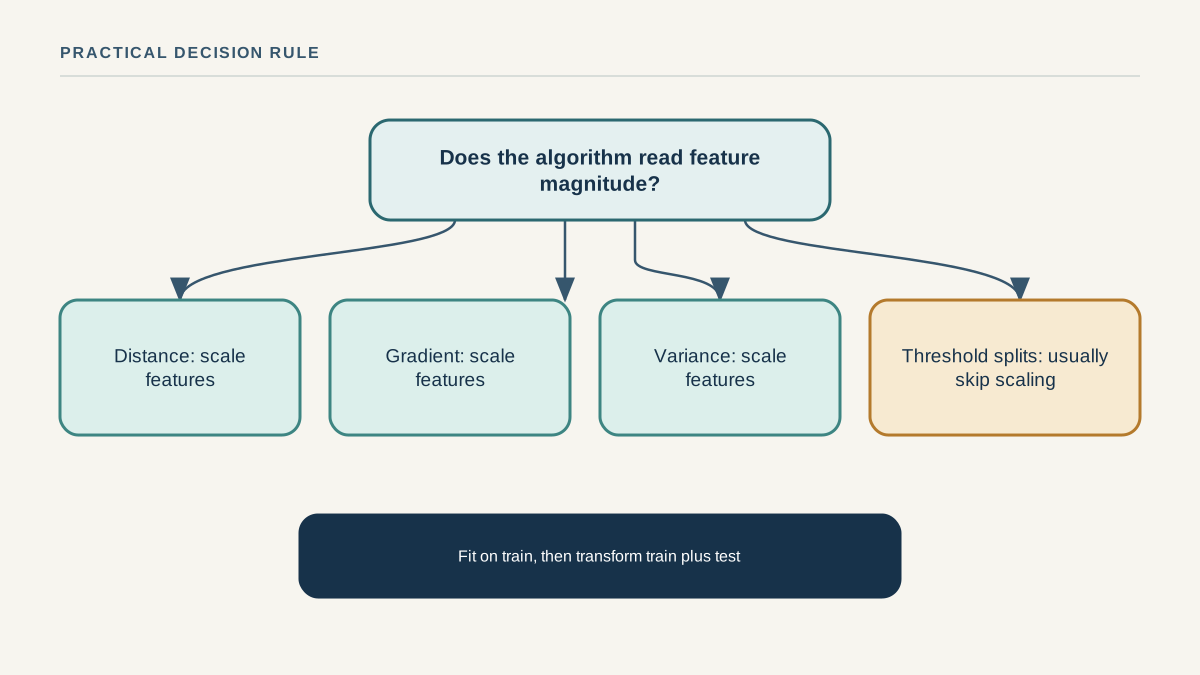
Here is a default you can apply to your next model without guessing:
- Scale features for distance-based, gradient-based, and variance-based methods.
- Skip scaling for tree ensembles.
- When unsure, scale and compare results on a validation set rather than assuming.
One warning matters more than any scaling choice: fit your scaler on the training data only, then apply it to the test data. If you compute the mean and standard deviation using the full dataset before splitting, information from the test set leaks into your training step. Your model looks better than it should, and that optimism does not survive contact with new data.
In scikit-learn, this means calling fit on the training set and transform on both training and test sets—or better, using a Pipeline so the scaling step is handled consistently.
Common Beginner Mistakes
The mistakes beginners make with feature scaling are not random. Each one comes from a misunderstanding of the mechanism.
Scaling before splitting the data. This leaks test-set information into training. The scaler learns statistics from data it should never have seen.
Scaling every feature blindly. If you have already-encoded categorical features or features that are naturally comparable, scaling adds nothing and can complicate interpretation.
Expecting scaling to fix data-quality problems. Scaling cannot repair missing values, outliers, or bad features. It only changes units.
Assuming "scaling is always good." When a tree model gives identical results with and without scaling, that is not a bug. It is the algorithm telling you it does not read magnitudes.
Each mistake is evidence about the mechanism. When you understand what the algorithm reads from the numbers, these errors become predictable—and avoidable.
The Decision That Matters
Feature scaling in machine learning comes down to one question: what does your algorithm actually read from the numbers?
If it measures distance across features, scale so no single feature's units drown out the others. If it follows gradients during optimization, scale so the path to a good model is smooth instead of zig-zagging. If it looks for directions of maximum variance, scale so magnitude does not masquerade as importance. If it splits on thresholds within individual features, scaling is optional work that will not change the result.
The next step is practical: build a repeatable preprocessing pipeline that handles scaling consistently across your training and test data. That is where the concepts here become a working part of your workflow—and where the real confidence begins.
Knowledge check
Final check
Finish the article by checking the ideas you just learned.
References
Research updated Sep 8, 2026


