
Loss Functions in Machine Learning: Tell the Model Which Errors Matter
Most people assume a machine learning model learns to be right. It doesn't. A model learns to minimize a number you hand it—and that number is the loss…

Key topics
Most people assume a machine learning model learns to be right. It doesn't. A model learns to minimize a number you hand it—and that number is the loss function. The choice of that function quietly decides which mistakes the model treats as expensive and which it tolerates. Get this choice right, and your model learns what you actually care about. Get it wrong, and you'll train a model that optimizes the wrong thing with perfect discipline.
The Model Only Learns What You Measure
Here's the mental model that changes everything: during training, a model adjusts its internal parameters to push one number down. That number is the loss. The model has no abstract sense of "being correct." It has a scoreboard, and it will do whatever it can to improve its score.
The loss function is how you translate a human goal into that scoreboard. "Predict house prices well" isn't measurable. "Minimize the average squared difference between predicted and actual prices" is. The loss function is the translation layer between what you want and what the model can optimize.
This is why two models trained on the same data can end up behaving differently. Feed them different loss functions and they're playing different games. One might learn to avoid big mistakes at all costs. Another might learn to keep all mistakes small and consistent. The data didn't change. The scoreboard did.
If you're new to this idea, you're building on a foundation you may already have: machine learning models learn by minimizing an objective. The loss function is that objective, made concrete.
Knowledge check
Check your understanding
Answer this question before you continue.
What a Loss Function Actually Computes
A loss function takes two things—a prediction and the true answer—and returns a penalty. Small penalty when the model is close. Large penalty when it's way off.
Let's make this real. Suppose you're predicting tomorrow's temperature and the true value is 20°C. If your model predicts 19.8°C, the error is tiny. If it predicts 35°C, the error is enormous. A loss function turns that error into a single number that tells the model how badly it did on that example.
Now, one prediction doesn't tell you much. What matters is the loss across your whole training set. The model's total loss is typically the average penalty across all examples. That averaging matters: it means one great guess can't hide a dozen bad ones. Every example gets a vote, and the model has to perform well across the board to bring the average down.
You'll hear several names for this idea—loss function, cost function, error function, objective function. In practice, they're used interchangeably. When someone says "the objective," they usually mean the loss.
Knowledge check
Check your understanding
Answer this question before you continue.
Why Squaring Errors Changes What the Model Cares About
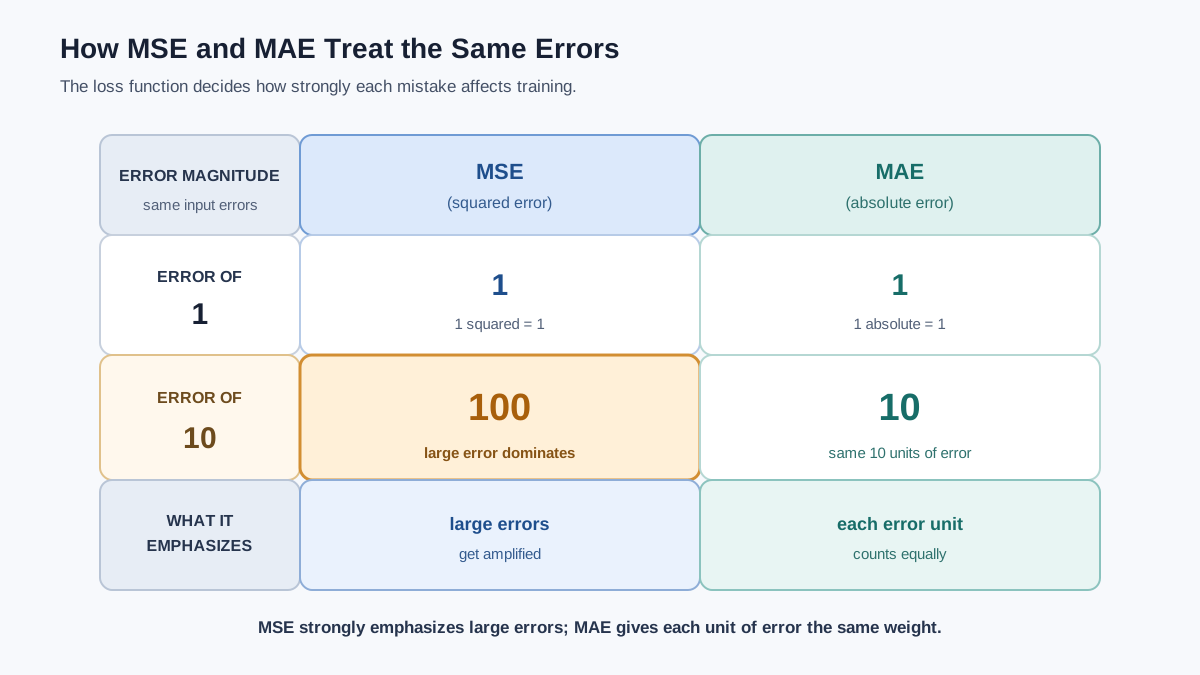
For regression problems—predicting continuous values like prices, temperatures, or ages—the most common loss is the mean squared error (MSE). It does exactly what its name says: average the squared differences between predictions and true values.
Squaring does two jobs. First, it removes the sign problem. If you just added up raw errors, a prediction that's 5 too high and one that's 5 too low would cancel out to zero. The model would look perfect while being wrong on every example. Squaring makes every error positive, so nothing cancels.
Second, and more importantly, squaring amplifies large errors. An error of 2 becomes a penalty of 4. An error of 10 becomes a penalty of 100. The model feels that difference acutely. It will work hard to avoid big misses, even if that means accepting several small ones.
Here's a concrete example. Suppose your model makes four predictions with errors of 1, 1, 1, and 10. The squared errors are 1, 1, 1, and 100. The average is about 26. That single large error dominates the loss. The model will reshape itself to avoid that kind of miss, even if it means the other predictions get slightly worse.
The alternative, mean absolute error (MAE), treats every unit of error equally. An error of 10 is penalized exactly ten times an error of 1, no more. That makes MAE less sensitive to outliers. If your data contains extreme values that are noise rather than signal, MAE won't chase them the way MSE will.
So which should you use? My rule is simple: choose MSE when big misses are genuinely costly, and choose MAE when outliers are noise you don't want the model to chase. If you're predicting house prices and a $100,000 miss is more than ten times as bad as a $10,000 miss, MSE matches your judgment. If your data has a few wild values that would distort the model, MAE keeps them from taking over.
Knowledge check
Check your understanding
Answer this question before you continue.
Classification Losses: Punishing Wrong Confidence, Not Just Wrong Answers
Classification problems need a different kind of loss, because the model isn't just producing an answer—it's producing a probability.
Think about a spam filter. The model doesn't just say "spam" or "not spam." It outputs something like "97% confident this is spam" or "51% confident this is spam." Both get classified as spam, but they're very different predictions. The first is reliable. The second is a coin flip.
A loss that only counts right versus wrong answers ignores that distinction entirely. It treats a confident correct guess and a hesitant correct guess as identical. That wastes information and gives the model no signal about how to improve its confidence.
Log loss (also called binary cross-entropy) fixes this. It penalizes a confident wrong prediction far more than a hesitant one, and it rewards confident correct predictions. A spam filter that's "right" but only barely isn't useful—you want a filter that knows when it knows. Log loss encodes that preference into the training signal.
This is why classification models are trained with log loss rather than squared error, even though you could compute either one. Squared error treats a probability of 0.9 versus 0.6 as a small difference. Log loss treats them as very different levels of certainty, and it pushes the model toward genuine confidence.
Knowledge check
Check your understanding
Answer this question before you continue.
How the Loss Choice Shapes Model Behavior
Here's the decision-oriented view: the loss function is a policy statement. It's where you encode what a mistake costs you.
In regression, consider what happens when overestimating and underestimating carry different real-world costs. If you're predicting inventory demand, underestimating means stockouts and lost sales. Overestimating means extra warehouse costs. Those aren't symmetric. A standard loss treats them as equal, but your business doesn't. Advanced loss functions can penalize one direction more heavily—but that's a customization you reach for only when you can name the specific asymmetry.
Classification has the same issue. A medical screening model and a spam filter face very different costs for false positives and false negatives. Missing a disease is catastrophic. Flagging a healthy patient for extra tests is inconvenient. A spam filter that deletes a legitimate email causes real harm; one that lets a spam email through is merely annoying. Standard losses treat these errors symmetrically, but your application doesn't.
That said, don't overcomplicate things at the start. Most libraries default to sensible losses: squared error for regression, log loss for classification. Those defaults exist because they work well across a wide range of problems. Start with them. Only reach for alternatives when you can name the specific error you want to tolerate or avoid.
Note: The loss function is not the same as an evaluation metric. Loss guides training—it's the signal the model optimizes. Metrics are how you judge the finished model. You'll use metrics like accuracy or error rates to decide whether the model is good enough, but those aren't what the model trains on.
Common Beginner Mistakes and How to Recover
A few confusions trip up nearly everyone learning about loss functions. Here's how to spot and fix them.
Treating loss as a report card. Loss is a training signal, not a judgment of quality. A low loss on training data can hide overfitting—the model memorizing the training set instead of learning general patterns. That's a problem for evaluation, not for the loss function itself.
Comparing loss values across problems. A squared error of 4 and a log loss of 0.3 mean completely different things. They're measured on different scales with different units. You can't compare them, and you shouldn't try. The only meaningful comparison is the same loss function on the same problem over time.
Chasing a loss of zero. A perfect training loss usually signals memorization, not learning. If your model hits exactly zero on training data, be suspicious. Real-world data has noise, and a model that reproduces every training example perfectly has probably learned the noise along with the signal.
Confusing loss with evaluation. The loss function shapes what the model learns. The evaluation metric tells you whether what it learned is useful. They serve different jobs, and keeping them separate will save you hours of confusion when you tune models later.
Your Next Step
When you frame a machine learning problem, start by naming the error you most want to avoid. Then pick the loss that punishes it. That single decision shapes everything the model becomes.
Here's a concrete experiment to make this stick: take a small regression dataset with a few outliers and fit a model twice—once with squared error and once with absolute error. Watch how the fitted line moves. The squared error model will bend toward the outliers. The absolute error model will ignore them. You'll see the loss function's personality in action.
And when you're ready to judge whether a finished model is actually good, you'll turn to evaluation metrics—not loss. The loss got the model there. The metrics tell you whether the trip was worth it.
Knowledge check
Final check
Finish the article by checking the ideas you just learned.
References
Research updated Sep 8, 2026


