
The Bias–Variance Tradeoff: Why Models Miss in Different Ways
Two models can post nearly identical test scores and still fail for opposite reasons. One misses because it never learned the pattern. The other misses…

Key topics
Two models can post nearly identical test scores and still fail for opposite reasons. One misses because it never learned the pattern. The other misses because it learned the noise too well. The fix for the first makes the second worse—and the fix for the second makes the first worse. That tension is the bias–variance tradeoff, and for classical model debugging, it is the most useful first lens you can carry.
Two Models, Two Opposite Ways to Miss
Imagine you train two models on the same housing dataset. Model A is a plain linear regression. Model B is a deep decision tree with no limits on its depth. Both land at roughly the same validation error. If you only compare scores, they look like equivalent choices.
They are not equivalent. They are failing in opposite directions.
Model A never captured the curved relationship between house size and price. It misses everywhere, systematically, because its assumptions are too rigid. Model B memorized every training house down to the last quirk—including the one buyer who overpaid because they loved the paint color. It will stumble on new data because it learned details that do not generalize.
This is the core reframe: bias and variance are not just fancy labels for underfitting and overfitting. They are two distinct sources of error with opposite remedies. Name the failure mode before you choose the fix. Pull the wrong lever and you will make the problem worse.
The Error Budget: Bias, Variance, and Noise
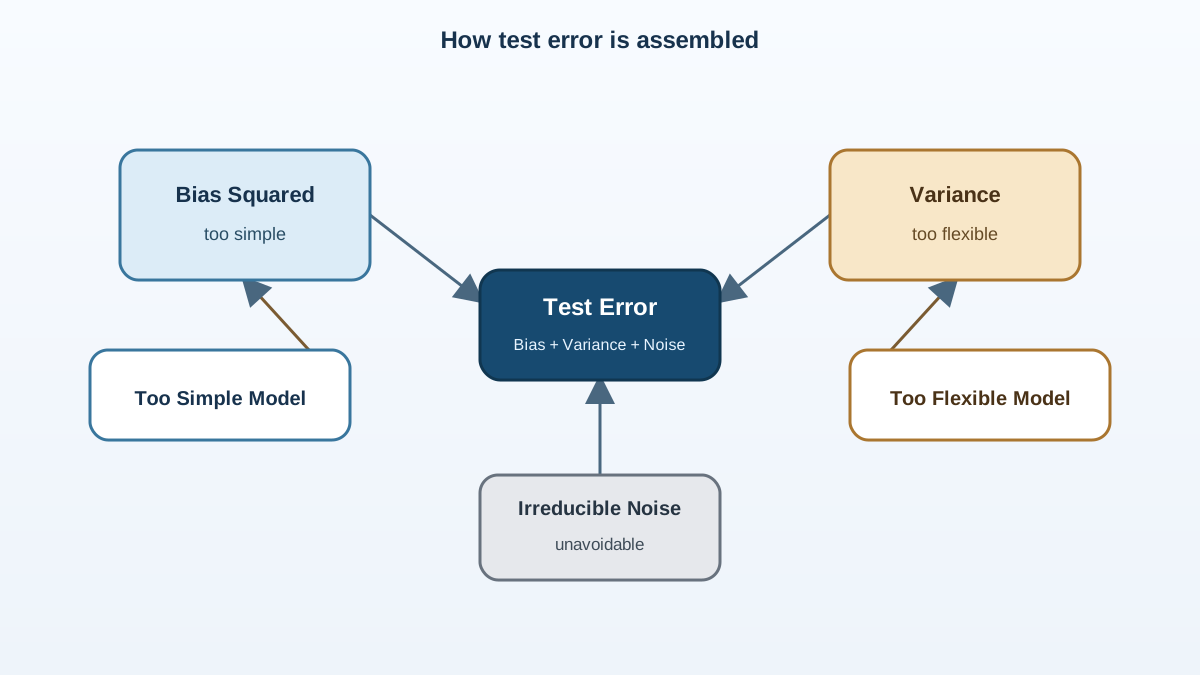
Every model's error on new data comes from three sources. Think of them as an error budget you can reason about.
Bias is systematic error from wrong assumptions about the relationship in your data. If the true pattern is curved and your model can only draw straight lines, it will be wrong in a consistent, predictable way. No amount of retraining fixes a wrong assumption.
Variance is how much your predictions shift when you retrain on a different sample of the same data. A high-variance model is unstable: train it on one slice of your data and it draws one shape; train it on another slice and it draws a different shape. The model is not discovering a stable pattern—it is chasing whatever happened to be in each training set.
Irreducible noise is the part no model can remove because it lives in the data itself. Some buyer overpays. Some sensor reads high. Some click does not reflect intent. This randomness is not your model's fault, and no amount of tuning will eliminate it.
Formally, total error decomposes roughly as bias squared plus variance plus irreducible noise. The math matters less than the budget idea: every modeling choice spends error somewhere. A simpler model spends more on bias. A more flexible model spends more on variance. The noise is the tax you cannot avoid.
High Bias: The Model That Cannot Reach the Pattern
High bias means your model lacks the capacity to represent the true pattern. It is not making a small mistake. It is structurally unable to see what is there.
The likely signature: both training error and validation error stay high, and they stay close together. The model performs poorly on data it has already seen. That is the tell. A model that cannot fit its training data is not overfitting anything—it is underpowered.
Picture fitting a straight line to a curved relationship. The line misses the curve's rise, misses its bend, and misses its flattening. It is wrong in the same way everywhere, like a ruler pressed against an arch. More data will not help by itself. A ruler is still a ruler no matter how many points you lay along the arch.
This is where beginners make a critical mistake: they treat low training error as the only goal. But training error is not the destination. A model that cannot reach the pattern on training data has no hope of reaching it on new data. The fix is not more data. The fix is more capacity—a more flexible algorithm, better features, or a model that can represent the relationship you suspect exists.
Knowledge check
Check your understanding
Answer this question before you continue.
High Variance: The Model That Memorizes the Noise
High variance is the harder failure to spot because the model looks fantastic on training data. That is exactly the problem.
The likely signature is a wide gap: training error very low, validation error much higher. The model has learned the training set so thoroughly that it memorized the noise along with the signal. Every random fluctuation, every outlier, every accident of that particular sample became part of the model's understanding of the world.
The same flexible model trained on a fresh sample would produce very different predictions. That instability is the definition of variance. It is not just a poor test score. It is a model that has no settled opinion about the underlying pattern because it is too busy conforming to whatever data it last saw.
Think of a very flexible curve wiggling through every training point. It nails the training data with theatrical precision. Then it meets new data and flails, because the wiggles were never real structure—they were the shape of one particular sample's noise.
The two failure signatures side by side:
| Symptom | Likely cause | What the model is doing |
|---|---|---|
| Training error high, validation error similarly high | High bias | Cannot represent the pattern |
| Training error very low, validation error much higher | High variance | Memorized the training noise |
One important boundary: these signatures are working hypotheses, not proof. A single training run and one validation split cannot directly measure formal bias or variance—true variance only shows up across many different training samples. A wide gap can also be amplified by a small or unrepresentative validation set, and high errors can come from weak features or a leaky evaluation setup. Treat the signature as a clue, then test it with a controlled experiment before you commit to the diagnosis.
Knowledge check
Check your understanding
Answer this question before you continue.
The Tradeoff Curve and the Sweet Spot
Here is the tension that makes this a tradeoff rather than a checklist. As model complexity rises, bias falls—the model can finally represent the pattern. But variance climbs—the model starts chasing noise. The two move in opposite directions.
Plot total error against complexity and you get a U-shape. On the left, the model is too simple: high bias dominates, total error is high. On the right, the model is too complex: high variance dominates, total error is high again. Somewhere in the middle, the two balance and total error on unseen data reaches its lowest point.
That sweet spot is not where training error is lowest. Training error keeps falling as complexity rises, all the way to the right edge of the chart. The sweet spot is where error on new data is lowest—the point where the model has enough capacity to capture the real pattern but not so much that it memorizes the noise.
One honest caveat: very large modern neural networks sometimes break the classical U-shape, and researchers have shown that variance can fall again in some over-parameterized regimes. But for the classical scikit-learn toolkit—linear models, trees, forests, regularized regressions—the classical curve is a reliable guide. Treat the tradeoff as the working model for the tools you will actually use here.
Knowledge check
Check your understanding
Answer this question before you continue.
Diagnosing Your Own Model: Which Failure Is It?
You already know how to read training versus validation error from earlier work on overfitting and underfitting. Now use that reading to name the likely failure mode before you touch any knobs.
Run this sequence:
- Check training error first. Is the model even fitting the data it has seen?
- Check the gap to validation error. How much worse does the model do on unseen data?
- Name the likely failure mode. Then choose the remedy.
- Test the diagnosis with one controlled experiment. Hold your split and metric fixed, change one lever, and read what happens.
If both errors are high and close together, high bias is the likely culprit. Add capacity: try a more flexible algorithm, engineer better features, or reduce constraints that are forcing simplicity. Then watch the validation error. If it drops as the model finally fits the training data, bias was indeed limiting you.
If training error is low but validation error is much higher, high variance is the likely culprit. Simplify the model, add regularization, or get more training data. Bagging is a proven variance reducer: averaging many trees fit on bootstrap samples slightly increases bias while cutting variance enough to lower total error overall. If regularization or bagging narrows the gap and improves validation error, variance was the problem.
If both errors are low and close together, you are probably near the sweet spot for this evaluation setup. Stop tuning. Further complexity will buy you nothing except variance. Just confirm your split and metric are trustworthy before you walk away—an easy validation set can flatter any model.
The trap is tuning complexity without first naming the failure mode. If you regularize a high-bias model, you make it simpler and push it further from the pattern. If you add capacity to a high-variance model, you give it more room to memorize noise. Both moves make the problem worse. Diagnosis first, then the lever.
Knowledge check
Check your understanding
Answer this question before you continue.
Where the Tradeoff Helps and Where It Breaks Down
The bias–variance tradeoff is a diagnostic lens, not a law that dictates every choice. Use it to name failure modes and choose experiments. Do not treat it as a precise formula for picking model complexity.
Two boundaries are worth keeping in mind.
First, parameter count is a poor measure of complexity. A model with very few parameters can still overfit badly if those parameters allow wild oscillations. Complexity is about how flexibly the model can contort itself to the data, not how many numbers it stores.
Second, the classical U-shape does not hold everywhere. Modern over-parameterized models sometimes generalize better as they grow, complicating the story. That research matters for deep learning. For the classical models this site teaches—the scikit-learn workhorses—the classical tradeoff remains the right mental model.
The durable takeaway survives all boundaries: name the failure mode before choosing the fix.
Before you tune another model, run the diagnostic. Check training error. Check the gap to validation error. Form a hypothesis about whether you are fighting bias or variance. Then pull the lever that matches the diagnosis and let the validation result confirm or overturn your guess. That habit will save you more hours than any hyperparameter trick, because it tells you which experiment actually has a chance of working.
Knowledge check
Final check
Finish the article by checking the ideas you just learned.
References
Research updated Sep 8, 2026


