
Bagging vs Boosting: Two Ways Ensembles Improve Weak Models
If you already understand decision trees, you know the dilemma: a deep tree memorizes the training data and fails on new data, while a shallow tree is too…

Key topics
If you already understand decision trees, you know the dilemma: a deep tree memorizes the training data and fails on new data, while a shallow tree is too timid to capture anything interesting. Both bagging and boosting solve this by combining many trees into one stronger model—but they attack different failure modes, and confusing the two leads to predictable tuning disasters.
The difference is not "more trees." It's how the trees are built and combined.
Two Names, One Question: Why Combine Trees at All?
A single decision tree faces a tradeoff you have likely felt already. Crank the depth up and the tree carves increasingly fine partitions until it has essentially memorized the training set—high variance, low bias. Keep it shallow and the tree makes simple, stable splits that miss real patterns—low bias, high variance.
Ensembles exist to escape this dilemma. But here is where beginners get stuck: bagging and boosting both combine many weak learners into one stronger model, so they sound like two recipes for the same dish. They are not.
Bagging reduces variance by averaging independent models. Boosting reduces bias by sequentially correcting error.
That one sentence is the entire article in miniature. Everything else—how you set hyperparameters, when you worry about overfitting, which algorithm you reach for first—follows from whether you are averaging away noise or chasing down mistakes.
Bagging: Train in Parallel, Average the Noise Away
Bagging, short for bootstrap aggregating, starts with a simple trick. Instead of training one deep tree on your full dataset, you create many bootstrap samples: random subsets drawn with replacement, meaning some rows appear multiple times and others get left out. Each sample gives a tree a slightly different view of the data.
Those trees train independently, in parallel, with no knowledge of each other. When it is time to predict, you average their outputs for regression or take a majority vote for classification.
Why does this work? A single deep tree overfits, but it overfits in a particular way. Another deep tree, trained on a different bootstrap sample, overfits in a different way. When you average many such trees, the idiosyncratic errors tend to cancel out while the genuine signal—the pattern present in most samples—survives.
Random forest is bagging plus one crucial addition: at each split, only a random subset of features is considered. This further decorrelates the trees. If every tree could pick the same dominant feature first, their errors would be correlated, and averaging correlated errors does not cancel them. Feature randomness forces the trees to disagree more, which makes the averaging work better.
The practical signature of bagging is its forgiveness. Add more trees and performance improves, then plateaus. It rarely degrades. A random forest with 500 trees is not meaningfully worse than one with 50—it just takes longer to train. This makes bagging a sensible first ensemble when your single tree overfits and you want a reliable improvement without much tuning.
Note: Bagging works best with strong, complex base learners—deep trees that individually overfit. If your base trees are already shallow and underfitting, averaging them will not fix the problem.
Knowledge check
Check your understanding
Answer this question before you continue.
Boosting: Train in Sequence, Correct the Last Mistake
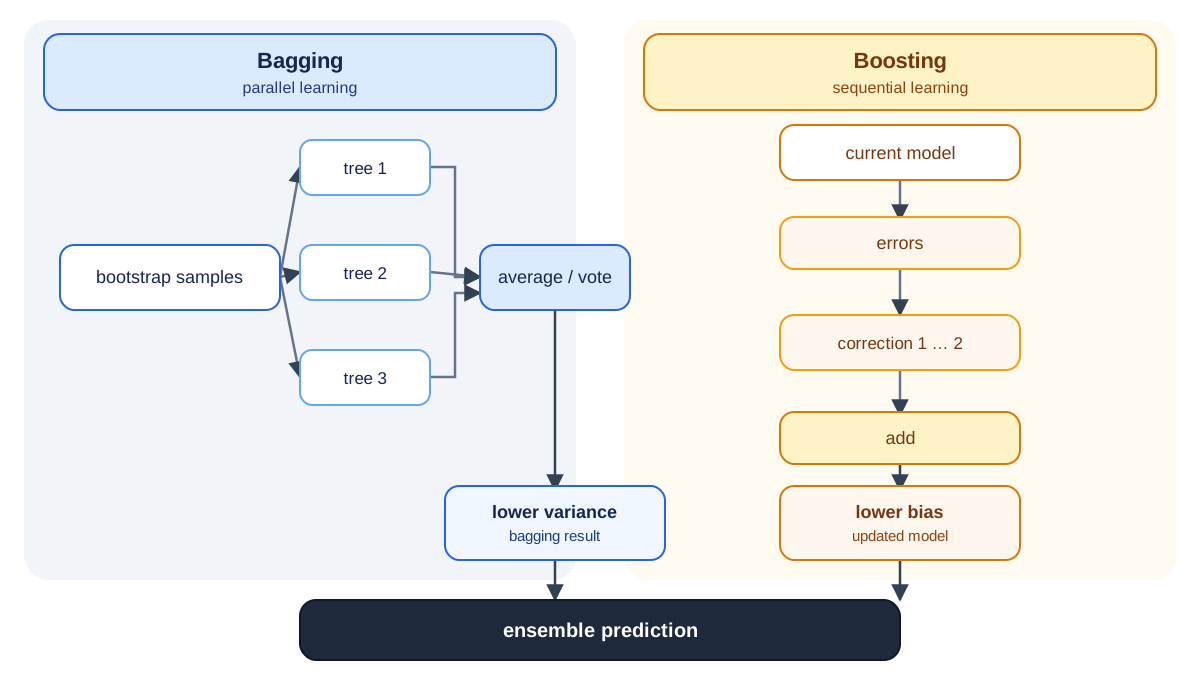
Boosting takes the opposite path. Instead of training trees independently, it builds them one at a time, and each new tree focuses on what the current ensemble still gets wrong.
Early boosting algorithms like AdaBoost did this by reweighting training samples: misclassified points got heavier weights, forcing the next weak learner to pay more attention to them. Modern gradient boosting reframes the idea. At each step, a new shallow tree is trained to predict the residual error of the current model—the difference between the true labels and the ensemble's current predictions for regression problems. That correction is then added to the model, and the process repeats.
One boundary worth keeping straight: "focus on errors" is the shared intuition across boosting methods, not an identical training procedure. AdaBoost changes how much each sample matters; gradient boosting fits a loss-specific correction that is easiest to picture as a residual when your target is numeric. For classification, the correction is computed through the loss function rather than a literal label-minus-prediction difference.
The trees in boosting are typically shallow—often just a few levels deep. Each one is a genuinely weak learner that captures a small piece of the pattern. The ensemble's strength comes from the accumulation of many small corrections, not from any individual tree.
Two hyperparameters control this dance. The learning rate (also called shrinkage) scales each correction before it is added. A small learning rate, like 0.01 or 0.1, means each tree contributes only a tiny adjustment, so the model builds its understanding gradually. The number of estimators determines how many correction rounds occur.
Here is the critical difference from bagging: boosting can overfit if you push it too far. Each new tree is trained to fix the errors the current model makes on the training data. Keep adding iterations and the ensemble will eventually start chasing noise—fitting the training set ever more precisely while generalization degrades. The performance curve is often not a plateau; it can rise, peak, and fall. More iterations help, then hurt.
Common mistake: Cranking up boosting iterations without lowering the learning rate. These two knobs work together. If you want more trees, shrink the learning rate to compensate, or you will watch validation error climb back up.
Knowledge check
Check your understanding
Answer this question before you continue.
The Mechanism Table: Bagging vs Boosting at a Glance
| Dimension | Bagging | Boosting |
|---|---|---|
| Training style | Parallel, independent | Sequential, each tree learns from the last |
| Primary tendency | Reduce variance | Reduce bias |
| Base learner preference | Deep trees that overfit individually | Shallow trees that underfit individually |
| How trees see the data | Bootstrap samples with replacement | Full dataset, with focus shifted to errors |
| Combination method | Averaging or majority vote | Weighted sum of corrections |
| Overfitting tendency | Often plateaus; rarely degrades with more trees | Can degrade sharply if pushed too far |
| Sensitivity to noise | Often less sensitive; averaging dilutes individual outliers | Can emphasize outliers and noisy labels |
| Typical tuning levers | Number of trees, tree depth | Learning rate, tree depth, number of estimators |
The noise sensitivity row deserves emphasis—with one qualification. Bagging does not make noisy labels disappear. An influential outlier can still affect many bootstrap-trained trees. But because each tree sees a slightly different sample, the averaging tends to dilute any single anomalous point's influence. Boosting, by contrast, actively seeks out hard cases—and an outlier is, by definition, hard to fit. Left unchecked, boosting can spend its capacity memorizing noise that does not generalize.
Knowledge check
Check your understanding
Answer this question before you continue.
When the Distinction Changes Your Model Choice
The bagging vs boosting distinction stops being academic the moment you look at your validation curve and ask, "What do I do now?"
Start by diagnosing your single tree's failure mode—but treat that diagnosis as a hypothesis, not a verdict. If a deep tree overfits badly—great training performance, poor validation performance—you likely have a variance problem. Bagging is a natural first response. A random forest will often give you a solid improvement with minimal tuning risk. This is why random forest is the classic baseline: it rarely hurts, and it tells you what a reasonable ensemble should achieve.
If your model underfits—poor performance on both training and validation—you likely have a bias problem. Bagging will not save you. Averaging deep trees that are systematically wrong produces a forest that is systematically wrong. This is a reasonable case for trying boosting. On a dataset where the signal is learnable, boosting can squeeze out accuracy that bagging cannot reach, because it keeps refining the model where it matters.
But notice the hedge in that paragraph. An underfit single tree does not automatically mean boosting is the right next model. The tree may be too shallow, the features may be uninformative, or the problem may need a different representation entirely. The bias-variance labels are a starting point for choosing an experiment, not a guarantee of the outcome.
The tell is in the behavior. Bagging often plateaus gracefully; boosting rewards attention and punishes neglect. If you can afford tuning time, boosting is often the stronger tool. If you need a reliable improvement fast, or your data has known label noise, bagging is the safer bet.
My practical rule: start with a random forest baseline, then try boosting when you need more accuracy and can afford the tuning time. The baseline tells you what a variance-reduction approach achieves; the boosting experiment tells you whether sequential error correction buys anything on your data.
Knowledge check
Check your understanding
Answer this question before you continue.
Common Mistakes Beginners Make
Mistake 1: Assuming boosting always beats bagging. Boosting's reputation for winning competitions obscures its conditions. It excels on clean data with careful tuning. On noisy data, or with default hyperparameters, it can underperform a well-configured random forest.
Mistake 2: Cranking up boosting iterations without lowering the learning rate. These two hyperparameters are a coupled system. A high learning rate with many iterations means large corrections compounding—a recipe for overfitting. Lower the learning rate first, then add trees.
Mistake 3: Expecting bagging to fix a bias problem. If your model is systematically wrong, averaging will not help. Bagging primarily reduces variance; it does not address underfitting. Diagnose the failure mode before choosing the ensemble.
Mistake 4: Treating noise sensitivity as a fixed property instead of a symptom to check. Boosting can emphasize noisy labels and outliers, but its actual behavior depends on the loss function, tree depth, learning rate, and stopping point. The warning sign to watch for is a widening gap: training loss keeps improving while held-out performance stalls or worsens. When you see that, check your data and your stopping strategy before blaming the algorithm.
Each of these mistakes shares a root cause: treating bagging and boosting as interchangeable "more trees" recipes instead of tracking which failure mode each ensemble targets.
The Decision Rule
Diagnose first, then choose. Does your single tree overfit? Try bagging. Does it underfit? Try boosting. Is your data noisy? Bagging is often the safer start. Is it clean and do you need maximum accuracy? Boosting may earn the tuning time.
Then run the experiment fairly. Train a random forest and a gradient-boosting model on the same data, using the same cross-validation split and comparable preprocessing. Watch how their validation curves behave as you add estimators. Bagging often shows diminishing returns; boosting may show a clearer stopping point. But treat those curves as hypotheses to inspect, not scripts to expect. If your boosting model does not show an inverted-U curve, that is not a bug—it may mean the learning rate is small enough, the trees are shallow enough, or the dataset is large enough that overfitting has not caught up yet.
The deeper mechanics of gradient boosting—how it fits trees to residuals, how learning rate and depth interact, and why the algorithm behaves the way it does—deserve their own careful treatment. For now, hold onto the core distinction: bagging averages away noise in parallel; boosting corrects mistakes in sequence. Everything else is tuning.
Knowledge check
Final check
Finish the article by checking the ideas you just learned.
References
Research updated Sep 8, 2026


