
Decision Tree Pruning Explained: Control Complexity Before the Tree Memorizes
Your decision tree scores 98% on training data. On new data, it drops to 74%. The tree didn't fail because it wasn't smart enough. It failed because it was…

Key topics
Your decision tree scores 98% on training data. On new data, it drops to 74%. The tree didn't fail because it wasn't smart enough. It failed because it was too thorough.
An unconstrained decision tree will keep splitting until leaves are very small or locally pure on the training data. It will happily carve the feature space into tiny boxes that each hold a handful of points—including the noise. The result is a tree that has memorized your training set instead of learning the patterns that generalize.
This is decision tree overfitting, and the fix is pruning: deliberately cutting the tree back so it keeps the rules that matter and drops the branches that memorize noise.
Why Your Tree Keeps Growing Until It Memorizes
Here's the symptom you've probably seen: training accuracy near perfect, validation accuracy disappointing. The gap between those two numbers is the tree's memorization showing.
The mechanism is straightforward. A decision tree builds itself by repeatedly splitting data into smaller groups. Nothing tells it to stop when the splits stop being useful. The default behavior is to keep partitioning until leaves hold only one or a few training points, each leaf nearly pure on the training data.
That sounds like precision. It's actually the tree learning the training set's accidents—the one odd customer, the single unusual transaction, the noise that happened to correlate with your target in this particular sample.
There's a deeper reason the tree can't self-correct. At any given node, the algorithm only sees the data in front of it. It cannot tell whether the next split will help on new data or just carve deeper into noise. This limitation has a name: the horizon effect. The tree literally cannot see past the current split to know whether more depth will generalize.
Think of each split as a bet. A split that separates a real pattern in the data pays off on new examples. A split that separates noise only pays off on the training set. The tree has no built-in way to tell which bet it's making, so it keeps betting until it runs out of data.
That's the core tension you're managing: partition detail buys training fit, but beyond a point it costs generalization. And it costs interpretability too—a tree with hundreds of leaves is no longer something you can explain to anyone.
Knowledge check
Check your understanding
Answer this question before you continue.
Pre-Pruning: Stop the Tree Before It Overgrows
Pre-pruning, also called early stopping, means applying rules during training that halt growth before the tree gets too deep. You're not letting the tree grow fully and then cutting back. You're setting limits on how far it's allowed to grow in the first place.
Scikit-learn gives you several knobs for this. The most intuitive is max_depth, which caps how many sequential splits any path can take. A tree with max_depth=3 can only ask three questions in a row before it must make a prediction. This directly controls tree depth in machine learning terms: fewer levels means simpler rules, but also less ability to capture complex structure.
The other two common controls work on sample counts. min_samples_split requires a node to contain at least a certain number of samples before it's allowed to split. min_samples_leaf requires every leaf to contain at least a certain number of samples after a split. These prevent the tree from making splits that isolate tiny groups of points.
Here's a concrete example. Say you have a noisy feature that happens to separate two training points from the rest. Without constraints, the tree will happily split on that feature, creating a leaf with two samples. With min_samples_leaf=10, that split is forbidden—there aren't enough samples to justify the new leaf.
The tradeoff with pre-pruning is real. Set max_depth too low and you get a tree too shallow to capture actual structure in your data. That's underfitting, and it's just as bad as overfitting. The tree becomes a blunt instrument that misses real patterns because you stopped it too early.
Pre-pruning is fast and simple. It's often the first thing beginners reach for, and that's reasonable. Just remember: you're making a judgment call about where the signal ends and the noise begins, and you need validation data to check that judgment.
Knowledge check
Check your understanding
Answer this question before you continue.
Post-Pruning: Grow a Large Tree, Then Cut Back
Post-pruning takes the opposite approach. Allow the tree to grow large—even to the point of memorizing training details—then remove the branches that don't earn their keep.
The main post-pruning method in scikit-learn is minimal cost-complexity pruning, controlled by a parameter called ccp_alpha. The idea is elegant. Every leaf in the tree adds complexity, so every leaf gets charged a small cost. A branch survives only if the impurity it removes justifies the cost of keeping its leaves.
Think of it like editing a long piece of writing. You write a full draft first, then cut every sentence that doesn't pull its weight. You can't know which sentences matter until you see the whole piece.
The math works like this: each subtree has a cost-complexity score that combines its impurity with a penalty for the number of leaves. As ccp_alpha increases, the penalty per leaf grows, and more branches become too expensive to keep. The algorithm prunes the weakest branches first—the ones whose impurity reduction is smallest relative to their leaf count.
The key question is how to choose ccp_alpha. You don't guess it. You use validation data or cross-validation to test different values and watch which one produces the best error on data the tree hasn't seen. As ccp_alpha increases, training error will rise—that's expected. The value you want is the one where validation error is lowest, before the tree gets so small it starts underfitting.
Post-pruning has a real advantage: it can inspect a large candidate tree before making cuts. A branch that looks useless early might become valuable once you see the broader structure. Post-pruning gets to make that judgment with more information.
But post-pruning is not automatically better. It costs more computation—you build the full tree first, then evaluate multiple pruning levels. And on some datasets, a well-chosen pre-pruning rule will give you the same result with far less work. Think of the two approaches as different strategies, not as a weak option and a strong option.
Knowledge check
Check your understanding
Answer this question before you continue.
Choosing the Right Control for Your Tree
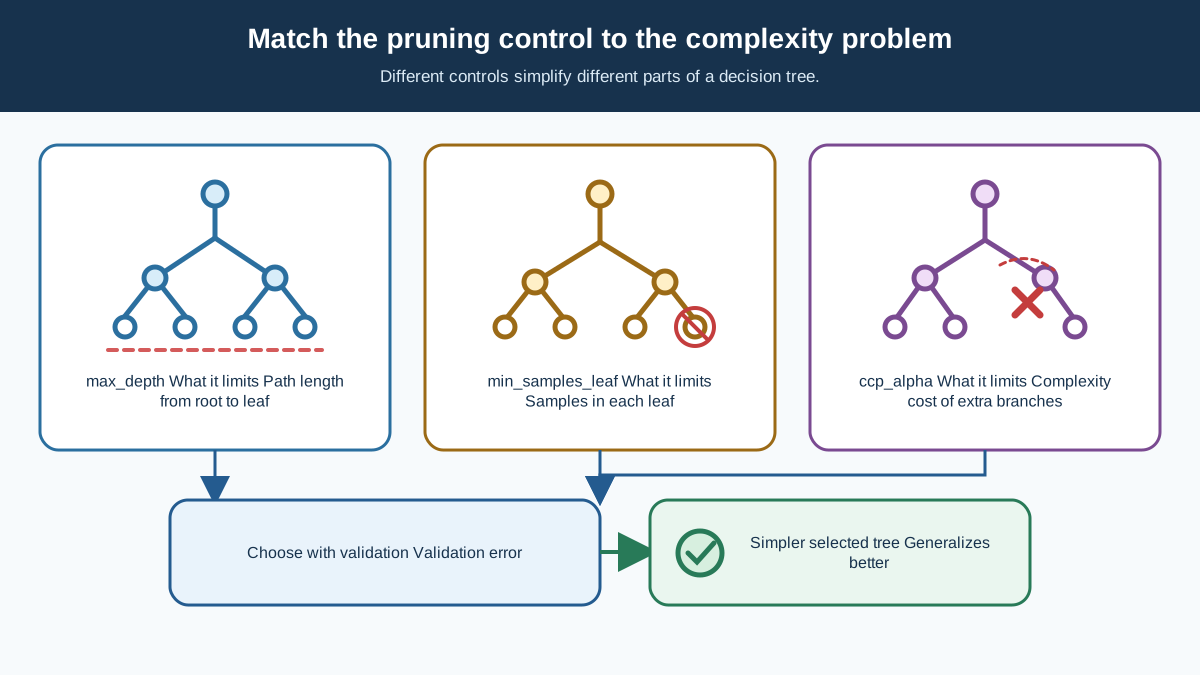
You now have several tools. Which one do you reach for? Instead of treating them as interchangeable knobs, ask what each control actually constrains:
max_depthcaps rule length. Use it when you want to limit how many questions any prediction path can ask. This is the clearest control when you care about keeping rules short enough to explain.min_samples_leafprevents tiny predictions. Use it when you want every leaf to represent a meaningful number of training examples. This is the most direct guard against splits that isolate a handful of points.ccp_alphacharges for complexity. Use it when you want to compare a sequence of subtrees and let validation data choose the balance between impurity and leaf count.
These controls can produce different-shaped trees even when their validation scores are similar. max_depth=4 and min_samples_leaf=20 might both give you 81% validation accuracy, but one tree might have balanced branches while the other has a few long paths. When scores are close, prefer the simpler tree—the one with fewer leaves or shorter rules—because it will be easier to explain and less likely to depend on accidents of the training sample.
My default advice: start with max_depth or min_samples_leaf when you want quick, understandable control. These are simple to reason about and easy to explain. Reach for ccp_alpha when you want to search across a spectrum of tree sizes and let validation data pick the cutoff.
Whichever control you use, one habit matters more than any parameter choice: judge your tree by validation error, never by training accuracy. Training accuracy will always look good on an overgrown tree. That's the point. Validation gives you evidence about whether the tree actually learned something useful.
Note: Validation is evidence, not an infallible witness. A single validation split can be noisy, especially with limited data. If your results look erratic, use cross-validation or repeat the split a few times to see whether the pattern holds. And remember the direction: higher accuracy is better, lower error is better.
There's a second payoff to pruning that beginners often miss: interpretability. A pruned tree has fewer rules to read and explain. When you need to present a model to stakeholders or understand it yourself, a tree with twenty leaves beats a tree with two hundred. Pruning isn't just about accuracy—it's about keeping the model comprehensible enough to trust.
One important note: these pruning rules apply to single decision trees. Random forests and gradient boosting handle complexity differently. In a random forest, individual trees are typically left unpruned because the ensemble averages away their individual overfitting. Boosting uses shallow trees by design and controls complexity through learning rate and tree count. If you're working with ensembles, the pruning playbook changes.
Knowledge check
Check your understanding
Answer this question before you continue.
Common Pruning Mistakes Beginners Make
Let me save you the debugging sessions I've watched beginners run into.
Mistake 1: Tuning against training accuracy. If you're comparing trees by their training scores, you're rewarding the tree that memorizes best. Always compare on validation data. This is the single most common error, and it produces exactly the overfitting you're trying to fix.
Mistake 2: Setting max_depth so low the tree underfits. I've seen beginners set max_depth=2, watch validation accuracy drop, and conclude decision trees are weak models. The tree wasn't weak—it was strangled. Start with a depth that captures reasonable structure, then work downward while watching validation error.
Mistake 3: Expecting one setting to work everywhere. The right max_depth or ccp_alpha depends on your data size, your number of features, and how noisy your target is. A setting that works on a clean 10,000-row dataset may badly overfit a noisy 200-row dataset. Treat these parameters as something you tune per dataset, not something you memorize once.
Mistake 4: Forgetting that a pruned single tree is still a single tree. Pruning reduces variance, but a single tree remains sensitive to small changes in training data. If your tree still seems unstable, the next step isn't more aggressive pruning—it's an ensemble like a random forest, which averages many trees to smooth out that instability.
The recovery pattern for all of these is the same: change one control at a time, watch validation error, and keep the tree readable enough to explain.
The Next Experiment
Here's your concrete next step. Pick one dataset you know well. Grow an unconstrained decision tree and record the gap between training and validation accuracy. That gap is your baseline overfitting measure.
Now apply one complexity control at a time. Set max_depth to a range of values and plot validation error against depth. Then try min_samples_leaf. Then try ccp_alpha and watch how the tree shrinks as the penalty increases.
The pattern you'll usually see: validation error falls as the tree gains useful structure, bottoms out, then rises as the tree starts memorizing noise. But don't expect a perfectly smooth curve every time. With a small dataset, the curve may look jagged or flat across several settings. When that happens, don't hunt for the single perfect value—pick a setting near the flat bottom and prefer the simpler tree.
Pruning isn't about making the tree smaller for its own sake. It's about cutting the branches that memorize noise so the tree keeps the rules that generalize. Get that balance right, and your tree will finally earn its validation accuracy.
Knowledge check
Final check
Finish the article by checking the ideas you just learned.
References
Research updated Sep 8, 2026


