
Voting and Stacking Ensembles: Combine Different Models Without Losing the Plot
More models do not automatically mean a better model. An ensemble only wins when its members make different mistakes—and the way you combine them…

Key topics
More models do not automatically mean a better model. An ensemble only wins when its members make different mistakes—and the way you combine them determines whether you harvest that diversity or just average the same error three times.
If you have already tuned a few solid models—say, a logistic regression, a random forest, and a gradient-boosted tree—you have probably wondered whether you can just throw them all into one prediction machine. You can. But the machine has two very different designs, and picking the wrong one—or skipping the validation discipline stacking demands—will quietly cost you.
Why Combining Models Works (and When It Backfires)
Here is the core mechanism behind every heterogeneous ensemble: error diversity. An ensemble helps when its members fail in different ways. If three models all misclassify the same tricky samples, voting among them just reproduces the shared error with extra ceremony.
Think about it this way. A strong model plus a weak-but-different model can beat two strong-but-similar models. The weak one might catch a pattern the strong one systematically misses. When you combine them, the ensemble's blind spots shrink because the models' blind spots do not fully overlap.
This is the same logic that powers the homogeneous ensembles you have already met. Bagging creates diversity by training many trees on different bootstrap samples, then averaging to reduce variance. Boosting creates diversity sequentially, with each new learner correcting the errors of its predecessors. Voting and stacking take a different route: they combine models of different types—linear models, trees, instance-based learners—each making different assumptions about the data. The diversity comes from algorithmic family, not from data sampling or sequential correction.
The practical consequence: before you combine anything, check whether your models actually disagree. If they all make the same errors on the same rows, no combination strategy will save you.
Knowledge check
Check your understanding
Answer this question before you continue.
Voting: A Committee That Counts Opinions
Voting is the simplest way to combine heterogeneous models, and it is exactly what it sounds like: each model predicts, and the committee decides.
Hard voting is majority rule. Each model predicts one class, and the class with the most votes wins. If your logistic regression, random forest, and SVM predict "approved," "approved," and "denied," the ensemble says "approved." Simple, transparent, and completely indifferent to confidence. A model that is 51% sure and a model that is 99% sure cast identical ballots.
Soft voting averages predicted probabilities instead. Each model outputs a probability for each class, the ensemble averages them, and the class with the highest average wins. This uses confidence information that hard voting discards. But it carries an assumption: your models' probabilities are roughly comparable. If one model is well-calibrated and another confidently overpredicts, soft voting lets the loudest voice dominate the committee.
Here is the full picture. Three classifiers look at one sample. The SVM says class A with probability 0.8 and class B with 0.2. The tree says class A with 0.4 and class B with 0.6. The logistic regression says class A with 0.5 and class B with 0.5.
Hard voting picks A: two votes against one. Soft voting averages the probabilities: class A lands at (0.8 + 0.4 + 0.5) / 3 ≈ 0.57, while class B lands at (0.2 + 0.6 + 0.5) / 3 ≈ 0.43. Both methods agree here—but they will not always. When they disagree, the question is whether your models' probabilities deserve equal trust. Soft voting assumes they do; hard voting does not even ask.
Voting requires no training step beyond fitting the base models. The combiner has no learned weights—no way to decide that the tree is more reliable on this kind of sample, or that the linear model should be ignored when it hesitates. That is the source of both its simplicity and its ceiling.
Knowledge check
Check your understanding
Answer this question before you continue.
Stacking: A Manager Who Learns When to Trust Each Member
Stacking—short for stacked generalization—takes the committee metaphor one step further. Instead of counting opinions equally, you train a meta-model to learn when each base model deserves trust.
The architecture has two levels. At level 0, you train your base models: the logistic regression, the random forest, the gradient-boosted tree. At level 1, you feed their predictions as features into a meta-model that learns the best combination. The meta-model can learn weights, interactions, and conditional trust. It might discover that when the linear model is uncertain and the tree is confident, the tree is usually right. Voting could never learn that; stacking can.
Consider a concrete case. Imagine a credit-scoring problem where a logistic regression handles most applicants smoothly, but a decision tree is better on a subgroup with a sharp threshold—say, applicants with a specific combination of debt ratio and payment history. On average, the two models score similarly. But they win on different rows. Equal voting cannot exploit that: it gives both models the same say on every sample. A stacking meta-model can learn that the tree deserves more weight precisely when its prediction diverges from the linear model in a certain direction. That conditional trust is the extra capability stacking buys you.
For classification, a logistic regression is a sensible default meta-model choice. You want a simple, well-behaved combiner that learns how to weight the base models without overfitting the relationship between their predictions. A complex meta-model on top of complex base models is a recipe for memorizing noise.
The contrast with voting is sharp: voting applies a fixed rule, stacking learns one. That learning is the source of both its power and its risk. A learned combiner can squeeze more performance from complementary models—but it can also learn to trust predictions that were never honestly tested.
Knowledge check
Check your understanding
Answer this question before you continue.
Voting vs. Stacking: A Quick Comparison
| Voting | Stacking | |
|---|---|---|
| How predictions combine | Majority vote or averaged probabilities | Base predictions become features for a meta-model |
| Does the combiner learn? | No—fixed rule | Yes—trained meta-model |
| Training cost | Base models only | Base models plus meta-model, with cross-validation |
| Leakage risk | Low | High if done carelessly |
| Interpretability | Transparent | Opaque—the combination rule is learned |
| Best when | You trust your base models and want a cheap first experiment | Base models have complementary strengths worth learning |
My rule of thumb: start with voting as a cheap baseline and a diagnostic. If your base models barely improve when combined, that is a warning sign—but not a final verdict. Voting can fail to show a gain even when stacking would succeed, because equal weights are a blunt instrument. And a voting gain does not automatically mean stacking is the right next step. The honest test for stacking is whether the base models' predictions carry complementary signal that a learned combiner can exploit—which you evaluate by running a properly validated stacking comparison against your best single model and your voting baseline.
Knowledge check
Check your understanding
Answer this question before you continue.
The Leakage Trap: Why Stacking Needs Out-of-Fold Predictions
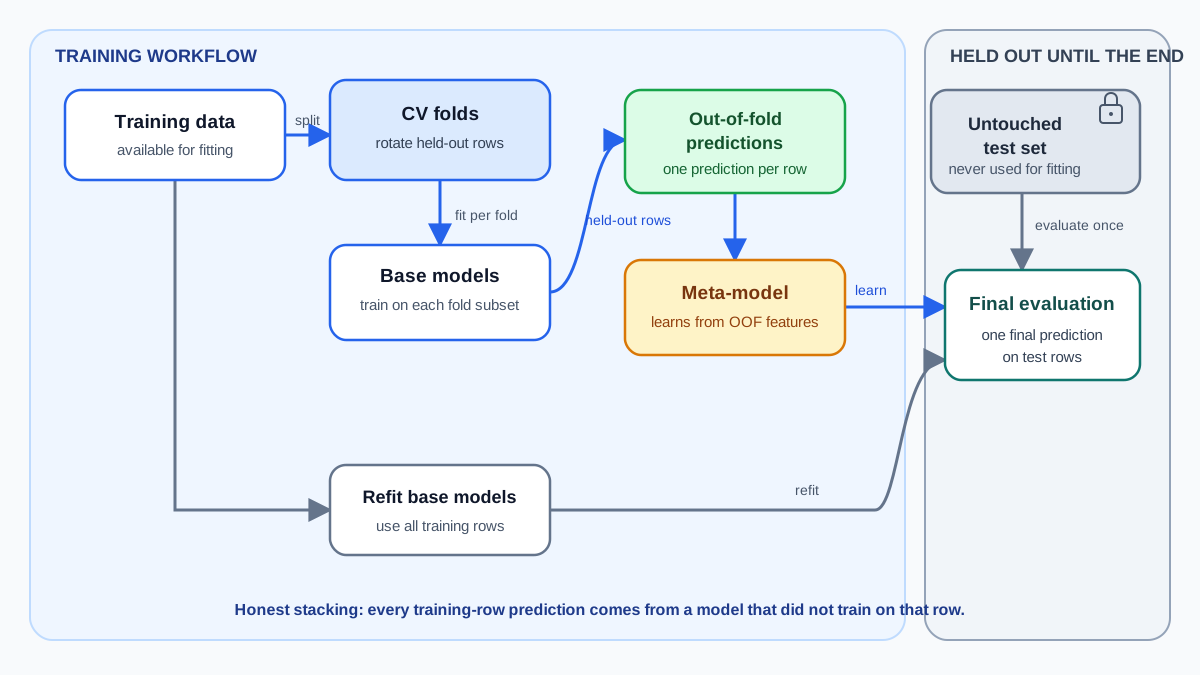
Here is where most stacking attempts quietly fail.
The meta-model learns from the base models' predictions. If those predictions came from data the base models were trained on, they are overfit predictions. The base models have already seen those rows, so their confidence on them is inflated. The meta-model learns to trust that inflated confidence—and then collapses on real data where the base models are not so sure.
The fix is out-of-fold predictions. Generate the meta-model's training features through cross-validation: split the training data into folds, train each base model on all but one fold, predict on the held-out fold, and repeat until every row has an out-of-fold prediction. The meta-model then trains on predictions the base models never saw during their own training.
The full lifecycle looks like this:
- Split off a test set once and do not touch it until the very end.
- Within the remaining training data, run cross-validation to generate out-of-fold predictions from each base model.
- Train the meta-model on those out-of-fold predictions.
- Refit each base model on the full training portion so the final ensemble uses all permitted data for inference.
- Evaluate the complete stack once on the untouched test set.
Keep your preprocessing and hyperparameter selection inside the same boundary. If you fit a scaler or tune a base model using the test set—even indirectly—you have leaked information, and your final score will flatter the ensemble.
The common beginner mistake looks like this: fit base models on the full training set, predict on that same training set, train the meta-model on those predictions, and celebrate a score that will not survive contact with real data. The ensemble looks brilliant in validation and ordinary in production.
One more warning: even honest stacking can overfit. If your meta-model is too complex or your dataset is small, the meta-model can memorize the quirks of a few out-of-fold rows. Simple meta-models and enough data are not optional extras; they are the safety margin.
When to Reach for Voting or Stacking (and When Not To)
Voting and stacking ensembles earn their complexity when you have several strong models from different families—linear, tree-based, instance-based—that each capture a different pattern in your data. That is the sweet spot: complementary strengths, not redundant competence.
Skip them when one model already dominates. If your gradient-boosted tree beats everything else by a wide margin, combining it with weaker models will only drag it down. Skip them when your base models are highly correlated—two tree ensembles with similar hyperparameters will make similar mistakes. And skip them when you need a simple, explainable deployment. A single well-tuned model is easier to audit, debug, and defend than a stacking pipeline.
Cost is real. Stacking multiplies training time—you are fitting every base model multiple times for the cross-validation pass—and adds a validation layer that demands care. On small datasets, the meta-model can overfit the limited out-of-fold rows available.
Treat voting and stacking as late-stage refinement, not a shortcut. Tune your individual models first. Understand their errors. Only then ask whether a combination adds value.
The Decision Rule
Run a quick voting experiment first. Compare each of your three best models from different families against a hard-voting and soft-voting ensemble, and inspect where each wins. A voting gain is useful evidence that your models disagree in productive ways.
Then take the next step honestly. If voting shows a real gain, stacking is worth trying—with out-of-fold predictions, a simple meta-model, and a validation comparison against both your best single model and your voting baseline. If voting does nothing, the case for stacking weakens, but it does not disappear: a learned combiner can still find conditional patterns that equal weights miss. The only way to know is to run the properly validated experiment.
That is the whole discipline in one sentence: prove the diversity exists before you build the machinery to exploit it—and validate the machinery before you trust the score.
Knowledge check
Final check
Finish the article by checking the ideas you just learned.
References
- 1.11. Ensembles: Gradient boosting, random forests, bagging, voting, stacking — scikit-learn 1.6.1 documentation
- Stacked generalization: An approach to Web data extractionAre Ensembles Getting Better All the Time? - jmlr.orgSearching for Fairer Machine Learning EnsemblesAn Asymptotic Study of Discriminant and Vote-Averaging ...Proceedings of Machine Learning Research
Research updated Sep 8, 2026


