
Train, Validation, and Test Sets: Who Gets to See the Data?
You've trained a model. The accuracy looks great. You're ready to ship it. Then someone asks the question that stops every beginner cold: How do you know…

Key topics
You've trained a model. The accuracy looks great. You're ready to ship it. Then someone asks the question that stops every beginner cold: How do you know it will work on data it has never seen?
Most people answer by splitting their data once, training on one chunk, and checking the score on the other. That feels responsible. It is not enough. The hidden problem is quieter than you think: every time you look at test results and use them to make a choice, your test set stops being an honest stranger and starts coaching your decisions.
This article gives each data split a clear job, explains why a simple train/test split quietly betrays you, and shows you the discipline that keeps your final evaluation honest.
Why Your Model Needs to Meet Strangers
A model that only performs well on data it has already seen tells you nothing about the real world. It can memorize training examples—every pattern, every quirk, every piece of noise—and look flawless while failing on anything new. That failure mode has a name: overfitting.
Overfitting is not exotic. It is the default behavior of a flexible model left alone with data for too long. The model does not know it is memorizing. It just finds that the easiest way to reduce error on the training data is to store the training data itself.
What you actually want is generalization: the ability to perform well on data the model never encountered during training. Generalization is the whole point of machine learning. A model that memorizes is a model that has learned nothing useful.
This is why you hold out a test set—a portion of your data the model never trains on. The test set is held out from every decision you make while building the model. It is the closest preview you can get of how the model will behave on new examples that resemble the ones in that set.
Think of the test set as a stranger. If you are deciding whether to trust advice, whose opinion matters more: someone who helped you build your answer, or someone who never saw the work? The stranger's opinion is the only one worth trusting, because the stranger had no chance to shape what you produced.
One qualification matters before we go further: a test set only earns that trust if the split itself is sound. If your test rows are near-duplicates of training rows, or if your data was collected under different conditions than the ones you care about, even an untouched test set can mislead you. We will come back to that.
Knowledge check
Check your understanding
Answer this question before you continue.
The Two-Split Trap: When the Test Set Starts Coaching
So you split your data into training and test sets. Train on the first, evaluate on the second. Done, right?
Not if you iterate. And you will iterate. You will try a different model. You will adjust a setting. You will add a feature. You will compare two approaches and pick the one that scored better.
On what data did you compare them? The test set.
Here is the trap: with only a training set and a test set, every model tweak gets judged on the test set. Each time you choose a model because it scored well on the test data, you are fitting your decisions to that specific data. Your choices—which model, which settings, which features—are now shaped by what you saw in the test set.
Repeat this enough times, and the test set stops being unseen data. It becomes a hidden training signal. Your model never trained on those rows, but you did. You trained your decisions on them.
The metric looks great. That is the cruel part. Your test score can improve with each round of iteration, and you feel like you are making progress. But the score no longer predicts how the model will behave on genuinely new data. You have optimized for the test set the same way the model optimizes for the training set—you just did it with your judgment instead of a fitting algorithm.
This is what practitioners mean when they say a test set "wears out" with repeated use. The data does not change. Your relationship to it does. Every peek spends a little of its honesty, and after enough peeks, nothing honest is left.
Knowledge check
Check your understanding
Answer this question before you continue.
Meet the Validation Set: The Practice Audience
The fix is to add a middle split: the validation set.
The validation set is data the model never trains on, but that you are allowed to check repeatedly. It absorbs all your iterative decision-making. You use it to compare candidate models, tune settings, decide when to stop training, and generally make a mess of experimentation—without ever touching the test set.
The validation set is the practice audience. The test set is opening night. You rehearse in front of the practice audience as many times as you need. You fix what does not land. You try new material. Only when you are confident do you perform for the real audience, and you only get one shot at that impression.
A common split is roughly 70/15/15 for training, validation, and test. The exact ratios shift with dataset size—bigger datasets can afford smaller validation and test slices—but the principle stays the same: the training set gets the bulk of the data, and both evaluation sets stay large enough to give you signal you can trust.
The key rule is simple: training and validation data may influence your decisions. Test data never should.
Knowledge check
Check your understanding
Answer this question before you continue.
What Each Split Is Allowed to Do
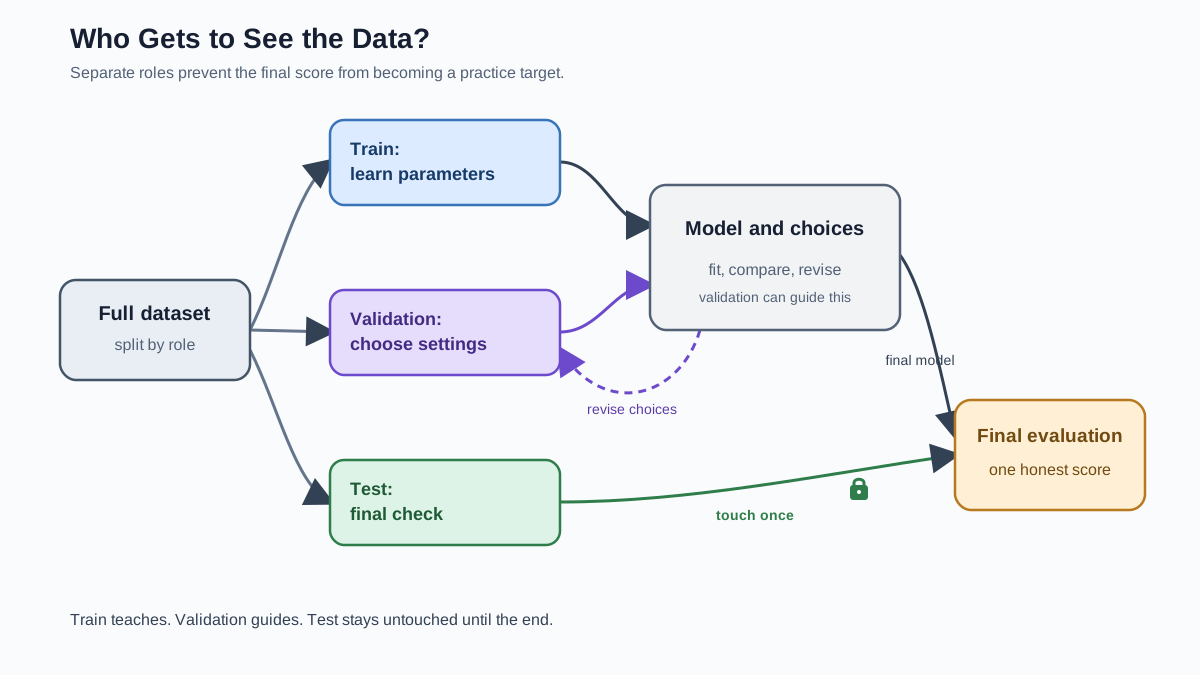
Before the job descriptions, one distinction will make everything clearer. Machine learning has two kinds of settings, and they are learned in different places:
- Parameters are the values the fitting algorithm learns from the training data—the weights in a linear model, for example.
- Hyperparameters are the choices you make before fitting: which algorithm to use, how strong its regularization should be, how deep a tree may grow, which features to include.
The model learns its parameters from the training set. You learn which hyperparameters and features work best by checking the validation set. That is why validation can shape the final model even though the model never trains on it directly.
Here is the job description for each split, in plain terms:
| Training set | Validation set | Test set | |
|---|---|---|---|
| Purpose | The model learns its parameters | You make modeling choices | Final evaluation |
| When the model sees it | Many times, during training | Never trains on it, but evaluated repeatedly | Once, at the end |
| How often you may check it | Constantly | As often as you need | Once |
| What decisions it informs | The model's internal parameters | Model selection, hyperparameter tuning, feature choices | Whether the model is ready to ship |
The training set is where the model learns. It sees this data over and over, adjusting its internal parameters to reduce error. This is the only split the model ever trains on.
The validation set is where you learn. The model never trains on it, but you look at its results repeatedly to make choices. Which model wins? What regularization strength works best? Which features help? The validation set answers those questions.
The test set is where the model proves itself. You touch it once, at the very end, for the final score. Nothing about the model was chosen using it. That is what makes its verdict meaningful—provided the split itself is sound.
Common mistake: Using validation results to declare final performance. The validation set has shaped your decisions, so its scores are optimistic. Only the test set can tell you how the model will really behave.
Knowledge check
Check your understanding
Answer this question before you continue.
How to Split Without Cheating Yourself
Creating three splits sounds trivial. Doing it without leaking information takes care. The most important question comes first: what should the split imitate?
Your test set is a stand-in for the data your model will meet in the real world. So the split must mirror how that future data will arrive. Ask yourself: when this model is deployed, will new rows look like a random sample of what I have now? Or will they arrive in a different pattern?
Here is the workflow I use:
Split before fitting data-dependent preprocessing. This one trips up a lot of beginners. If you compute the mean for scaling, fill missing values, or engineer features using the whole dataset, information from your validation and test sets has already leaked into your training pipeline. Fit preprocessing on the training set only, then apply it to the other splits.
The distinction matters: some transformations are safe to apply everywhere. Converting a temperature column from Fahrenheit to Celsius changes nothing about the information content. But a scaler that uses the mean and standard deviation of your data, or an imputer that fills missing values with the average, is learning from whatever data it sees. That learned information must come from the training set only. In scikit-learn, the clean way to enforce this is to put scaling and imputation inside a Pipeline so they are fitted on each training fold and never see validation or test data.
Use a random or stratified split when rows are independent. If your rows are reasonably independent and future data will resemble a random sample of what you have, shuffle before splitting so each set reflects the full variety of your dataset. If classes are imbalanced, stratify on the target so every split keeps the same class proportions as the whole.
Preserve time order for forecasting. If you are predicting the future from the past—sales next month, demand next week—do not shuffle. Train on older data, validate on more recent data, and test on the newest data. Shuffling here would leak the future into your training set and flatter your results.
Keep related groups together. If your rows share a person, patient, customer, device, or repeated measurement, a random split can put the same entity in both training and test. The model then gets credit for recognizing an entity it already saw, not for generalizing to new ones. Split by group instead: all rows from one entity stay in the same set.
Check for duplicates. A row that appears in both training and test quietly inflates your score. The model has already seen that exact example, so the test result flatters you. Scrub duplicates before splitting, and watch for near-duplicates too—two rows that are nearly identical can leak almost as much information.
Keep the split fixed across experiments. When you compare two models, they should see the same training, validation, and test data. Otherwise you are comparing lucky shuffles, not models.
Warning: Data leakage is silent. Your metrics look better, your model ships, and only in production do you discover the score was a mirage.
When a Fixed Split Is Not Enough
A single fixed split has a weakness: its results depend on which rows happened to land in each set. With a small dataset, one unlucky shuffle can make a good model look bad or a bad model look good.
Cross-validation addresses that. Instead of one validation set, the data is divided into several folds. The model trains multiple times, each time holding out a different fold for validation, and the results are averaged. Every row gets used for both training and validation, so your performance estimate does not depend on one lucky shuffle.
Here is the workflow cross-validation replaces:
- Reserve the test set and do not touch it.
- Run cross-validation on the remaining development data.
- Choose your model and settings based on the cross-validation results.
- Fit the chosen approach on all the development data.
- Evaluate once on the test set.
Cross-validation replaces the validation set, not the test set. The test set is still held out for final evaluation. And the same split-design rules apply: if your data has time order or natural groups, your cross-validation folds must respect them too.
This is a brief bridge because cross-validation deserves its own full treatment. For now, keep the mental model: validation is for choosing, test is for proving.
The One-Use Rule and What It Buys You
The discipline is simple to state and hard to follow: decide everything on training and validation, then touch the test set once.
That single untouched evaluation is the closest preview of how the model will behave on data it has never met. It is the difference between a number you trust and a number you hoped for.
If the final test score disappoints, do not re-run the test after tweaking a hyperparameter. Here is the honest lifecycle: once a test result changes your choices, that set has become development data. It no longer counts as a final evaluation. Go back, iterate on training and validation, and when you are confident again, evaluate on a fresh untouched set if you can get one. If you do not have fresh data, you have learned something uncomfortable but valuable: your validation workflow was not giving you enough signal. The temptation to re-check the test set is a symptom, and the cure is a better validation process, not another peek.
The cost of breaking the rule is silent. Your metrics look better while your deployed model underperforms. No error message appears. No warning fires. You just ship a model whose real behavior is worse than its reported score, and you may not discover the gap until the model meets actual users.
Here is the decision rule I want you to keep:
- Training data teaches the model.
- Validation data teaches you.
- Test data proves the result.
Decide everything on training and validation. Touch the test set exactly once. Treat any urge to re-check it as a sign that your validation workflow is not giving you enough signal.
When a single split starts feeling fragile—when your validation score swings wildly between experiments, or your dataset is small enough that one shuffle seems to decide your fate—cross-validation is the natural next step. It gives you a more stable estimate of model quality without sacrificing the final evaluation the test set provides.
The test set is a stranger. Keep it that way. Its opinion is only worth trusting because it never helped you build the answer.
Knowledge check
Final check
Finish the article by checking the ideas you just learned.
References
Research updated Sep 8, 2026


