
Multiclass vs Multilabel vs Multioutput: Frame the Prediction Problem
You have your features. You have your target. You are about to reach for a classifier — and then you freeze on a question that feels too basic to ask out…

Key topics
You have your features. You have your target. You are about to reach for a classifier — and then you freeze on a question that feels too basic to ask out loud: how many answers should the model give for one example?
That question is not basic. It quietly decides your loss function, your output shape, and your evaluation metric before you write a single line of model code. Get it wrong and you will spend a weekend debugging a model that was answering a different question than the one you asked.
Here is the good news: you only need one diagnostic handle. For a single example, how many answers are allowed, and are they mutually exclusive? Three answers map to three framings.
We will use one running example throughout: a support ticket that arrives in your inbox. Depending on how you frame the target, that same ticket becomes a multiclass problem, a multilabel problem, or a multioutput problem.
The One Question That Decides Everything
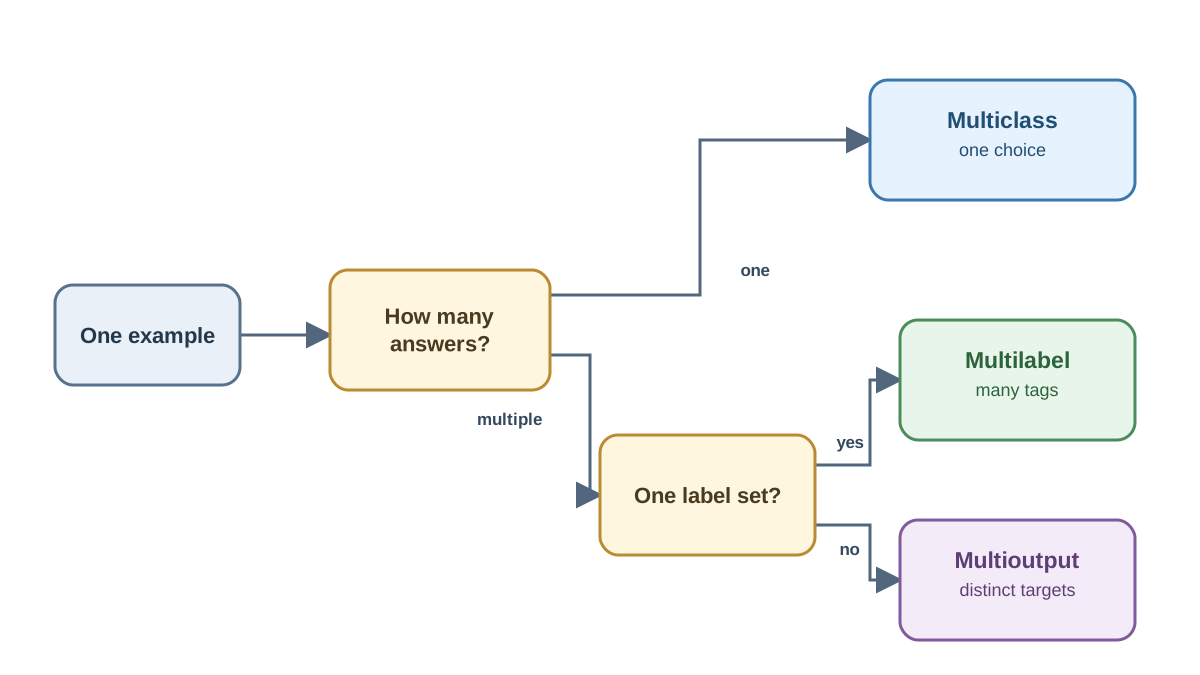
Before any terminology, sit with your dataset and answer this for one row:
- Can this example have exactly one answer from a set of options?
- Can it have zero, one, or many answers from the same set, all at once?
- Are you predicting several different quantities, each with its own meaning?
Those three questions produce three problem shapes:
- Multiclass — one winner, chosen from three or more mutually exclusive classes.
- Multilabel — several labels can be true at the same time, drawn from the same label set.
- Multioutput — several distinct target variables, each predicted separately.
The shape of your target determines three downstream things: the loss the model minimizes, the number of outputs the estimator produces, and the metric you use to judge it. A model trained for one shape will not silently adapt to another. It will just produce numbers that look plausible and mean the wrong thing.
Tip: Write your answer as a single sentence before you touch an estimator. "For one ticket, exactly one priority level" is a different sentence from "for one ticket, any number of issue categories." That sentence is your framing.
Multiclass: Exactly One Answer Wins
Multiclass classification means each example gets exactly one label from a set of three or more classes. The defining constraint is mutual exclusivity: the classes compete, and one wins.
Your support ticket example: predict the ticket's priority — low, medium, high, or urgent. A ticket has one priority. It cannot be both high and low. The model produces a score per class, and the classes compete for the single winning slot.
If you already understand binary classification, multiclass is a natural extension, not a new species. Binary asks "yes or no?" Multiclass asks "which one of these?" The output is still a single decision.
The mechanics of how a classifier handles many classes — one-vs-rest, one-vs-one, and the per-class evaluation views that reveal failures hidden by aggregate accuracy — deserve their own treatment, and they get it elsewhere in this series. For framing purposes, the only thing you need to carry forward is this: the output is one decision, and the classes cannot co-occur.
Common mistake: Forcing a genuinely multi-answer problem into a multiclass frame. If a ticket can legitimately be about billing and a login bug, a multiclass model will pick one and silently discard the other. You will not see an error. You will see a confident, incomplete answer.
Knowledge check
Check your understanding
Answer this question before you continue.
Multilabel: Several Answers Can Be True at Once
Multilabel classification means each example can carry zero, one, or many labels from the same label set, and those labels are not mutually exclusive.
Same support ticket, different question: which issue categories apply? Billing, login, performance, data loss, feature request. A single ticket might be about billing and performance at once. It might be about none of your categories. There is no competition and no single winner.
This is the mental shift that trips people up. Multiclass is one competition. Multilabel is one yes/no decision per label. You are not choosing among categories; you are asking each category, separately, "does this apply?"
That shift changes the output. In multiclass, scores compete and typically sum to one, so you take the highest. In multilabel, scores no longer need to sum to one — each label gets its own score, and you apply a threshold per label. A label is predicted when its score crosses the threshold. Every label can pass. No label can pass. Both are valid outcomes.
There is a real tradeoff hiding here. Treating each label as an independent binary decision is simple and easy to reason about, but it ignores structure between labels. If billing issues and refund requests tend to appear together, an independent model never learns that. Some multilabel approaches model the labels jointly to capture that correlation. Start independent, then ask whether your labels actually co-occur in patterns worth modeling.
Note: Co-occurrence is the defining feature of multilabel framing, not statistical independence. Labels can be correlated and still belong to a multilabel problem. Independence describes one common modeling strategy, not the problem itself.
Knowledge check
Check your understanding
Answer this question before you continue.
Multioutput: Several Separate Targets, Each With Its Own Rules
Multioutput is where the confusion peaks, because the word "multiple" appears in both multilabel and multioutput. The distinction is not how many answers you get. It is what kind of question each answer belongs to.
Multilabel is multiple answers to one question. Multioutput is multiple distinct questions, each with its own target variable.
Back to the ticket. Suppose you want to predict both the resolution time in hours (a continuous number) and the priority category (low, medium, high, urgent). Those are two different quantities with two different meanings. That is multioutput.
Multioutput splits into two common sub-cases:
- Multioutput regression — several continuous targets. Predict resolution time and customer satisfaction score together.
- Multiclass-multioutput — several categorical targets, each with its own set of classes. Predict priority (four classes) and department (five classes) at once.
Notice that multiclass-multioutput sits at the intersection: it is multioutput because there are multiple distinct targets, and it is multiclass because each target has more than two classes.
Because the targets are genuinely different variables, the natural implementation is often one estimator per target, or a meta-estimator that wraps a base estimator and fits one copy per target for you. That is the practical shape of most multioutput work in scikit-learn.
Knowledge check
Check your understanding
Answer this question before you continue.
Side-by-Side: A Comparison Table
| Multiclass | Multilabel | Multioutput | |
|---|---|---|---|
| Number of outputs | One | One per label | One per target variable |
| Exclusivity | Mutually exclusive | Not exclusive | Not applicable — separate targets |
| Output type | One class | Binary per label | Class or continuous, per target |
| Typical output shape | Single label | Set of labels | Vector of values |
| What the model decides | Which one wins | Which labels pass threshold | Each target independently |
A short note on the intersection: multiclass-multioutput is multioutput (several distinct targets) where each target is itself a multiclass problem. It is not a fourth thing — it is where two of these framings meet.
Keep this table as a reference to return to. It compresses the three framings, but the explanations above are what make it usable.
What This Means for Your Estimator
The framing decision is not academic. It changes what you hand the estimator and what you ask back from it.
- Multiclass: a single estimator that outputs one class. Internally it may use a softmax-style competition or a one-vs-rest strategy, but from your side, you get one label per example.
- Multilabel: either independent binary classifiers per label, or a native multilabel estimator. The choice matters: independent classifiers ignore label correlations; native multilabel models can capture them.
- Multioutput: a meta-estimator that fits one base estimator per target, or a native multioutput model. In scikit-learn, meta-estimators let you reuse a base estimator across these framings by transforming the multi-target problem into a set of simpler ones.
The practical rule I use: match the estimator's expected target shape to your framing, and make sure your evaluation metric agrees with that shape. A metric built for single-label accuracy will quietly mislead you on a multilabel problem, because it rewards getting the "main" label right while ignoring the labels you dropped.
Knowledge check
Check your understanding
Answer this question before you continue.
When to Use Each — and When Not To
Use multiclass when the answers are genuinely mutually exclusive — one priority, one category, one winner. Do not use it when an example can legitimately hold several answers at once. Forcing a multi-answer problem into a single-label frame discards information and produces accuracy numbers that look fine while hiding the loss.
Use multilabel when labels can co-occur from the same set — issue tags, topic tags, content warnings. Do not use it when your "labels" are actually separate variables with different meanings. Billing category and priority level are not two labels of one variable; they are two variables.
Use multioutput when you are predicting distinct quantities — a price and a demand category, a time and a score. Do not collapse distinct targets into one label set just to simplify your pipeline. You will lose the meaning of each target and make evaluation harder, not easier.
Two failure modes worth naming:
- Forcing a multi-answer problem into a single-label frame silently drops information. The model is not wrong in a way you can see; it is answering a smaller question than the one you care about.
- Splitting genuinely correlated labels into separate models can lose signal and multiply your maintenance cost. If your labels move together, a joint model may serve you better than a pile of independent ones.
A short checklist to run against your own dataset:
- For one example, can more than one answer be true at once? If no, you are likely in multiclass territory.
- If yes, are those answers drawn from the same label set? If yes, multilabel. If they are different quantities, multioutput.
- Does each target have its own class set or its own units? If yes, you are in multioutput, possibly multiclass-multioutput.
- Does your evaluation metric match the shape you just chose?
Where to Go Next
Before you choose a model, write one sentence for one row of your data: how many answers are allowed, and are they mutually exclusive?
That sentence determines your framing, your estimator, and your metric. It costs you two minutes now. Getting it wrong costs you a weekend of debugging a model that was answering the wrong question the whole time.
Your next step is to pick an evaluation metric that matches your framing — accuracy for single-label multiclass, per-label precision and recall or a threshold-aware metric for multilabel, and a separate metric per target for multioutput. Framing first, metric second, model third. That order is cheaper than the reverse.
Knowledge check
Final check
Finish the article by checking the ideas you just learned.
References
Build stronger machine learning foundations
Use structured resources to connect theory, scikit-learn workflows, and evaluation practice.


