
Multioutput Prediction: When One Example Has Several Targets
You open a dataset, and the last few columns all look like answers. One column says the fruit is an apple. The next says it is red. A third says it is…

Key topics
You open a dataset, and the last few columns all look like answers. One column says the fruit is an apple. The next says it is red. A third says it is ripe. You have one row, one example, and three things to predict.
Your first instinct is to call it multiclass, because there are multiple classes floating around. Then you remember multilabel, because there are multiple labels. Then you get stuck, because neither name quite fits.
Here is the reframe that clears the fog: the number of targets and the type of each target are two separate questions. Multioutput prediction is the umbrella for every task where the first answer is "more than one." Multiclass and multilabel are specific corners underneath it.
Get that frame right before you touch an estimator. It saves hours of debugging a model that was never going to accept your target shape.
The Confusion: One Row, Several Answers
Picture a small table. Each row is one example. The first columns are inputs. The last columns are targets.
| image_id | pixel_features | fruit_type | color | ripeness |
|---|---|---|---|---|
| 1 | ... | apple | red | ripe |
| 2 | ... | pear | green | unripe |
| 3 | ... | orange | orange | ripe |
Three target columns. One example. That is the shape of the problem.
If you have followed single-target regression and classification, you already understand the input side. Nothing about X changes here. Same features, same rows, same preprocessing. The only thing that changes is y — it stops being a single column and becomes a matrix.
That is the whole shift. Multioutput prediction changes the target side, not the input side.
Knowledge check
Check your understanding
Answer this question before you continue.
Two Questions That Separate Every Task
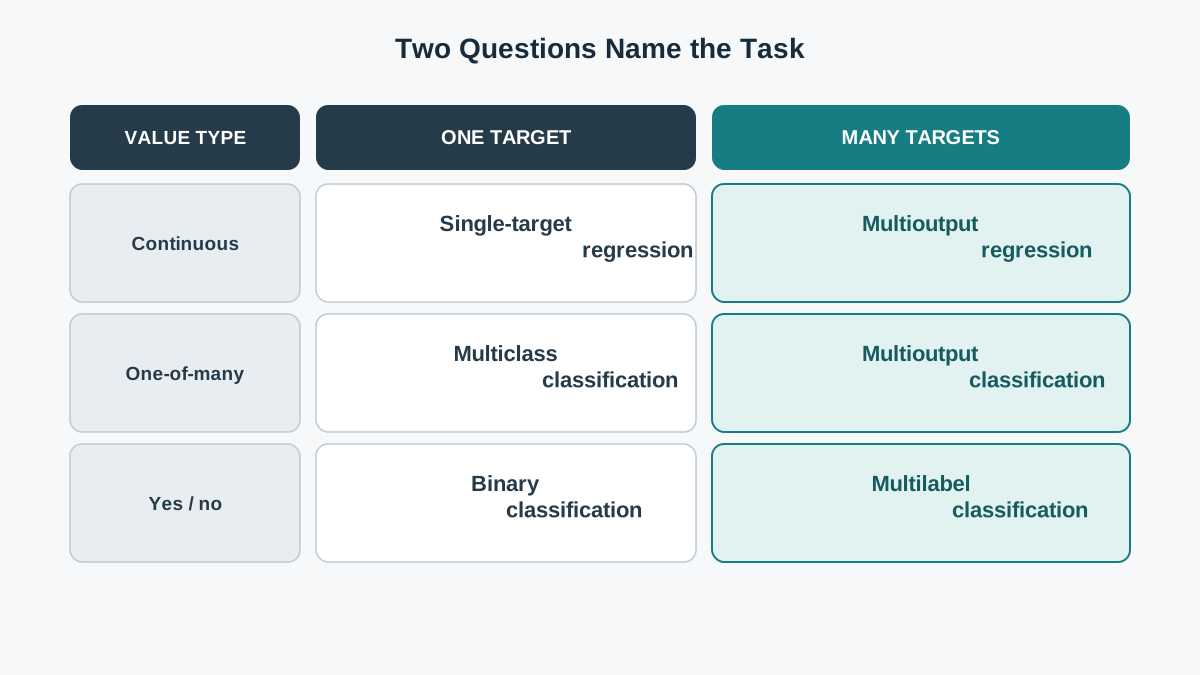
Before naming anything, ask two questions about your y.
Question 1: How many targets does each example have? One, or many?
Question 2: For each target, what kind of value is it? Continuous, one-of-many, or independent yes/no?
Answer both, and the task names itself.
| One target | Many targets | |
|---|---|---|
| Continuous value | Single-target regression | Multioutput regression |
| One-of-many class | Multiclass classification | Multioutput classification |
| Independent yes/no | Binary classification | Multilabel classification |
Read the grid left to right. The left column is everything you already know. The right column is the multioutput family.
Notice what stays constant: X is the same shape in every cell. Only y changes — its width, and the meaning of each column.
Tip: When you meet a new dataset, sketch this grid on paper and drop your task into a cell. If you cannot place it, you do not yet understand your own target.
Multiclass, Multilabel, Multioutput: Where the Lines Are
These three get tangled because they all involve "more than two of something." The difference is what there is more than two of.
Multiclass means one target with more than two mutually exclusive classes. The answer is exactly one label. A fruit is an apple or a pear or an orange — never two at once.
Multilabel means multiple targets, each binary. The answer is a set of independent yes/no labels, and any combination is allowed. A document can be about politics and finance and education, or none of them.
Multioutput classification means multiple targets, each with more than two classes. Each target has its own label set, and the targets are not interchangeable. Fruit type has {apple, pear, orange}; color has {green, red, yellow, orange}. Two separate questions, two separate answer spaces.
Multioutput regression means multiple targets, each continuous. Predict tomorrow's temperature, humidity, and wind speed from today's readings.
| Task | Number of targets | Per-target cardinality | Example |
|---|---|---|---|
| Multiclass | 1 | >2 | Which fruit is in the image? |
| Multilabel | >1 | 2 (yes/no) | Which topics does this article cover? |
| Multioutput classification | >1 | >2 | Fruit type and color |
| Multioutput regression | >1 | Continuous | Temperature, humidity, wind speed |
The fruit example is worth holding onto. Predicting fruit type alone is multiclass. Predicting fruit type and color together is multioutput classification. Same image, same features, different target shape — and a different estimator conversation.
Knowledge check
Check your understanding
Answer this question before you continue.
Why the Distinction Changes Your Estimator Choice
Most classical estimators are built for a single target column. They expect y to be one-dimensional. Hand them a two-dimensional y and many will either error out or silently do the wrong thing.
So the practical question becomes: does my estimator accept a 2D y?
There are two broad strategies.
Native multioutput support. Some estimators handle a 2D y directly. Tree-based models are the common example — they can split on multiple targets at once and produce a matrix of predictions in a single fit call.
Meta-estimators that wrap a single-target model. scikit-learn provides wrappers like MultiOutputRegressor and MultiOutputClassifier. The idea is simple: take a model that predicts one target, fit one copy per target column, then stack the predictions back into a matrix. Same model, trained several times.
from sklearn.multioutput import MultiOutputRegressor
from sklearn.ensemble import RandomForestRegressor

base = RandomForestRegressor()
model = MultiOutputRegressor(base)
model.fit(X_train, y_train)   # y_train has shape (n_samples, n_targets)
preds = model.predict(X_test) # preds has shape (n_test_samples, n_targets)
The shape tells the story. y_train is a matrix, and preds comes back as a matrix of the same width.
Here is the part that trips people up. Accepting a multi-column target and learning relationships between those columns are two different things. The wrapper makes the first true and the second false: each copy trains in isolation, blind to what the other copies predict. A native estimator that accepts a 2D y may or may not share information across targets — that depends on its internal strategy, not on the shape of its interface. Read the estimator's documentation before assuming it exploits target correlations.
If you want the model to use target relationships, you can chain them instead: feed earlier predictions in as features for later ones. That lets the model see target structure, but it adds complexity and error propagation. A wrong first prediction becomes a wrong input for the second.
Note: Start with the wrapper. It is the simplest thing that works, and it tells you whether joint prediction is even worth the extra machinery.
Knowledge check
Check your understanding
Answer this question before you continue.
What You Gain and What You Give Up
Joint prediction is not free. It buys you something and it costs you something.
What you gain. One model interface, one fit call, one place to manage. For forecasting-style problems, predicting several steps at once avoids feeding predictions back in as inputs — which stops small errors from compounding. And when an estimator genuinely shares information across targets, correlated outputs can help each other. That benefit is real, but it is a property of the specific estimator, not of multioutput support in general.
What you give up. More output dimensions means more parameters or more models to train. That raises your data requirements and your overfitting risk. A model that predicts three targets needs enough signal to learn all three.
Evaluation gets harder too. A single aggregate score can hide one target performing badly. Your model might nail fruit type and completely miss color, and the average still looks fine.
Common mistake: Reporting one averaged metric and calling it done. Check per-target error. If one target is dragging, you want to know before you ship.
When Multioutput Framing Is the Wrong Move
Multioutput is a useful frame, not a universal one. Sometimes it adds ceremony without adding value.
If the targets are truly independent and you only care about each separately, separate single-target models are simpler to debug and evaluate. You can tune each one on its own terms.
If one target is a deterministic function of another, predicting both is redundant. Predict the cause, derive the effect. Predicting a rectangle's width and area separately is wasteful — area follows from width and height.
If the "multiple targets" are actually one label with a compound name, you have a multiclass problem in disguise. "Red apple" and "green apple" are not two targets; they are one class with a space in it.
If targets must satisfy a constraint — say, three proportions that must sum to one — independent per-target models will not respect it. Each model predicts freely, and the outputs may not add up. This is a known limitation, not something to paper over. You either accept the violation or move to a formulation that enforces the constraint.
The decision rule: frame as multioutput when the targets are genuinely multiple and you benefit from predicting them together. Otherwise, keep it simple.
Knowledge check
Check your understanding
Answer this question before you continue.
A Quick Way to Classify Any New Task
Here is the checklist I run on every new dataset. It takes two minutes and prevents a lot of wasted training runs.
- Look at
y. Is it one column or several? - For each column, classify the value. Continuous, one-of-many, or binary?
- Name the task using the two-question frame.
- Check your estimator. Does it accept that
yshape natively, or do you need a wrapper? - Decide on joint modeling. Are the targets related enough to justify predicting them together — and does your chosen estimator actually use that relationship?
Step 4 is where beginners lose the most time. They pick a model they like, then discover it will not accept a 2D target. Checking the shape first costs seconds. Discovering it after a failed fit costs an afternoon.
Tip: Before writing any training code, print
y.shapeandtype_of_target(y). The shape tells you the number of targets; the type tells you the kind. Together they name the task.
Where to Go From Here
Go back to that dataset you opened at the start — the one with several answer columns. Inspect the shape of y. Run the two questions. Write down whether it is single-target, multiclass, multilabel, multioutput regression, or multioutput classification.
Then check whether your intended estimator accepts that target shape before you write a single line of training code. And if you plan to rely on target relationships, verify that the estimator actually models them — do not assume the interface promises more than it delivers.
That one habit — naming the target before choosing the model — is the difference between a clean first run and an afternoon of shape errors. The frame is small. The time it saves is not.
Knowledge check
Final check
Finish the article by checking the ideas you just learned.
References
Build stronger machine learning foundations
Use structured resources to connect theory, scikit-learn workflows, and evaluation practice.


