
PCA vs Feature Selection: Compress the Data or Keep the Original Variables?
You have a wide table of features, a model to build, and a quiet suspicion that half those columns are noise. The instinct is to shrink the dataset. But…

Key topics
You have a wide table of features, a model to build, and a quiet suspicion that half those columns are noise. The instinct is to shrink the dataset. But which way?
Drop the useless columns? Or let PCA compress everything into a few tidy components?
The two options look like they solve the same problem. They don't. Feature selection prunes your feature set down to a subset of the original variables. PCA replaces your variables with new ones—weighted blends of everything you started with. One keeps the columns you can name. The other keeps the variance you can compress. Those are different goals, and confusing them is where projects go sideways.
The Real Question Behind the Choice
Before you pick a method, answer the question underneath: what does the model's output need to support?
If a stakeholder will question the model, a regulator will audit it, or a clinician will act on it, you need variables that survive with their names, units, and meaning intact. "Credit score" stays "credit score." That points to feature selection.
If you need a compact input for a distance-based algorithm, a visualization, or a model that will never be interrogated by a person, PCA earns its keep. It finds the directions of maximum variance in your data and lets you keep only the strongest few.
But keep one qualification in mind: named features are a prerequisite for interpretability, not a guarantee of it. A selected set can still contain correlated variables, unstable choices, or coefficients that resist explanation. Selection gives you the chance to explain the model clearly. You still have to check whether the explanation actually holds up.
Think of feature selection as pruning a tree: you cut branches, and what remains is still the same tree. Think of PCA as rotating the whole tree until it points along its longest axis, then deciding how many dimensions of that rotated view you actually need. The tree is still there, but every retained component carries a little of every original branch.
What Each Method Actually Does to Your Data
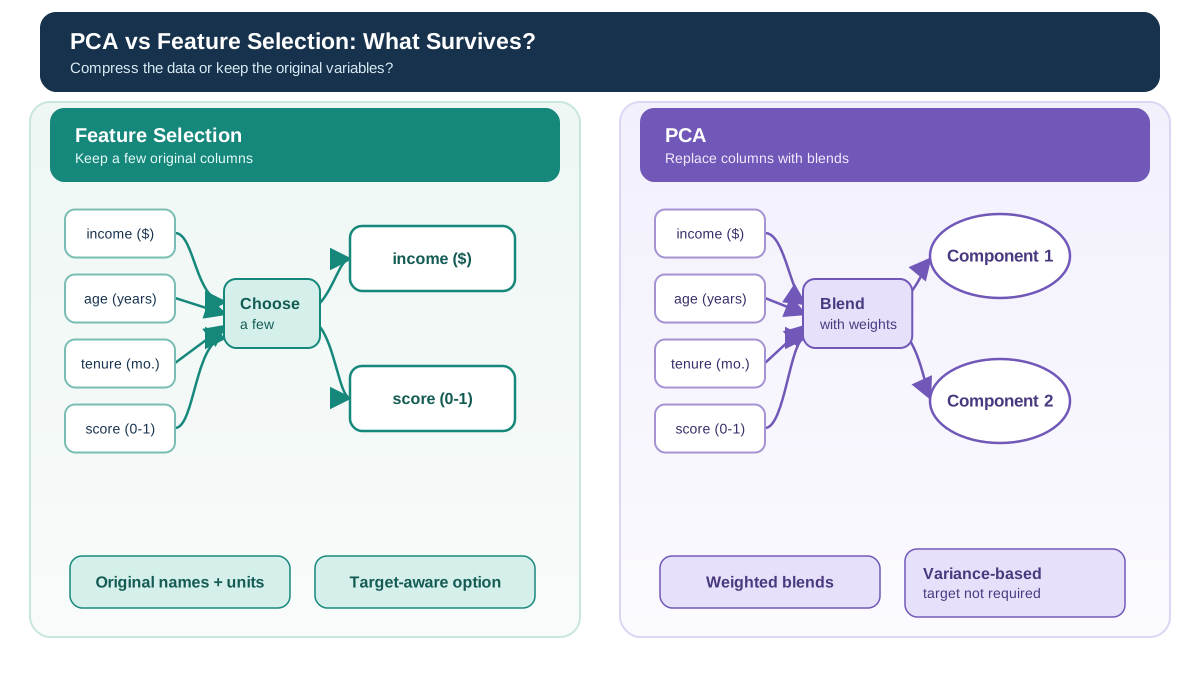
Feature selection keeps a subset of original columns and drops the rest. The surviving features keep their names and units. If you select age, income, and credit_history out of forty columns, your model sees exactly those three, with the same meanings they always had.
PCA builds new columns as linear combinations of the originals. The first principal component is the direction along which your data varies most. The second is the direction of most remaining variance, orthogonal to the first. Each component is a weighted sum of every original variable. That is the core difference in representation: a retained component is a blend, not a column.
Because PCA works on variance, scaling matters. If one feature is measured in dollars and another in years, the dollars will dominate the variance calculation unless you standardize first. Fit a scaler, then PCA, and only then look at components.
The components are also uncorrelated by construction. That can help models sensitive to collinearity, and it can be a genuine headache when you try to explain what "component 3" means to someone who never asked for a linear algebra lesson. But correlation alone is not a reason to reach for PCA. Many regularized or tree-based models handle correlated inputs fine. Ask first whether your chosen model, memory budget, distance geometry, or visualization actually benefits from the transformed space.
Knowledge check
Check your understanding
Answer this question before you continue.
Interpretability: Can You Explain the Model to a Stakeholder?
This is where most real projects make the call.
A retained feature keeps its meaning. "Credit score" stays "credit score" in the model. You can point at a coefficient and say, "higher credit score pushes the prediction up." A business user can sanity-check that against their own intuition. A regulator can follow the logic.
A principal component is a blend. You can inspect its loadings—the weights on each original variable—and see that component 1 is mostly credit history with a bit of income and a dash of debt ratio. But explaining that to a stakeholder is genuinely harder. "The model uses a weighted combination of your features" is a harder sell than "the model uses your credit score."
There is a nuance worth keeping. PCA can still be useful for exploratory visualization even when your final model uses selected features. Plot the first two components to see cluster structure, then build the deployable model on interpretable columns. The two methods are not enemies; they serve different stages of the workflow.
Knowledge check
Check your understanding
Answer this question before you continue.
Supervised Signal: What Each Method Ignores
Here is the difference beginners miss most often.
PCA never looks at your target. It compresses whatever variance dominates the data, and that variance may be noise, irrelevant structure, or—worst case—the very feature that separates your classes.
Imagine a binary classification problem where one feature has tiny variance but perfect separation: almost all positives have value 1, almost all negatives have value 0. PCA will rank that feature near the bottom because it barely contributes to overall variance. Compress to a few components and you may have thrown away the one column that mattered.
Feature selection can use the target. Filter methods rank features by correlation with the label. Wrapper methods try subsets and keep the ones that score well. Embedded methods like LASSO learn which features matter while fitting the model. When the goal is prediction, supervised feature selection often beats unsupervised PCA on the same budget of retained dimensions.
PCA is a compression tool first and a modeling aid second. It does not know what you are trying to predict, and it will not apologize for discarding the signal you needed.
Knowledge check
Check your understanding
Answer this question before you continue.
Validation: The Leakage Trap Both Methods Share
Both methods share a validation hazard, and it is the one that silently inflates scores.
PCA must be fit on training data only. If you fit it on the full dataset before splitting, the components have absorbed information about test-set variance. Your validation scores will look better than they should, and the model will underperform when it meets genuinely new data.
Supervised feature selection has the same rule. Choosing features using the whole dataset's target leaks label information into the selection step. The model looks great in cross-validation and disappoints in production.
The mechanism differs, but the evaluation boundary is the same: any reduction that uses information from outside the training fold is leakage.
The practical pattern is to fit the reduction inside a pipeline or cross-validation loop so the test fold never touches the fit. Standardize inside the training fold. Fit PCA inside the training fold. Select features inside the training fold. If you standardize or fit PCA before splitting, you have already contaminated the evaluation.
Common mistake: Standardizing or fitting PCA before splitting the data, then wondering why validation scores look too good. The scores are lying because the reduction already saw the test set.
Knowledge check
Check your understanding
Answer this question before you continue.
When to Reach for Each: A Decision Guide
| Consideration | Feature Selection | PCA |
|---|---|---|
| What survives | Subset of original columns | New components, each a weighted blend |
| Interpretability | High—features keep names and units | Low—components require loading inspection |
| Uses the target? | Can be supervised | Never—unsupervised variance maximization |
| Scaling required | Not inherently | Yes—variance-based, scale-sensitive |
| Handles correlated features | Drops redundant ones | Replaces them with uncorrelated components |
| Leakage risk | Supervised selection must fit inside training folds | PCA fit must happen inside training folds |
Choose feature selection when you need interpretable features, the feature count is manageable, or you want to remove irrelevant and redundant columns.
Choose PCA when features are highly correlated, very numerous, noisy, or when you need a compact representation for visualization or distance-based methods.
Consider combining them. Select a sensible subset first to cut obvious noise, then compress if the remaining set is still too wide. The two methods are not mutually exclusive; they are tools for different stages of the same problem.
A Worked Decision in Practice
Suppose you have a wide table of correlated sensor readings—fifty columns of temperature, pressure, vibration, and humidity measurements, all drifting together. You need to build a model that predicts equipment failure, and a maintenance engineer will question every prediction.
Start with the human test. The engineer will ask why the model flagged a machine. If you hand them "component 2 exceeded a threshold," they will stare at you. If you hand them "vibration amplitude exceeded a threshold," they can act.
That pushes toward feature selection. But fifty correlated sensor columns are a lot to reason about, and many of them carry the same information. So you select first—but not by blindly taking whatever a ranking produces. Use a supervised method to score features by their relationship with the failure label, then compare candidate subset sizes inside cross-validation. Watch whether the same sensors keep recurring across folds. A feature that only appears in one fold is a feature you cannot trust. Then check whether the recurring set is something the engineer can actually act on.
Then run the honest comparison. Split the data first. Fit a model on the selected features, fitting the selection inside the training folds. Fit another model on the top PCA components, fitting the reduction inside the training folds. Compare them with cross-validation.
Let the scores and the explanation burden decide together. If the selected-feature model performs nearly as well, take it—the interpretability is free. If PCA is dramatically better, you have a real tradeoff to negotiate with the engineer, and you can show them the loadings to explain what each component represents.
The order matters more than the choice. Split first. Fit any reduction inside the training side. Let the test fold stay untouched.
The Decision Rule That Settles Most Projects
One question settles the choice for most projects: does a human need to read this model?
If yes, select features and keep the variables you can name—then verify that the selected set is stable and genuinely explainable. If no, compress with PCA and keep the variance you can use. When you are genuinely unsure, run the honest cross-validated comparison on your own data—selected-feature model against PCA model, reduction fitted inside the training folds—and let the score plus the explanation burden decide.
The method that wins is the one that survives contact with the people who have to trust it.
Knowledge check
Final check
Finish the article by checking the ideas you just learned.
References
Research updated Sep 8, 2026


