
Feature Engineering for Classical Machine Learning: Add Signal Without Adding Leakage
You've tried different algorithms. You've tuned parameters until your eyes glaze over. And still, your model's score sits at a plateau, stubbornly refusing…

Key topics
You've tried different algorithms. You've tuned parameters until your eyes glaze over. And still, your model's score sits at a plateau, stubbornly refusing to improve. Here's the uncomfortable truth: the model was never the bottleneck. The features were.
A machine learning model doesn't see your dataset the way you do. It sees numbers—one row per example, one column per feature—and it learns patterns from those numbers alone. If the information you need to make a good prediction isn't in that grid, no algorithm on earth can conjure it. Feature engineering is the art of putting useful information into that grid. And done carelessly, it's also the easiest way to poison your model with leakage.
Why Your Model Is Only as Good as What You Feed It
When you trained your first model, you probably did something like this: loaded a CSV, split it into features and target, fit a model, and checked the score. The model didn't read your data like a human would. It consumed a matrix of floating-point numbers and searched for mathematical patterns in those columns.
One example becomes a feature vector—the processed, numeric representation of that single example. Stack those vectors for many examples and you get the feature matrix your model trains on. Here's the catch: feature vectors rarely use raw dataset values. They use processed values—representations you've chosen because they make patterns easier for the model to find.
This is why two people can build models on the same data and get wildly different results. One feeds the model raw values and accepts mediocre performance. The other transforms those values into features that expose the underlying structure of the problem. Same algorithm. Same data. Different representation. Different outcome.
Feature engineering is where much of your practical performance lives before you reach for a more complex algorithm. But it comes with a central tension: you want to add signal—useful information the model can learn from—without adding leakage—information that shouldn't be available at prediction time. Get the first right and your model improves. Get the second wrong and your model lies to you.
What Feature Engineering Actually Means
Feature engineering is the process of creating or transforming inputs so your model can learn patterns more effectively. It turns domain knowledge into numbers the model can use.
Let me be precise about what it is not. Feature selection is choosing among the features you already have—deciding which columns to keep and which to drop. Data cleaning is fixing problems in your raw data—handling missing values, removing duplicates, correcting errors. Feature engineering is different: it's creating new inputs or reshaping existing ones.
If you've worked through the basics of features and targets and data preparation, you already know the raw material. You have a feature matrix and a target column. Feature engineering asks: what else could I compute from what I already have that would make the patterns in this data visible?
Here's the mental shift I want you to make. Raw values are rarely the best representation of a problem. A model cannot infer relationships you never encode. If you're predicting house prices and you hand the model bathrooms and square_feet as separate columns, it has to discover on its own that the ratio of bathrooms to square feet matters. You could just give it that ratio directly. That's feature engineering.
Knowledge check
Check your understanding
Answer this question before you continue.
The Three Moves: Create, Transform, Combine
You don't need a bag of tricks. You need three moves, and each one is small, testable, and explainable.
Create. Derive a new feature from domain knowledge. A ratio, a difference, a count—anything that captures a relationship you understand about the problem. Predicting delivery time? Instead of just distance and traffic_level, create distance_per_traffic_unit. Predicting energy consumption? Instead of house_size and num_occupants, create size_per_person. The new feature encodes a relationship the model would otherwise have to stumble upon.
Transform. Reshape an existing feature so the model can use it. Some features have skewed distributions where most values cluster at one end. A logarithmic transform can spread those values out, making patterns visible that were compressed into a narrow range. This isn't about changing what the feature means—it's about changing its shape so the model can actually work with it.
Combine. Join or aggregate information across rows or sources. If you're predicting whether a customer will churn, a single transaction row tells you little. But the total number of transactions in the last 30 days—computed by grouping rows together—tells you a lot. Aggregations turn scattered events into meaningful descriptions of an entity.
Here's a concrete example. Suppose you're predicting house prices. Your raw features are square_feet and lot_size. A model might learn a rough relationship between each and price. But you know something the model doesn't: houses with a large structure on a small lot feel cramped, and houses with a small structure on a large lot feel wasteful. Create structure_to_lot_ratio and suddenly the model has a feature that directly captures the density of the property. One column. Clear meaning. Real signal.
The rule for all three moves: each new feature should be something you can explain in one sentence. If you can't say what it measures and why it matters, you probably don't understand it well enough to trust it.
Knowledge check
Check your understanding
Answer this question before you continue.
Polynomial Features: Letting the Model See Curves and Interactions
Sometimes the relationship you need isn't a ratio—it's a curve. A linear model can only draw straight lines in feature space. Feed it area and it will fit a straight line to the price-vs-area relationship. But real relationships are often curved: a 500-square-foot increase matters more for a small apartment than for a mansion.
Polynomial features bend that straight line. By squaring an existing feature—creating area_squared—you give a linear model the raw material to fit a curve. The model still uses linear math, but now it has a feature that grows quadratically, which lets it capture curvature it couldn't see before.
Polynomial features also capture interactions. If you have area and num_bedrooms, you can create area × num_bedrooms. This feature changes value when either input changes, letting the model learn that the effect of extra bedrooms depends on the size of the house.
The caution is real: polynomial features multiply your columns quickly. Three features squared and paired produce dozens of new columns. That invites overfitting—the model memorizes noise instead of learning patterns. Start with polynomial features when you have a small feature set and a linear baseline model. If you're using tree-based models like random forests or gradient boosting, don't assume polynomial terms are useless—test them. Trees can approximate many interactions through splits, but an engineered feature can still sharpen the signal or reduce the depth the model needs.
Knowledge check
Check your understanding
Answer this question before you continue.
The Leakage Trap: When a Feature Cheats
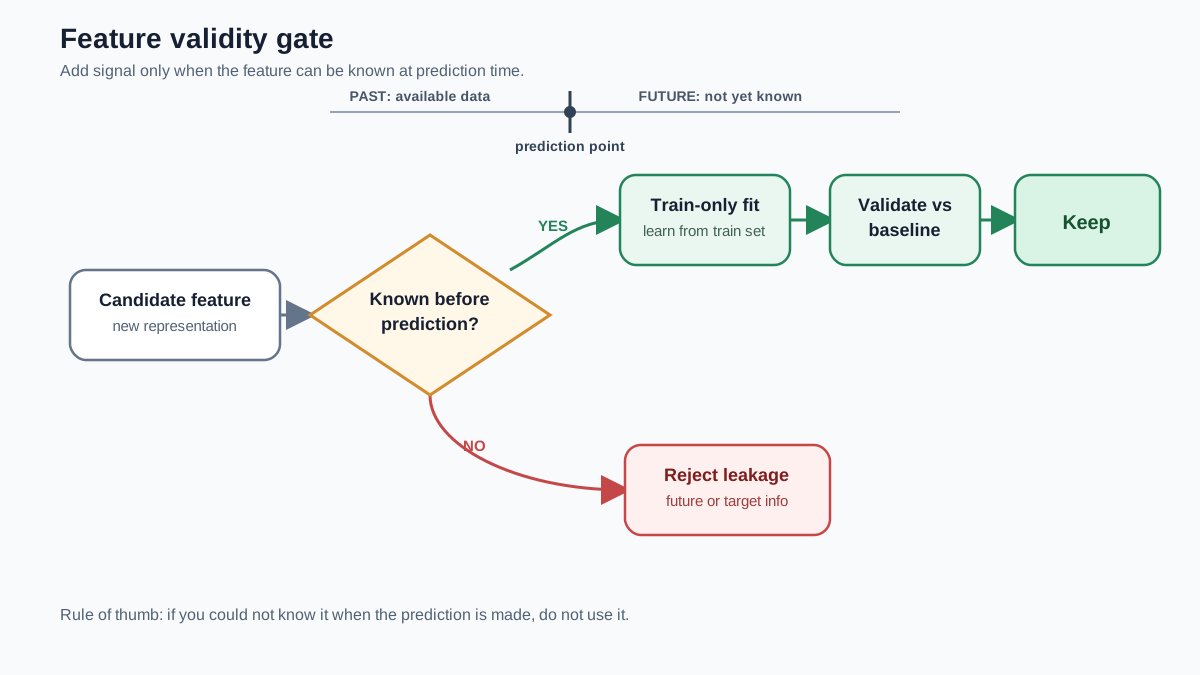
Now the part that separates useful feature engineering from dangerous feature engineering: leakage.
Leakage happens when a feature carries information that wouldn't be available at the moment you make a prediction. The model looks like it's learning brilliantly—training scores soar—and then collapses in production when the leaking information isn't available.
The test is simple: imagine a prediction point in time. Could you compute this feature using only information available before that moment? If the answer is no, the feature is leaking.
Here's the classic failure. You're predicting whether a customer will default on a loan. You create a feature called missed_payment_last_month—but you compute it from the customer's payment behavior after the loan was issued. At the moment you need to predict default, that information doesn't exist yet. Your model uses it during training, sees inflated performance, and then fails in production when it has to predict on a new customer whose future behavior hasn't happened.
Another common leak: you create a feature from the target itself. If you're predicting whether a customer will churn, and you include a feature like has_complained_recently that was actually derived from churn-related behavior you're trying to predict, you've built a circular argument. The model isn't predicting—it's reading the answer.
Leakage inflates training scores because the model has access to information it shouldn't. The validation score looks great. The production score collapses. The model was never learning the real relationship—it was memorizing a cheat sheet.
Common mistake: Confusing leakage with preprocessing. Fitting a scaler on your full dataset before splitting doesn't create a cheating feature in the same way target leakage does—but it does contaminate your evaluation, because the test set influenced the scaling statistics. The rule is simple: fit learned transformations on training data only, then apply them to validation and test data.
Knowledge check
Check your understanding
Answer this question before you continue.
A Validity Checklist for Every New Feature
Before you add any feature to your model, run it through this checklist. If it fails any question, drop it.
Would this value be known at the prediction point? Imagine the exact moment you need to make a prediction. Could you compute this feature from information available before that moment? If the feature requires data from after that point, it's leaking.
Does this feature depend on the target or on future information? If your feature is derived from the thing you're trying to predict—directly or indirectly—it's circular. The model will look great in training and fail in the real world.
Can I compute this feature identically in training and in production? If your feature uses a statistic like a mean or scale, fit that statistic on training data only, then apply the same fitted transformation to new data. The same rule applies to aggregate features: their time windows must end at the prediction point, never after it.
Does this feature add signal beyond what's already there, or just redundancy? A feature that's perfectly correlated with an existing feature adds complexity without adding information. Ask what new perspective it brings.
Keep a running list of candidate features. Test them one at a time against a baseline. A feature earns a candidate place when it improves the appropriate validation scheme, survives comparison with the baseline, and remains available at prediction time.
Your Next Experiment: One Feature at a Time
Feature engineering is not a one-shot event. It's an iterative search, and most of your candidates will fail. That's normal. That's the cost of searching.
Here's your next experiment. Take a dataset you already have. Build a baseline model on your existing features and record its validation score. Then add exactly one engineered feature—one you can explain in a single sentence and that passes the prediction-time test. Retrain. Compare.
Judge the feature by validation performance, not training performance. A feature that improves training but not validation is memorizing noise. A feature that improves validation is earning its place—though if you try many candidates against the same validation set, keep a final untouched test evaluation for the feature that wins.
Expect most candidates to fail. Each failure teaches you something about your data and your domain. The feature that finally works—the ratio you hadn't considered, the aggregation that captured the pattern—is worth the search.
Feature engineering is where domain knowledge becomes model capability. The model only sees what you hand it. Make what you hand it count.
Knowledge check
Final check
Finish the article by checking the ideas you just learned.
References
Research updated Sep 8, 2026


