
Feature Hashing Explained: Fixed-Size Representations for Large Categorical Spaces
Feature hashing trades a little information and a lot of interpretability for something genuinely rare in machine learning: a categorical encoding that…

Key topics
Feature hashing trades a little information and a lot of interpretability for something genuinely rare in machine learning: a categorical encoding that never grows, never needs a vocabulary, and never meets a category it hasn't seen before.
The Problem a Vocabulary Can't Solve
Imagine you're building a click predictor and one of your features is user_id. You have millions of users. Your first instinct, inherited from every introductory tutorial you've read, is one-hot encoding: assign each distinct category its own column, put a 1 where the category appears, and let the model sort out which columns matter.
That instinct works beautifully when your categorical feature has a dozen values. It starts to creak at a thousand. It collapses entirely at a million.
The problem isn't just memory, though that's real. A one-hot matrix with millions of columns is mostly zeros, and sparse storage handles that reasonably well. The deeper problem is the vocabulary itself. A vocabulary is a learned mapping built from training data. It assigns each category it has seen to a column index, and it has no answer for anything else. When a new user appears at prediction time—which happens constantly in production—your encoder doesn't know where to put them. The category is silently dropped, or the pipeline throws an error, or you retrain the vocabulary every day just to keep up.
You're not fighting the model anymore. You're fighting the representation.
If you've worked with sparse data before, you already know the storage mechanics: only the non-zero entries are kept, which makes wide matrices practical. Feature hashing builds on that same sparse foundation, but it changes the fundamental question. Instead of asking "which column does this category own?", it asks "which column will this category land in?"
Knowledge check
Check your understanding
Answer this question before you continue.
The Hashing Trick: Let the Hash Decide the Column
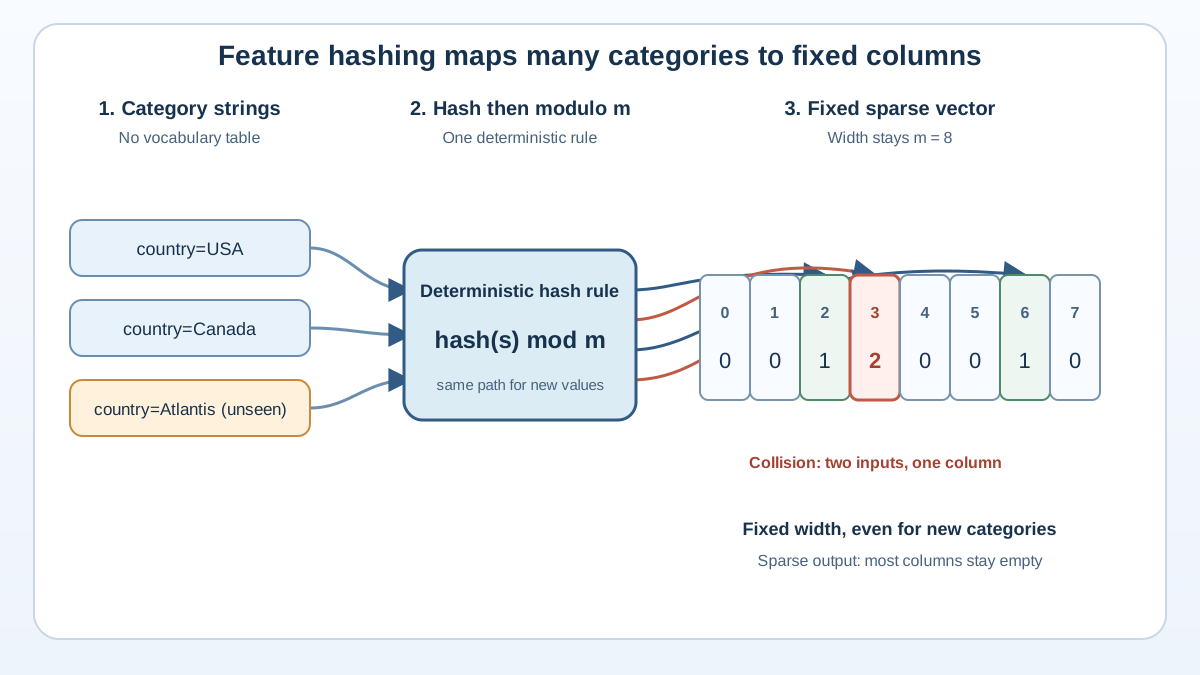
Here's the core move: stop maintaining a dictionary entirely. Run the category string through a hash function, take the result modulo your chosen vector size m, and use that number as the column index.
That's it. That's the whole trick.
Let's make it concrete. Suppose you've decided your hashed representation will have m = 1000 columns. A category like "country=USA" gets fed through a hash function, producing some large integer. You compute that integer modulo 1000, and the result—say, 437—is the column where "country=USA" lives. Tomorrow, a category you've never seen, "country=Atlantis", gets hashed and lands somewhere deterministic too. Maybe column 812. You didn't need to pre-scan your data. You didn't need to maintain a growing dictionary. You didn't need to decide what happens when a new country shows up, because the hash function doesn't care whether it has seen the string before.
This is called the hashing trick, and it has two properties that make it powerful for large categorical spaces:
- It's stateless. There's no vocabulary to store, grow, synchronize, or version. The transformation is a pure function of the input string.
- It's fixed-size. No matter how many categories exist in the wild, your feature matrix always has exactly
mcolumns.
The cost of these properties is that you no longer know which column belongs to which category. Column 437 might be "country=USA" today, but it's also where "browser=Firefox" could land. The encoder doesn't remember. That loss of inspectability is the price of admission.
Knowledge check
Check your understanding
Answer this question before you continue.
Why Collisions Happen and What They Cost
When two distinct categories hash to the same column, that's a collision. With m columns and far more than m possible categories, collisions are mathematically guaranteed. The question isn't whether they happen—it's whether they hurt.
Here's the counterintuitive part: collisions are not inherently fatal. When two categories share a column, the model sees their signals blended together. It can't tell whether the predictive weight on that column comes from one category or the other. But the model doesn't need to know. It just needs the blended signal to be useful for prediction. A collision adds noise, and noise is something models handle all the time.
The real dial is m, your output dimension. Smaller m saves memory but raises collision probability. Larger m reduces collisions but costs more memory and computation. There's a practical rule of thumb: choose m to be several times larger than the number of active features you expect per row. If a typical row has 50 non-zero categorical values, an m in the low thousands gives you plenty of room. But the honest answer is that cross-validation is the real tuning mechanism. Sweep m across a few orders of magnitude and watch validation performance.
One refinement worth knowing: the sign hash. Instead of always adding +1 to the hashed column, use a second hash function to decide whether the contribution is +1 or -1. When two categories collide, there's roughly a 50% chance their signs differ, which means their contributions partially cancel instead of accumulating. This doesn't eliminate collision noise, but it prevents systematic bias from collisions clustering in one direction.
Knowledge check
Check your understanding
Answer this question before you continue.
When Feature Hashing Wins (and When It Doesn't)
Feature hashing is not the right tool for every categorical feature. It's the right tool for a specific set of circumstances.
Use feature hashing when:
- Cardinality is huge or unbounded—user IDs, ad IDs, IP addresses, free-text tokens
- Data streams in and you can't pre-scan to build a vocabulary
- Memory is constrained and a one-hot matrix would be impractical
- You don't need to trace predictions back to specific categories
Skip feature hashing when:
- You need interpretability—regulatory requirements, debugging, or stakeholder explanations
- The category set is small enough that one-hot encoding is cheap and readable
- Downstream consumers need human-readable feature names
Here's how the main categorical encodings compare:
| Feature Hashing | One-Hot with Vocabulary | Target Encoding | |
|---|---|---|---|
| Memory | Fixed, bounded by m | Grows with cardinality | Grows with cardinality |
| Interpretability | Low—columns aren't traceable | High—each column maps to a category | Medium—columns are named, values are statistics |
| Unseen categories | Handled naturally | Dropped or error | Requires fallback logic |
| Leakage risk | None by construction | None | High if done naively |
That last row deserves emphasis. Target encoding, which replaces categories with their mean target value, has a genuine leakage problem when computed on the full training set. Feature hashing has no such risk because it never looks at the target. It's a stateless projection. That's a real advantage, not a footnote.
Knowledge check
Check your understanding
Answer this question before you continue.
Common Mistakes Beginners Make
I've watched people trip on the same feature hashing mistakes repeatedly. Here are the symptoms to recognize.
Mistake 1: Trying to read the hashed columns. You will be tempted to look at which column has the highest model weight and ask what category it represents. You can't answer that question. The column is an aggregation of many possible categories. If you need that traceability, you need a different encoding.
Mistake 2: Choosing m too small out of memory anxiety. I understand the instinct. You've been burned by a 100,000-column matrix and you want to compress aggressively. But if m is too small relative to your active features, collisions become so dense that the signal degrades. The fix is to treat m as a hyperparameter and validate it, not to guess at the smallest number that fits in memory.
Mistake 3: Assuming hashing removes all sparsity concerns. Feature hashing produces a sparse matrix, but it doesn't make sparsity irrelevant. Models that handle sparse data well—linear models, tree-based models with sparse support—still work best. And if you accidentally densify the hashed output, you've thrown away the memory advantage.
Mistake 4: Changing the hash function or m between training and prediction. The hash function and output dimension must be identical at training and inference time. If you update your library version and the hash function changes, or if someone reconfigures m in production, every feature index shifts. The model silently receives garbage. This is the kind of bug that doesn't error—it just degrades performance slowly while you hunt for the cause elsewhere.
The Tradeoff in One Sentence
Feature hashing trades a bounded amount of collision noise and nearly all interpretability for a fixed, stateless, memory-safe representation that handles any categorical space—including ones you haven't seen yet.
If you're facing a high-cardinality categorical feature, here's your next move: implement feature hashing with a reasonable starting m, then sweep m across a few values—say, 2^10 through 2^18—and compare validation performance against a vocabulary-based baseline. You'll likely find a sweet spot where hashing matches or beats one-hot encoding while using a fraction of the memory and zero vocabulary maintenance.
The hashing trick won't replace every encoding in your toolkit. But when your categorical space is huge, unbounded, or streaming, it's the rare representation that doesn't fight back as your data grows.
Knowledge check
Final check
Finish the article by checking the ideas you just learned.
References
Research updated Sep 8, 2026


