
Label Noise in Machine Learning: When the Target Teaches the Wrong Lesson
You've added features. You've tuned hyperparameters. You've tried a more flexible model. And still, validation performance sits at the same stubborn…

Key topics
You've added features. You've tuned hyperparameters. You've tried a more flexible model. And still, validation performance sits at the same stubborn ceiling, as if the model has decided it simply won't learn anything more.
Before you blame the model, consider a different suspect: the labels themselves. Your model learns whatever lesson your target teaches. If some of those targets are wrong, ambiguous, or inconsistent, you're not training a model—you're training it to repeat mistakes.
The Symptom: A Model That Stops Improving
Imagine you're building a spam filter. You've collected thousands of emails, labeled each one as spam or not spam, and trained a classifier. Validation accuracy stalls around 85 percent. You add better features—still 85 percent. You switch to a more powerful algorithm—85 percent. You tune parameters until your training score climbs—and validation barely moves.
This is the classic plateau: a performance ceiling that resists every model-side fix you throw at it.
The beginner instinct is to blame the model. More features, more complexity, more tuning—surely one of those will break through. But when the target itself is the problem, these reflexes fail because they're aimed at the wrong layer of the system. The model isn't the bottleneck. The lesson it's being taught is.
Here's the reframe that changes how you debug: the model is only as good as the lesson the target teaches it. If your training data contains emails labeled "spam" that are actually legitimate newsletters, your model will learn patterns that match those errors. No amount of model complexity fixes a wrong answer key.
So before you change the model, check what the target is actually saying.
Note: A plateau is a reason to inspect labels, not proof that labels are the cause. Limited features, distribution shift, or genuinely hard cases can also cap performance. The inspection steps below are how you tell the difference.
Knowledge check
Check your understanding
Answer this question before you continue.
What Label Noise Actually Is
Label noise refers to errors, inaccuracies, or inconsistencies in the target values your model is trained on. In classification, that means instances given the wrong class label. In regression, it means targets that are measured or recorded incorrectly.
To see it clearly, recall the distinction between features and targets: features are what the model sees, and the target is what it's told to predict. Label noise lives on the target side. The features can be perfectly clean, well-scaled, and informative—and the model will still fail if the targets lie.
Label noise shows up in three common forms:
- Errors: A human annotator misclicks and labels a cat photo as "dog."
- Ambiguity: A borderline image sits halfway between two categories, and the "correct" label depends on judgment.
- Inconsistency: Two annotators look at the same case and disagree, so similar examples end up with different labels.
These problems come from rushed manual labeling, unclear instructions, automated labeling pipelines, and problems where the answer genuinely isn't obvious.
Label noise also comes in two flavors, and the distinction matters:
- Random noise: Labels are flipped independently of the input. A small percentage of emails are mislabeled, but the errors aren't concentrated anywhere in particular. Random noise is annoying but relatively forgiving.
- Systematic noise: Mislabeling is tied to certain patterns or subgroups. Perhaps all emails with promotional language tend to get mislabeled, or one annotator handled a specific batch and made consistent errors. Systematic noise is more dangerous because the model can learn the error pattern itself—it will confidently reproduce the same mistake.
One more distinction matters for beginners: not every target problem is an annotation mistake. Targets can be wrong because of how they were measured, when they were recorded, or how the outcome was defined. A customer who churned but came back a week later isn't a misclick—the label "churned" may need a better definition or a different observation window. Sometimes the fix is redefining the target, not relabeling individual rows.
Knowledge check
Check your understanding
Answer this question before you continue.
How Noisy Targets Hurt Training and Evaluation
Here's the mechanism that makes label noise so insidious: the model treats every label as ground truth. It has no way to know which targets are reliable and which are corrupted. So it learns patterns that match the errors as faithfully as it learns patterns that match the real signal.
The damage shows up in two places.
Training gets corrupted through memorization. A flexible model can eventually memorize the wrong labels. Watch what happens: training performance climbs—sometimes to near perfection—while the model quietly absorbs the noise. The training score looks great, but the model has learned a mixture of real patterns and pure error. Generalization suffers because the memorized mistakes don't transfer to new data.
Evaluation gets corrupted too. If your validation or test labels contain noise, the score itself becomes an unreliable report card. You might be improving your model and never see it, because the noisy validation labels are punishing correct predictions and rewarding wrong ones. The measurement instrument is dirty, so you can't trust what it reads.
A small example makes this concrete. Picture a simple classification problem with two clusters of points and a decision boundary between them. Now flip one label near the boundary—say, a point that should be class A is labeled class B. The model will shift its boundary slightly to accommodate that wrong point. One flipped label pulls the boundary a little. A cluster of flipped labels in the same region pulls it a lot. The model isn't learning the true boundary between classes; it's learning a boundary that dodges around the errors.
Knowledge check
Check your understanding
Answer this question before you continue.
Label Noise vs. Underfitting vs. Data Leakage
When your model performs poorly, three failure modes deserve suspicion. They look different, and telling them apart saves you from fixing the wrong problem.
| Failure mode | Training score | Validation score | Error pattern |
|---|---|---|---|
| Underfitting | Poor | Poor | Model is too simple to capture the signal; errors are spread broadly |
| Data leakage | Great | Suspiciously great | Validation looks unrealistically good, then real-world performance collapses |
| Label noise | Can be great | Stuck at a ceiling | Confident mistakes on specific cases; erratic per-class errors |
Underfitting means the model is too simple for the signal in your data. Both training and validation scores are poor. The fix is more model capacity or better features. You'll recognize this from the training-versus-validation gap: there's no gap, because the model isn't learning well enough to overfit anything.
Data leakage means information from the future or the target itself leaked into the features. Validation looks unrealistically great—often near-perfect—because the model is cheating. When deployed on genuinely new data, performance collapses. The fix is finding and removing the leaked information.
Label noise sits between these two. Training can look fine—even great, if the model is flexible enough to memorize the errors. Validation stalls at a ceiling that resists improvement. The model may make confident mistakes on specific cases, repeating a wrong lesson with conviction.
Here's my decision rule for which diagnosis to suspect first: if validation looks too good to be true, check for leakage. If both scores are poor, check for underfitting. If training looks fine but validation is stuck at a ceiling, inspect your labels before you touch your model.
Common mistake: Don't treat a plateau as proof of label noise. Treat it as a trigger to investigate. The inspection steps below are what turn suspicion into evidence.
Knowledge check
Check your understanding
Answer this question before you continue.
How to Inspect Your Labels Before You Blame the Model
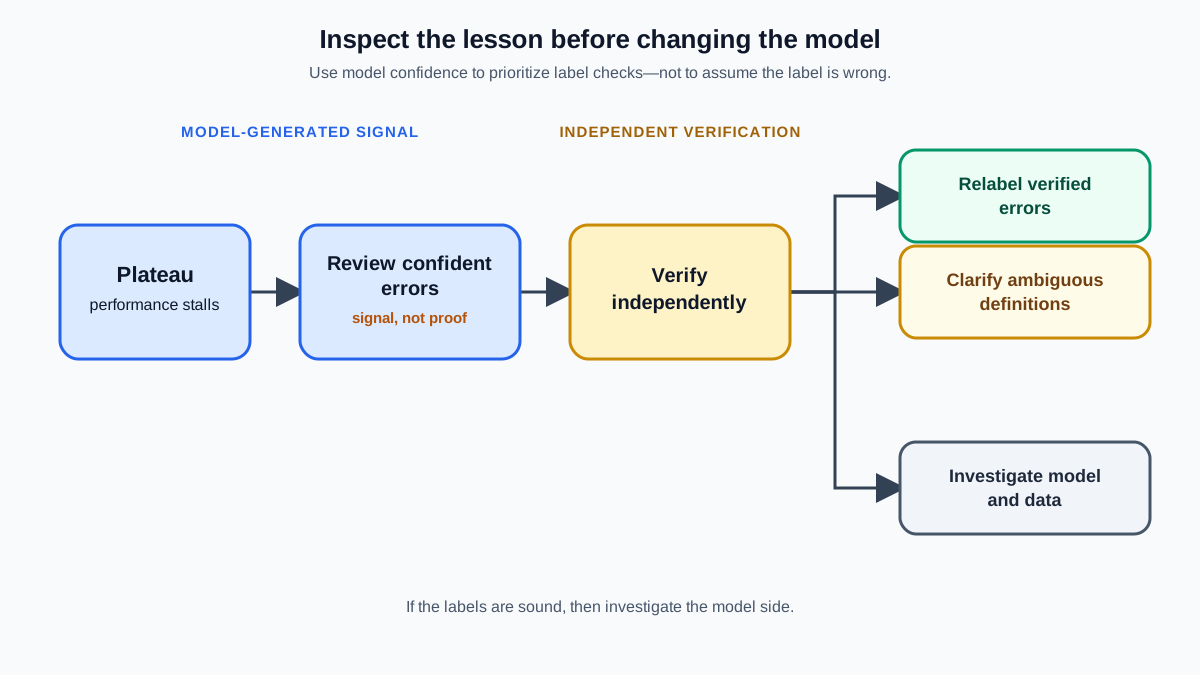
Label noise is a data problem, and data problems need data inspection. Before you change anything about the model, look at the labels themselves. These checks are cheap, and they'll tell you whether the target is the bottleneck.
Start with the hardest examples. Find the cases your model gets most wrong—especially the ones it gets confidently wrong, where it predicts with high probability and still misses. In scikit-learn, you can train a model, generate predictions, and sort your validation examples by prediction confidence. Look at the top of that list.
But here's the critical caveat: model confidence is a prioritization signal, not proof. A confident model can be wrong because of missing features, distribution shift, or systematic bias—not because the label is bad. Confidence tells you where to look, not what you'll find.
For each suspicious case, verify against something independent of the model:
- Re-read the original labeling rule. Does this example actually fit the definition?
- Check reliable metadata or source records that might confirm the true outcome.
- Ask a domain expert or a second annotator to review the case.
- If you have repeated labels for the same example, compare them.
Examine per-class error patterns. Systematic noise often concentrates in one subgroup. If your model confuses class A with class B far more often than any other pair, pull up examples from both classes and check whether the labels are trustworthy. Consistent errors in one region of your data point to systematic noise, not random bad luck.
Look for ambiguous or borderline cases. Some examples are genuinely hard to label. A blurry image, an email that's half promotion and half newsletter, a customer who churned but came back a week later. When you find these, ask whether the label definition itself is clear enough. Often, "noisy" labels are really ambiguous targets wearing a disguise.
Measure annotator disagreement. If multiple people or systems labeled your data, disagreement is a direct signal worth investigating. When two annotators disagree, the case may be genuinely ambiguous, the instructions may be unclear, or one annotator may have made an error. Disagreement alone doesn't tell you which—it tells you to look closer. If you don't have multiple annotators, you can have a second person (or yourself, on a different day) relabel a sample and compare.
Practical Fixes: Relabel, Clean, or Rethink the Target
Once you've confirmed label noise exists, work through these fixes from cheapest to most involved.
Relabel the worst offenders. Start with the cases you verified during inspection. Re-examine them by hand or with a domain expert. You don't need to relabel the whole dataset—just the worst offenders. A few hours fixing the most damaging errors can break through a plateau that weeks of model tuning couldn't touch.
Tighten the label definition. Many "noisy" labels are really ambiguous targets. If your churn model defines "churned" differently depending on who you ask, the problem isn't the annotators—it's the definition. Write down exactly what each label means, with edge cases spelled out. Clear instructions prevent inconsistency before it happens.
Use consensus labeling. When multiple annotators disagree, majority vote or expert review can resolve the conflict. This is more expensive, so reserve it for the cases where disagreement actually exists rather than relabeling everything.
Accept that some noise is irreducible. Some problems have inherent ambiguity. A medical image might genuinely sit on the boundary between two diagnoses. A customer who churns and returns makes "churned" a fuzzy concept. When the noise comes from the problem itself, no amount of cleaning will remove it. This sets a realistic performance ceiling—not a fixable bug.
So when is relabeling worth the effort? Work through this sequence:
- Identify a pattern. Is the noise concentrated in a specific subgroup or region?
- Sample the cases. Pull a handful and verify them against the labeling rule, not the model.
- Check the definition. Is the target itself clear, or does it need refinement?
- Estimate consistency. Would correction produce a clear answer, or would experts still disagree?
If the noisy cases are concentrated, systematic, and verifiably wrong, fix them. If the noise is a small, random sprinkling across the dataset, tolerate it and move on. If the cases are genuinely ambiguous, redefine the target rather than forcing a label.
When to Add Model Complexity (and When Not To)
Here's the warning that ties this together: when your target is noisy, adding model complexity often makes things worse.
Flexible models are better at memorizing. A simple model—a linear classifier, a shallow tree—can't absorb every wrong label, so it's forced to learn the broader patterns. A flexible model has the capacity to memorize the noise itself, fitting the errors so precisely that generalization collapses.
This is why the fix sequence matters. Inspect the labels. Relabel the worst offenders. Clarify the target definition. Then, and only then, revisit the model.
There are techniques that genuinely help with label noise—noise-robust loss functions, sample reweighting, early stopping—and they have their place. Early stopping, in particular, can prevent a model from entering the memorization phase where it starts absorbing noise. But these are tools for when you've already done your data-quality work, not substitutes for it.
The durable rule is simple: when a model plateaus, check the lesson the target is teaching before you change the student.
Here's your next step. Open your dataset, train your current best model, and generate predictions on your validation set. Sort the examples by prediction confidence and look at the top twenty that the model got wrong. For each one, pull the original labeling rule and ask: is the model wrong, or is the label wrong? Verify against the rule, not against the model's opinion.
You already know what to do with the answer.
Knowledge check
Final check
Finish the article by checking the ideas you just learned.
References
Research updated Sep 8, 2026


