
The IID Assumption in Machine Learning: When Random Splits Make Sense
You train a model, split your data randomly, and the test score looks great. Then the model meets real-world data and quietly falls apart. The usual…

Key topics
You train a model, split your data randomly, and the test score looks great. Then the model meets real-world data and quietly falls apart. The usual suspect is the model. But sometimes the culprit is the split itself.
Here is the uncomfortable truth about that random train_test_split you have run a hundred times: it is not a neutral, assumption-free measurement. Every random split is a bet about how your data was generated and what your model will face next. When that bet fails, your validation score stops meaning what you think it means.
This article walks through what IID actually means, why ordinary validation relies on it, and the three ways the assumption breaks: dependence, groups, and drift.
Why Your Random Split Can Lie
Imagine this scene. You have a dataset of customer transactions. You shuffle the rows, carve off 20 percent as a test set, train a model on the rest, and get an accuracy of 94 percent. Confident, you deploy the model. Three weeks later, it is noticeably worse on new transactions.
What happened? The model did not suddenly forget how to learn. The problem is that your validation setup and your deployment reality were answering different questions.
The weak mental model goes like this: a random split is a fair way to measure a model because it does not favor any particular rows. It feels neutral, like drawing names from a hat.
But shuffling rows only produces a fair measurement under a specific condition. If the data was generated with hidden structure — related observations, natural groups, or change over time — then shuffling destroys the very structure your model needs to learn. Your test score becomes a mirage: impressive in the lab, misleading in production.
What IID Actually Means
IID is an abbreviation for independent and identically distributed. It sounds like statistics jargon, but it is really two plain claims about how your data was generated.
Independent means that knowing one observation tells you nothing about the next. If you know the value of row 47, you have gained no information about row 48. There is no hidden thread connecting them.
Identically distributed means that every observation is drawn from the same underlying population. Row 1 and row 5,000 come from the same distribution, with the same patterns and the same range of possibilities.
A useful image: drawing numbered balls from a well-mixed urn. Each draw is fresh — the previous ball tells you nothing about the next one. And each draw comes from the same urn, so the distribution never changes. That is IID sampling.
Two clarifications matter here.
First, IID does not mean the data is balanced or unbiased. A loaded die still produces IID rolls — each roll is independent, and each comes from the same biased distribution. IID is about how observations relate to each other, not about whether the data is fair.
Second, IID is a property of the data-generating process, not something you can confirm by staring at a spreadsheet. You cannot look at a table of rows and columns and see independence. You have to reason about how the data was collected.
Knowledge check
Check your understanding
Answer this question before you continue.
What a Validation Score Actually Estimates
Here is the mental model that ties everything together: every validation scheme estimates performance for a particular kind of future.
A random split estimates how the model will perform on another random row from the same population. That is its job, and it does that job well — when the future really is another random row.
Grouped splitting estimates something different: how the model will perform on a group it has never seen. Time-based splitting estimates something different again: how the model will perform on a later time period.
The same model, the same data, and three different validation schemes can produce three different scores — because they are answering three different questions. The score is not wrong. The mismatch happens when the question your split answers does not match the question your deployment asks.
So when I say ordinary validation relies on IID, I mean something precise: random splitting treats every observation as interchangeable. It assumes row 500 could just as easily have been row 3, and the model would not care. That interchangeability is what makes a shuffled test set an honest estimate of the next random row.
When the assumption fails, shuffling becomes destructive. If your data contains related observations, groups, or time-based change, a random split scatters those structures across the train and test sets. The model gets to peek at near-duplicates of its training data during evaluation, and the test score inflates accordingly.
Knowledge check
Check your understanding
Answer this question before you continue.
Three Ways the Assumption Breaks
Dependence: observations that influence each other
Some data has a memory. Repeated measurements from the same sensor, spatial data where nearby locations correlate, or time series where today's value depends on yesterday's — these all violate independence.
When observations influence each other, knowing one leaks information about the next. A random split lets the model train on one member of a correlated pair and test on the other. The model looks like it learned a general pattern when it actually memorized a near-duplicate.
Visible symptom: an unrealistically high validation score that collapses when the model meets genuinely new data.
Groups: data that clusters into natural units
Some data comes in clusters. One patient with fifty hospital visits. One user with hundreds of sessions. One factory with thousands of product measurements.
A random split scatters each group across train and test. The model sees some of the patient's records during training, then gets tested on the rest. It does not need to learn medicine — it just needs to recognize that particular patient.
This is the classic group leakage problem. The model memorizes the group instead of learning the pattern that generalizes to new groups.
But here is the distinction that matters: not every repeated identifier requires a group split. The question is what your deployment actually asks.
If your model will predict outcomes for new patients — people who never appeared in training — then yes, split by patient. The model must prove it can generalize across the group boundary.
If your model will predict the next visit for patients already in your data — say, flagging which existing patients need follow-up care — then the deployment boundary is a new row from a known group. A random split is closer to the right question, because the model will see those same patients again in production.
The split must match the target generalization question. Group holdout is for the unseen-group question, not for every dataset that happens to contain repeated IDs.
Visible symptom: great performance on the shuffled test set, poor performance when the model meets a patient, user, or factory it has never seen.
Knowledge check
Check your understanding
Answer this question before you continue.
Drift: the distribution shifts over time
The world moves. Customer behavior changes with seasons and trends. Sensor readings drift as equipment ages. Fraud patterns evolve as criminals adapt.
When the distribution shifts over time, past data no longer represents the future your model will meet in deployment. A random split ignores time entirely, mixing old and new observations together. The model trains on a blend of eras and gets tested on another blend — but in production, it only faces the future.
Visible symptom: the model performs fine on shuffled historical data but degrades as time passes after deployment.
Knowledge check
Check your understanding
Answer this question before you continue.
The Deployment Question
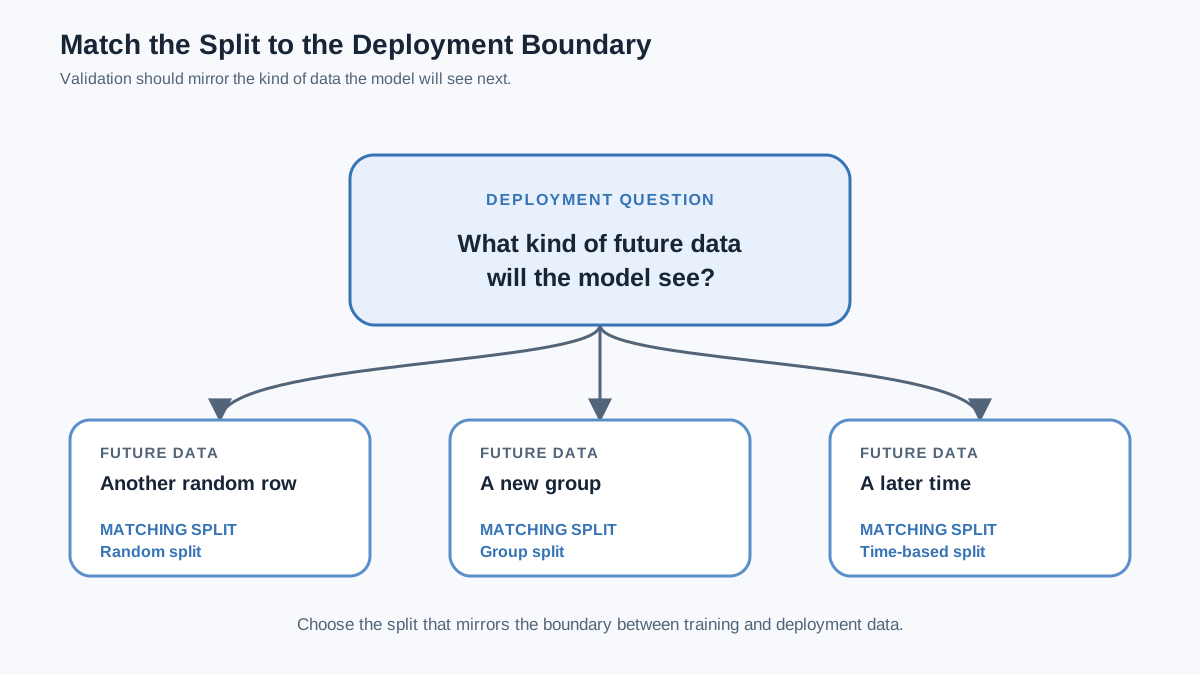
Here is the durable decision rule that turns all of this into a practical habit.
Stop asking "Is my data IID?" as if it were a property you can test once. Instead, ask the question that actually determines whether your validation scheme is honest: does my split mirror the boundary between the data the model sees at training time and the data it meets in deployment?
| Deployment asks for... | Evidence in your data | Split strategy | What the score estimates |
|---|---|---|---|
| Another random row from one stable population | No repeated IDs, no timestamp structure, one source | Random split or standard k-fold | Performance on the next random row |
| A new group the model has never seen | Repeated patient, user, or device IDs | Group split by identifier | Performance on an unseen group |
| A later time period | Timestamps, seasonal patterns, trends | Time-based split | Performance on the future |
When the deployment boundary is a random draw from one stable population, a random split is exactly right. If you are building a model to classify images scraped from the same source, and new images will come from that same source, shuffle away.
When the deployment boundary is a group, a time point, or a new source, your split must respect that boundary instead of shuffling across it.
Common mistake: treating a random split as the default and grouped or time-based splitting as a special case. In practice, it is the reverse. Ask what boundary the model will cross in real use, then choose the split that matches it.
How to Check Before You Split
Before you trust a random split, run through a short checklist about your data-generating process.
Were these observations collected independently? If one record came from the same patient, user, device, or location as another, you likely have dependence or groups.
Do the observations come from one population or several? If your data blends different sources, regions, or customer segments, the distributions may not be identical.
Does the future look like the past? If your data has a timestamp column, ask whether the patterns you are modeling are stable or drifting.
Then look for the structural tells in your data. Repeated identifiers — patient IDs, user IDs, device IDs — signal groups. Timestamps signal time-based structure. Source columns signal multiple populations.
No single statistical test settles whether your data is IID. This is a judgment informed by two things: how the data was produced, and how the model will be deployed. The checklist above is not a statistics lecture; it is a habit that takes thirty seconds and can save you from a misleading validation score.
The Honest Split
Here is the mental model worth keeping: the split is only as honest as the assumption underneath it.
A random split is not a default tool. It is a precise instrument that works when every observation is a fresh draw from one stable population — and when the future your model faces really is another draw from that same population.
So before you split, write down two things: the unit of your data (a row, a patient, a session, a day) and the direction of your deployment (another row, a new group, a later time). If the unit is a single independent row and the direction is more of the same, shuffle away. If either answer points to structure, choose the split that respects it.
That is exactly where grouped and time-based cross-validation come in. When your data has natural units or a temporal order, those methods give you a validation score you can actually trust — because they make the same bet your deployment will.
Knowledge check
Final check
Finish the article by checking the ideas you just learned.
References
Research updated Sep 8, 2026


