
Feature Selection vs Feature Engineering: Remove Signal or Build It?
You're staring at a wide table of columns, and the model is underperforming. The fix could mean deleting half the columns, reshaping the ones that remain,…

Key topics
You're staring at a wide table of columns, and the model is underperforming. The fix could mean deleting half the columns, reshaping the ones that remain, or inventing new ones from domain knowledge—and the worst part is that tutorials use the same umbrella term for all three moves. No wonder the choice feels blurry.
Here's the mental model that clears it up: feature selection prunes your candidate inputs. Feature engineering changes or builds the representation itself. One removes columns from the set the model sees; the other transforms existing columns or constructs new ones. Both live under the same umbrella, which is exactly why beginners confuse them—but they work on different parts of the problem.
Two Directions of Information Flow
Feature selection keeps a subset of the columns you already have and drops the rest. It changes which variables the model sees, not what those variables mean. A column called price_per_sqft stays price_per_sqft whether it survives selection or gets cut.
Feature engineering changes the representation—the form in which the model receives the inputs. That might mean transforming a column, like taking the log of a skewed price column, or building a new one, like dividing price by area to create price_per_sqft in the first place. Either way, you are not just choosing among available columns; you are reshaping what is available.
One honest boundary up front: neither operation creates information from nothing. Both rearrange or expose signal that already exists in your observed inputs. Selection removes candidate inputs that do not earn their place; engineering makes relationships easier for the model to see. Pruning does not destroy predictive signal when the retained representation is sufficient, and engineering does not conjure signal out of thin air.
The one-line decision handle I keep coming back to:
- Selection asks: Which of these columns earn their place?
- Engineering asks: What better column could I build from these?
If you have worked through the mechanics of building valid transformations, you already know the core discipline: a new feature is only worth anything if it generalizes beyond the training data. This article is about the decision before that—whether your problem calls for pruning, reshaping, building, or some combination.
Knowledge check
Check your understanding
Answer this question before you continue.
What Selection Actually Buys You
Selection reduces dimensionality without touching a single value. The surviving columns keep their original meaning, which means they keep their interpretability. When a domain expert asks what your model depends on, you can point at real columns with real names.
The wins are practical:
- Less noise for the model to chase
- Fewer parameters to fit
- Faster training
- A clearer story about which inputs matter
Selection is also a defense against overfitting. Irrelevant features give the model extra degrees of freedom to memorize training noise instead of learning the underlying pattern. Removing them narrows the space of stories the model can tell.
But here is the honest limit: selection can only choose among the representations you already have. If the relationship you care about only exists as an interaction between two weak columns, dropping either one can destroy it. A feature that looks useless in isolation—low correlation with the target, say—can become critical when combined with another feature through a nonlinear interaction.
This is the trap of filter methods that score each column alone. They see the weak individual signal and cut the column, never noticing that its real value only appears in combination. Selection is pruning, not planting. Pruning keeps a tree healthy; it does not grow new fruit.
Knowledge check
Check your understanding
Answer this question before you continue.
What Engineering Actually Buys You
Engineering earns its keep when the raw columns cannot express the relationship in a form the model can use. A model trying to predict delivery time from distance and traffic_delay separately may struggle to find a pattern that only emerges when you look at distance / traffic_delay as a ratio. The raw columns hide the relationship; the engineered column exposes it.
That is the real payoff: representation. You are not deleting noise—you are reshaping the data so the model can see what was always there but invisible.
The tradeoff is real, though. Every new column adds dimensionality, and aggressively generated feature pools can overfit badly when the dataset is small relative to the number of constructed features. Generate tens of thousands of new columns from a few hundred rows, and you have handed the model a perfect memorization machine.
Engineering also changes interpretability in both directions. A constructed ratio like debt_to_income can be more meaningful than its parts. But a heavily transformed projection—a transformation into a new coordinate system—can become a black box that no domain expert can read. You traded clarity for representation, and sometimes that trade is worth it—just know you made it.
The deeper risk is leakage. A new feature is only valid if it would be available and computable at prediction time. If your engineered feature uses information from the future, from the target, or from rows it should not see, you have built a feature that looks brilliant on training data and collapses in production.
Knowledge check
Check your understanding
Answer this question before you continue.
Selection vs Engineering: A Side-by-Side
| Dimension | Feature Selection | Feature Engineering |
|---|---|---|
| What it does | Chooses a subset of available columns | Transforms existing columns or creates new ones |
| Information content | Reduces redundancy and noise | Exposes hidden relationships; can add redundancy |
| Interpretability | Keeps original meaning intact | Can clarify meaning (a ratio) or obscure it (a projection) |
| Leakage risk | Leaks if selection peeks at the target before splitting | Leaks if features use future or out-of-fold information |
| Workflow timing | After engineering, or as a separate pruning stage | Before selection, ideally; must respect the split either way |
Use selection when: you have many noisy or redundant columns, interpretability of original variables matters, or the model is overfitting to irrelevant inputs.
Don't use selection when: the signal only exists in combinations of weak features, and no single column carries enough information on its own.
Use engineering when: the relationship you need is hidden in the raw representation—a ratio, a difference, a time window, a domain-derived quantity.
Don't use engineering when: you cannot guarantee the new feature would be computable at prediction time, or when you are generating hundreds of features from a small dataset without a validation strategy.
The Order That Keeps Validation Honest
Here is the rule that governs both operations: any choice informed by the target or by the full dataset must happen inside cross-validation, not before the split.
The reason is simple. If you select features by measuring their correlation with the target on the full dataset, then split into train and test, your test set has already influenced which features you kept. The test score is contaminated. It looks honest, but it is not.
The same logic applies to engineering. Defining a transformation from domain knowledge—say, area = length × breadth—is generally safe before splitting, because the definition does not depend on the data. But any feature whose construction is tuned to improve a validation score must be refit inside each fold. The same goes for selection methods that fit models against the target: they are model-selection decisions and belong inside the same resampling process.
The practical pattern:
- Define the transformation once.
- Fit any parameters it needs on the training fold only.
- Apply it to the validation fold.
Filter selection that uses only X—variance, correlation between features—is safer than wrapper or embedded methods that fit models against the target. But "safer" is not "safe." If you are not sure whether your selection method peeked at the target, assume it did and move the whole operation inside cross-validation.
If you have read about leakage before, this is the same disease in a different costume. The cure is identical: respect the split.
Knowledge check
Check your understanding
Answer this question before you continue.
Choosing What Your Problem Needs
Start from the symptom, not from the technique.
Too many noisy columns and a wide table? That points to selection. You have signal, but it is buried in noise and redundancy. Prune.
A relationship the raw columns cannot express? That points to engineering. The signal exists, but the representation hides it. Build.
Interpretability of original variables matters most? Lean selection. You keep the columns your stakeholders can read.
The pattern only exists in a combination? Engineering is the only path. No amount of pruning will manufacture an interaction that is not represented.
Here is the part beginners miss: these two are not rivals. Real workflows almost always do both. The mistake is treating them as separate sequential stages with a hard boundary. Engineer a small, defensible set of domain features first, then let selection prune the ones that do not earn their place. The engineering creates candidates; the selection judges them.
My rule is to engineer conservatively and select aggressively. Build a handful of features you can justify from domain knowledge, then let selection cut the ones that do not pull their weight. A small, defensible feature set beats a thousand generated columns every time.
The Decision Rule
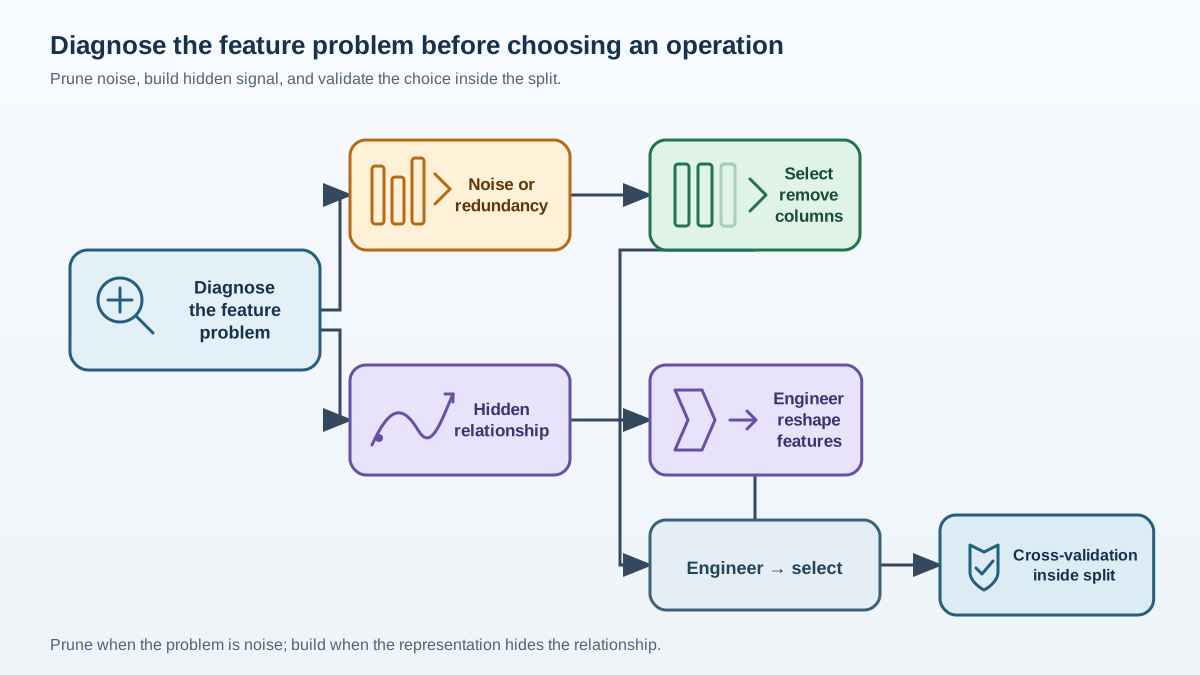
Name the symptom, choose the operation, respect the split.
Here is your concrete next step: pick one dataset you are working with, and before touching any code, write down one sentence answering this question—is my problem noise to prune or a hidden relationship to represent?
If the answer is noise, reach for selection. If it is a hidden relationship, reach for engineering. If you are not sure, do not guess. Run a small three-way comparison under the same cross-validation: a raw-feature baseline, a version with one or two meaning-preserving transformations, and a version where selection prunes the engineered set. Compare validation scores and model complexity, then keep the simplest representation that earns a repeatable improvement. "Engineer then select" is a useful candidate workflow, not a law—let your validation results tell you which representation actually earns its place. The code comes after the diagnosis, not before it.
Knowledge check
Final check
Finish the article by checking the ideas you just learned.
References
Research updated Sep 8, 2026


