
One-Hot Encoding in Machine Learning: Turn Categories Into Model Inputs
Your data is clean. Your rows are ready. Then you feed the model a column of colors—"red", "green", "blue"—and it refuses to train. The error message is…

Key topics
Your data is clean. Your rows are ready. Then you feed the model a column of colors—"red", "green", "blue"—and it refuses to train. The error message is unhelpful, but the problem is simple: most classical machine learning models only understand numbers. Your column of words is invisible to them.
The tempting shortcut is to assign each color a number. Red becomes 1, green becomes 2, blue becomes 3. The model trains without complaint. But you've just taught it something that isn't true: that blue is three times "more" than red, and that green sits exactly halfway between them. For categories with no natural order, that invented ranking quietly corrupts your model's understanding.
One-hot encoding is the fix. It gives each category its own on/off switch instead of a position on a number line.
Why a Column of Words Won't Reach the Model
Most classical machine learning models—linear regression, logistic regression, support vector machines, k-nearest neighbors—operate on numbers. They multiply weights, compute distances, and find decision boundaries. A string like "red" has no numeric value a model can consume directly.
This is the categorical-versus-numerical distinction at the heart of data preparation. Numerical features have meaningful magnitudes: a house with 2,000 square feet is twice the size of one with 1,000. Categorical features, by contrast, hold labels that name a group or type. The values in a categorical column are discrete possibilities, not measurements along a scale.
So the real question becomes: how do you turn a category into features a model can actually use, without inventing a ranking that doesn't exist?
Knowledge check
Check your understanding
Answer this question before you continue.
What One-Hot Encoding Actually Produces
One-hot encoding answers that question by creating one new binary column for each distinct category. Each column acts as an indicator: it holds a 1 when the row belongs to that category and a 0 when it doesn't.
Here's a small worked example. Suppose you have a color column with three possible values:
| color |
|---|
| red |
| green |
| blue |
| red |
After one-hot encoding, that single column becomes three:
| color_red | color_green | color_blue |
|---|---|---|
| 1 | 0 | 0 |
| 0 | 1 | 0 |
| 0 | 0 | 1 |
| 1 | 0 | 0 |
Notice what happens in each row: exactly one column holds a 1, and the rest hold 0s. That's where the name comes from—each row has exactly one column "lit up" like a hot wire, while the others sit cold at zero.
If you've encountered the term dummy variables in statistics, it's the same idea wearing different clothes. One-hot encoding is the machine learning name for creating indicator columns that mark category membership.
Knowledge check
Check your understanding
Answer this question before you continue.
Why Not Just Number the Categories?
The integer-label shortcut feels reasonable because it produces numbers the model can consume. But it smuggles in assumptions about order and spacing that don't exist in nominal categories.
Consider what happens when you encode red=1, green=2, blue=3. A linear model treats those numbers as real quantities. It learns a coefficient for the color feature, which means it will treat blue as three times "more" of something than red. A distance-based model like k-nearest neighbors treats red and green as closer together than red and blue, purely because 1 and 2 are nearer than 1 and 3. Neither assumption reflects reality. The colors aren't ordered, and the gaps between them aren't equal.
This matters most for linear and distance-based models, which are sensitive to the numeric spacing of their inputs. Tree-based models are more tolerant of arbitrary integer labels because they split on thresholds rather than computing distances. But unless you have a specific reason to trust integer labels, one-hot encoding is the safer default for nominal categories.
The tradeoff is real, though. One-hot encoding removes false order, but it pays for that honesty in extra columns. A single categorical feature with ten distinct values becomes ten columns. That cost is worth understanding before you choose.
When One-Hot Encoding Is the Right Tool
One-hot encoding shines when your categories are nominal—unordered, independent groups—and the number of distinct values stays small. Colors, countries, product types, and job titles all fit this pattern. If a feature has five or ten categories, the resulting columns are manageable and the encoding is easy to interpret.
It also works cleanly with the models that need it most. Linear models, logistic regression, and distance-based algorithms all require numeric, non-ordered inputs. One-hot encoding gives them exactly that.
But not every categorical feature deserves one-hot treatment. Ordinal categories—like low, medium, high—already carry a meaningful order. Encoding them as 1, 2, 3 preserves information that one-hot encoding would throw away. When the ranking is real, integer labels aren't a lie; they're a summary.
My rule of thumb: if the categories have no natural order and there aren't many of them, one-hot encoding is the default choice. If the categories are ordered, use an ordinal encoding that respects the sequence.
Knowledge check
Check your understanding
Answer this question before you continue.
The Cost: More Columns and Sparse Data
Every category adds a column, and that arithmetic can get expensive. A feature with 500 unique values becomes 500 columns. A second feature with hundreds of categories doubles the damage. Before long, your tidy table has exploded into a wide matrix where most cells contain 0.
This is called a sparse matrix, and it carries practical consequences. More columns mean slower training and more memory usage. With limited data, the extra dimensions also increase the risk of overfitting—the model finds patterns in the noise because it has so many features to work with.
High-cardinality features are the warning sign. Cardinality simply means the number of distinct values in a feature. ZIP codes, user IDs, and product identifiers can have thousands of distinct values. One-hot encoding them produces a feature matrix that's mostly zeros and mostly useless. When you see a feature with hundreds of categories, it's time to consider alternatives like frequency encoding, target encoding, or embedding-based approaches.
Knowledge check
Check your understanding
Answer this question before you continue.
The Leakage Trap: Categories Must Be Learned From Training Data Only
Here's the subtle failure mode that catches many beginners. The set of categories in your data is knowledge about the world. Like any other knowledge, it must be learned from training data alone. If your encoder sees test categories during fitting, information crosses the evaluation boundary—and your validation scores stop meaning what you think they mean.
The correct sequence is simple: split your data first, fit the encoder on the training set only, then transform both training and test sets with that same fitted encoder. The encoder's vocabulary—the list of categories it knows—comes entirely from training data. When the test set contains a category the training data never saw, that category simply has no column. It's unknown by definition.
Two separate mistakes hide in this area, and it helps to keep them apart:
- Fitting on all data before splitting leaks category vocabulary. If a category appears only in the test set, the encoder learns it exists and creates a column for it. The model never saw that column during training, yet the encoder built the feature space using test information. Your evaluation is compromised.
- Encoding train and test separately creates mismatched columns. If you call
get_dummiesindependently on each split, a category that appears only in the test set produces a column there that doesn't exist in the training set. The model receives input with a different shape than it learned.
Scikit-learn's OneHotEncoder prevents both problems with a clean fit/transform split. You call fit on training data to learn the category vocabulary. You call transform on any new data to apply that same vocabulary. The handle_unknown parameter lets you decide what happens when an unseen category appears: raise an error, or ignore it.
Note: When
handle_unknown='ignore'produces a row of all zeros, that doesn't mean the model learned anything about the new category. It means the category has no indicator column, so no switch gets flipped. The feature shape stays stable, but the model sees "none of the known categories"—which is useful for keeping predictions working, not for teaching the model what the new category means.
If you're already using scikit-learn pipelines, the encoder belongs inside the pipeline. That keeps fit-time and transform-time behavior consistent across training and evaluation, and it prevents the leak from ever happening.
One-Hot Encoding in scikit-learn: The Mental Model
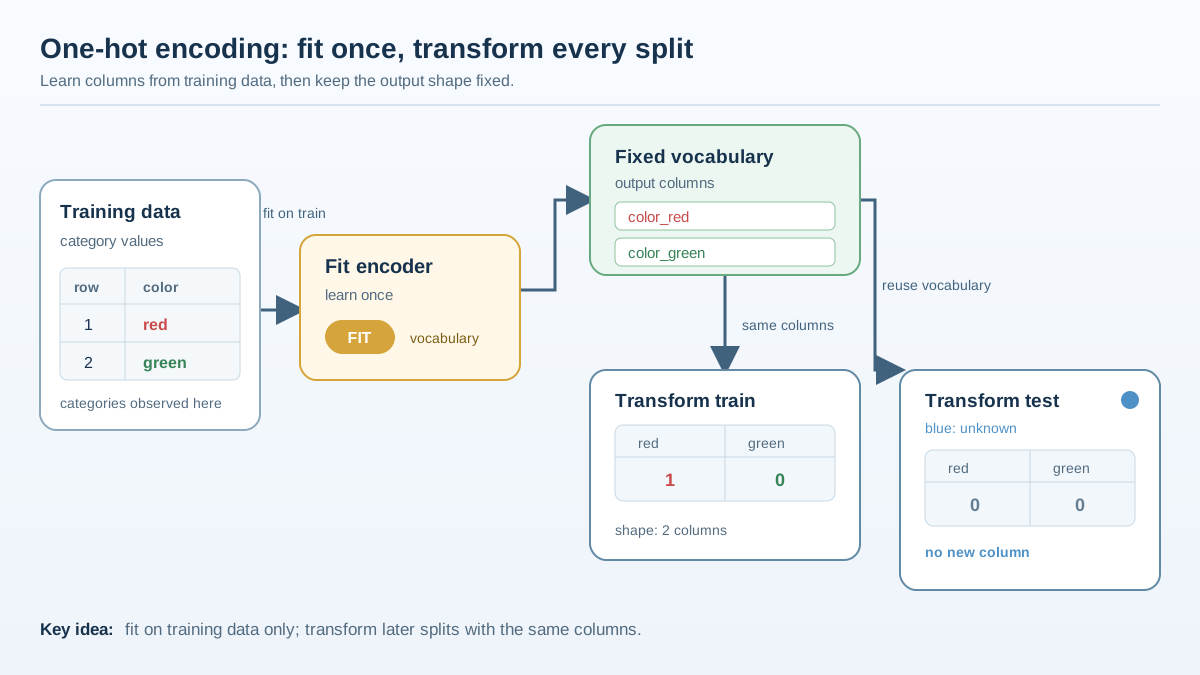
The fit/transform rhythm is the core mental model for OneHotEncoder. Think of fit as the encoder reading the training data and writing down the complete list of categories it sees. That list becomes its vocabulary. Think of transform as the encoder taking any new data and checking each value against that vocabulary—creating the appropriate indicator columns for known categories and handling unknown ones according to your settings.
Here's the shape of a leakage-safe workflow:
from sklearn.model_selection import train_test_split
from sklearn.preprocessing import OneHotEncoder

X_train, X_test, y_train, y_test = train_test_split(X, y, random_state=42)

encoder = OneHotEncoder(handle_unknown="ignore")
encoder.fit(X_train[["color"]])

X_train_encoded = encoder.transform(X_train[["color"]])
X_test_encoded = encoder.transform(X_test[["color"]])
The encoder learns its vocabulary from X_train only. When transform runs on X_test, it applies that same fixed vocabulary. A color that never appeared in training produces no new column—it simply activates no indicator.
This discipline is what separates scikit-learn's approach from pandas' get_dummies. The pandas function is convenient: you hand it a DataFrame and it derives categories from whatever data it sees. That's fine for quick exploration. But get_dummies doesn't separate learning the vocabulary from applying it—you have to manage that alignment yourself. If you call it on your full dataset before splitting, the category vocabulary includes test information. If you call it separately on each split, you risk mismatched columns.
OneHotEncoder makes the safer workflow explicit. It stores the vocabulary as learned state, fits naturally inside a pipeline, and applies the same categories to every dataset you transform afterward.
The Decision Rule to Carry Forward
One-hot encoding is the right default for nominal categories with few distinct values. It converts words into numbers without inventing a false order, and it works cleanly with the classical models most beginners start with.
But two conditions keep it honest. First, watch the column count: when categories multiply, the sparse matrix becomes a liability rather than a convenience. Second, and more importantly, the category vocabulary must always come from training data alone. Fit the encoder on your training set. Transform everything else with that fixed vocabulary. Bundle it in a pipeline so the discipline becomes automatic.
The best way to make this stick is to watch it happen. Fit an encoder on a small training set, transform a test set that contains a category the training data never saw, and observe how the encoder responds. Try both handle_unknown settings. You'll see the vocabulary stay fixed, the unknown category produce no active indicator, and the feature shape remain consistent. That single experiment will teach you more about leakage-safe encoding than any explanation can.
Knowledge check
Final check
Finish the article by checking the ideas you just learned.
References
Research updated Sep 8, 2026


