
Scikit-Learn Pipelines Explained: Keep Preparation and Prediction Together
You fit a scaler on your full dataset, split into training and test sets, train a model, and watch it score beautifully. Then the model meets real data and…

Key topics
You fit a scaler on your full dataset, split into training and test sets, train a model, and watch it score beautifully. Then the model meets real data and quietly falls apart. The score was a lie, and the scaler was the leak.
This is one of the most common beginner failures in machine learning, and it is not a discipline problem. It is a structural one. The fix is not to try harder. The fix is to package your preprocessing and your model together so the correct order becomes automatic—provided you put every data-learning step inside that package before you evaluate anything.
That packaging tool is the scikit-learn pipeline.
The Mistake That Pipelines Fix
Here is the scene. You have a dataset, you want to scale your features before training a model, and your mental model of preprocessing goes something like this: clean the data first, then split it, then train.
So you write:
scaler = StandardScaler()
X_scaled = scaler.fit_transform(X)   # fit on everything
X_train, X_test, y_train, y_test = train_test_split(X_scaled, y)
model.fit(X_train, y_train)
The model trains, the accuracy looks great, and you move on. Weeks later, the model ships and underperforms on new data. What happened?
The scaler learned its parameters—the mean and standard deviation of each feature—from the entire dataset, including the rows you later set aside as your test set. Information from your test set quietly traveled backward into your training data. The model never saw a truly unseen test set. It saw a test set that had already influenced how the training data was prepared.
This is a form of data leakage, and the visible symptom is usually the same: a score that looks too good to be true, followed by a model that disappoints in the real world.
The weak mental model here is treating preprocessing as a one-time cleanup that happens before the train/test split. Preprocessing is not cleanup. Preprocessing is a learned step. A scaler learns from data, just like a model does, and anything that learns from data must learn only from training data.
That last sentence deserves a boundary, because "preprocessing" is a broad word. Some preparation is deterministic: fixing column types, dropping rows with missing identifiers, or correcting inconsistent string formats. Those steps do not estimate anything from your data, so doing them before a split is harmless. The danger lives in steps that calculate statistics, discover categories, fill missing values, or select features—anything whose output would change if it saw different rows. Those steps belong inside the evaluation workflow.
You could try to remember this every time. You could write careful code that fits the scaler on the training split only, then transforms the test split with the already-fitted scaler. That works, but it depends on you being careful every single time, in every notebook, on every late night. I prefer a fix that does not depend on my discipline.
What a Pipeline Actually Is
A scikit-learn pipeline is a list of named steps that run in order. Every step before the last must be a transformer—an object that can learn from data and then modify data. The final step is the estimator—the model that learns from data and makes predictions.
Here is a minimal pipeline:
from sklearn.pipeline import Pipeline
from sklearn.preprocessing import StandardScaler
from sklearn.linear_model import LogisticRegression

pipe = Pipeline([
    ("scaler", StandardScaler()),
    ("model", LogisticRegression())
])
That is the whole idea. Two steps, chained. The scaler transforms the data, then the model trains on the transformed data.
Think of an assembly line. Raw parts enter at one end. Each station does one job—cleaning, shaping, fitting—and passes the result to the next station. The product that exits the line is the finished model. The analogy holds well for the order of operations, but it stops being exact in one important way: the stations on this line do not just process parts. They also learn from the parts they see. That learning behavior is where the real power lives.
The key insight is that a pipeline behaves like a single estimator object. It has a fit method, a predict method, and a score method, just like a model. You can pass a pipeline into cross-validation, into a grid search, into any scikit-learn tool that expects an estimator. From the outside, it looks like one model. On the inside, it is a coordinated sequence of preparation and prediction.
Knowledge check
Check your understanding
Answer this question before you continue.
Fit-Time vs Transform-Time: The Heart of It
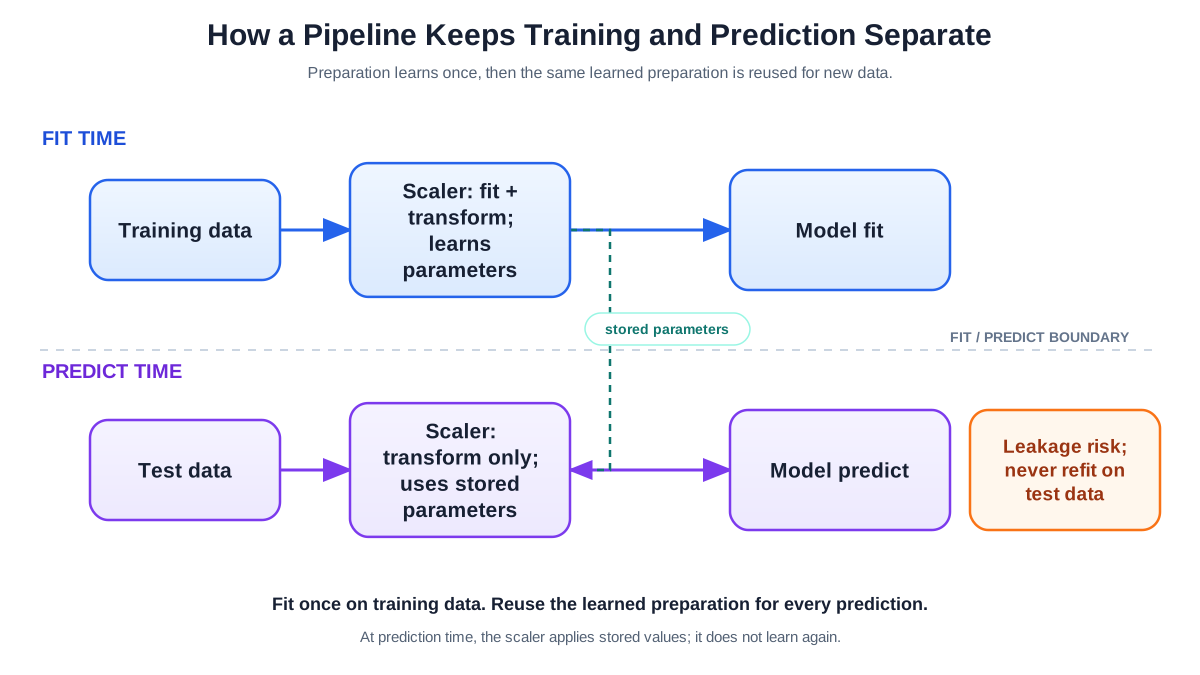
The single most confusing thing about pipelines is that they do different work depending on whether you are training or predicting. Let us trace both paths.
When you call pipe.fit(X_train, y_train), the pipeline runs a specific sequence:
- The scaler fits on
X_train. It computes the mean and standard deviation of each feature from this data alone. - The scaler transforms
X_train, producing a scaled version of the training data. - The scaled training data flows to the model.
- The model fits on the scaled training data.
Every transformer in the chain does the same dance: fit, then transform, then pass the result to the next step. The final estimator only fits.
When you later call pipe.predict(X_test), something different happens:
- The scaler transforms
X_testusing the mean and standard deviation it already learned at fit time. - The scaled test data flows to the model.
- The model predicts.
Notice what does not happen at predict time. The scaler does not re-fit. It does not recompute its parameters from the test data. It applies parameters that were learned once, during training, and never touches them again.
This is the distinction between fit-time and transform-time behavior. At fit time, transformers learn. At transform time, they only apply what they already learned.
The same logic applies to encoders, imputers, and any other preprocessing step. A SimpleImputer learns the median of a column at fit time and applies that stored median to new data at transform time. A OneHotEncoder learns the category list at fit time and applies that fixed list to new data. Nothing that arrives later ever changes what was learned.
Knowledge check
Check your understanding
Answer this question before you continue.
Why Bundling Prevents Leakage
Now connect this back to the original mistake. When you fit a scaler on the full dataset before splitting, the scaler learns statistics that include test rows. Those test statistics become part of how your training data is prepared. The model trains on data that has already been influenced by the test set, and your evaluation score is inflated.
A pipeline prevents that mistake when you use it as the estimator inside your evaluation workflow. The key is where the split happens.
With a holdout test set, the order is: split the raw data first, then fit the pipeline on X_train, then predict on X_test. The scaler inside the pipeline learns only from training rows.
With cross-validation, the same principle repeats on every fold. When you pass a pipeline into cross_val_score, scikit-learn splits the data into folds and, for each fold, fits the entire pipeline on the training portion only. The scaler inside the pipeline learns its parameters from that fold's training rows. Then the pipeline transforms the validation portion using those training-learned parameters. Then the model trains and scores.
Each fold repeats this process from scratch. The preprocessing is re-fit on every training fold, never on the validation fold, never on the whole dataset.
This is why bundling matters. The pipeline does not just keep your code tidy. It enforces the evaluation boundary that manual preprocessing code so easily crosses. If a step learns anything from data, it belongs inside the pipeline. That is the decision rule.
Knowledge check
Check your understanding
Answer this question before you continue.
What Pipelines Do Not Do
Pipelines are powerful, but they are not magic, and it helps to be honest about their boundaries.
A pipeline does not clean your data. If your dataset has garbage values, inconsistent formats, or nonsense entries, a pipeline will not fix that. Deterministic data cleaning happens before the pipeline, at the level of raw data inspection.
A pipeline does not choose your features or fix a bad model. If your features are uninformative or your model is wrong for the problem, chaining them into a pipeline will not help. The pipeline preserves the quality of its inputs; it does not improve them.
A pipeline handles linear chains of steps. Data flows through one step after another in a straight line. If you need to apply different preprocessing to different columns—scaling numerical features while one-hot encoding categorical ones—you need a different tool called ColumnTransformer, which can be composed with a pipeline. That is a natural next step after you are comfortable with the basic pattern.
And here is the warning that matters most: a pipeline only prevents leakage from steps you actually put inside it. If you scale your data outside the pipeline and then feed the scaled data into a pipeline that contains only a model, the leakage has already happened. The pipeline cannot protect you from preprocessing that occurs before it. Everything that learns from data must live inside the pipeline.
Knowledge check
Check your understanding
Answer this question before you continue.
When to Use a Pipeline (and When Not To)
Use a pipeline whenever you have any preprocessing step that learns from data and you plan to evaluate how well your model generalizes. That covers most real workflows: comparing models, tuning hyperparameters, running cross-validation, or preparing a model for deployment.
The reason is simple. If you are measuring generalization, every step that learns must be re-fit inside each training fold. A pipeline guarantees this automatically. Without one, you are one careless line of code away from a silently inflated score.
A plain approach is acceptable while you are exploring data or learning an API, when no score will be treated as evidence. But the moment a score, feature choice, or model comparison will influence a decision, restart the evaluation with the split first and learned preprocessing inside the workflow. Exploration has a way of becoming evaluation without a clear boundary, so make the pipeline the default for anything you will reuse, compare, or trust.
My rule is plain: if you are measuring how well a model generalizes, preprocessing belongs in the pipeline.
Build One Small Pipeline
The fastest way to make this concrete is to build a tiny pipeline yourself. Take any small dataset, build a pipeline with a scaler and a simple model, and run it through cross-validation.
from sklearn.pipeline import Pipeline
from sklearn.preprocessing import StandardScaler
from sklearn.linear_model import LogisticRegression
from sklearn.model_selection import cross_val_score

pipe = Pipeline([
    ("scaler", StandardScaler()),
    ("model", LogisticRegression())
])

scores = cross_val_score(pipe, X, y, cv=5)
Run that, then think about what happened. Five times, the scaler learned new parameters from a different training fold. Five times, those parameters were applied to a validation fold the scaler had never seen. The preprocessing was re-fit automatically, correctly, every single time.
That is the durable mental model: a pipeline is a single estimator that learns its preprocessing only from training data. Once that clicks, the natural next direction is tuning. Because a pipeline behaves like one estimator, you can search over its internal parameters—the scaler's settings, the model's hyperparameters—with tools like GridSearchCV, and every candidate configuration gets evaluated with leakage-free preprocessing.
The assembly line runs itself. You just have to put the right stations on it.
Knowledge check
Final check
Finish the article by checking the ideas you just learned.
References
Research updated Sep 8, 2026


