
Inference Input Schemas: Stop New Data From Quietly Breaking Predictions
You load a saved model, feed it a fresh batch, and get predictions back. No error. No warning. Just numbers that look perfectly reasonable—except a column…

Key topics
You load a saved model, feed it a fresh batch, and get predictions back. No error. No warning. Just numbers that look perfectly reasonable—except a column was renamed upstream, and every feature quietly shifted into the wrong slot. The model never complained because it never knew the column names in the first place.
That gap between what your fitted pipeline expects and what your new data actually provides is the machine learning inference input schema problem. It is the difference between a model that fails loudly and one that fails silently, and it is why your saved pipeline deserves a visible guard before every predict call.
Why a Fitted Model Can Predict on the Wrong Data
Here is the misconception that causes most of the pain: people assume a fitted scikit-learn estimator remembers the DataFrame it was trained on. It does not.
A fitted estimator holds learned parameters—coefficients, splits, class probabilities. It does not hold a memory of your column names, their order, or the dtype labels you saw in pandas. By the time data reaches the model, it has been transformed into a numeric feature matrix. The model consumes positions and values. Everything about names and meaning was resolved upstream by your preprocessing steps.
That is why the real input contract belongs to the whole saved pipeline, not the estimator alone. If you saved only the model and rebuilt preprocessing from scratch at inference time, you created two separate code paths that can drift apart even when the model file is identical. Training code and inference code become asymmetric: one does feature engineering one way, the other does it slightly differently, and nobody notices until the predictions look wrong.
If you have already saved a complete pipeline with its preprocessing steps, you have solved half the problem. The pipeline carries the transforms with it. What it does not carry, by default, is a record of what it expects to receive.
Knowledge check
Check your understanding
Answer this question before you continue.
Follow the Data Through the Pipeline
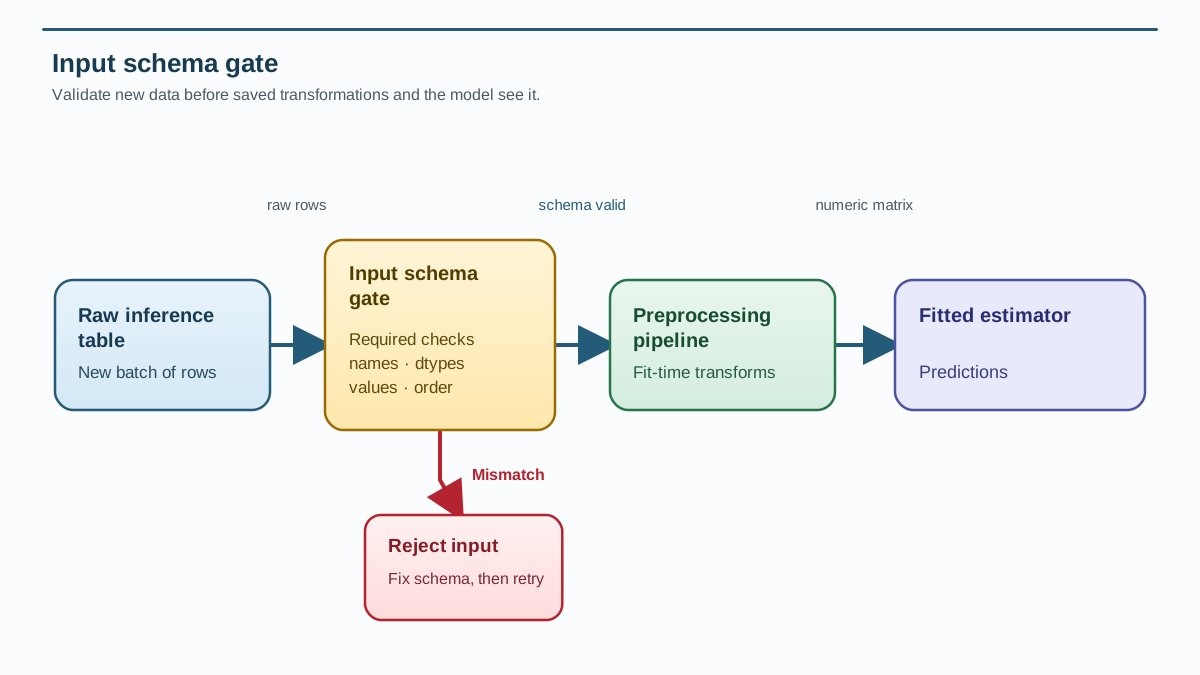
To see where the contract lives, trace what happens to a raw table between your database and the model's predict method:
- Raw table — the DataFrame you load from upstream, with the column names your source system actually produces.
- Pipeline selectors —
ColumnTransformersteps that pick columns by name and route them to the right transformers. - Transformed matrix — the numeric feature matrix that comes out of preprocessing.
- Estimator — the fitted model that consumes that matrix by position.
The guard you want sits at boundary one. It checks the raw table before the pipeline touches it, because that is the representation your upstream systems control. The transformed matrix is a debugging artifact, not the contract. If you validate the transformed feature names instead, you are checking the pipeline's internal output—and by then, bad input has already been silently absorbed.
This distinction matters most when you handle a DataFrame by name versus a manually constructed matrix. A pandas-aware pipeline can select columns by name, so order is flexible as long as the names are right. A raw NumPy matrix has no names at all. If you build one by hand, you have taken on the responsibility of matching the exact column order the pipeline expects, and a single reordering becomes a silent semantic break.
Knowledge check
Check your understanding
Answer this question before you continue.
The Input Schema: What the Pipeline Expects to Receive
An input schema is the set of rules new data must satisfy before it is safe to score. For a classical pipeline, that means four things:
- Feature names — which columns must exist
- Dtypes — whether values arrive as numbers, strings, or dates
- Value domains — the categories and ranges preprocessing assumed
- Column order — the sequence the pipeline expects when you feed it a raw matrix
There is an important distinction here. The raw-data schema describes what your source table looks like when it arrives from upstream. The model-input schema describes what the fitted pipeline expects after its own transforms. These are not the same thing, and confusing them is a common source of bugs.
Consider a pipeline trained with a OneHotEncoder that saw three categories in a column. At inference time, a fourth category appears. If the encoder was configured to ignore unseen categories, it will silently drop the new value. If it was not, the pipeline may crash or produce a misaligned matrix. Either way, the model's assumptions about the world no longer match the data you are feeding it.
Scalers and categorical encoders bake in assumptions about ranges and categories. A StandardScaler remembers the mean and variance of training data. A OneHotEncoder remembers the exact category set. When new data violates those assumptions, the pipeline does not adapt—it either errors or quietly produces distorted features.
The uncomfortable truth is that this schema is not stored in the model file by default. You must capture it yourself, at training time, and carry it alongside the saved pipeline.
Hard Failures vs. Silent Semantic Changes
Input problems fall into two buckets, and only one of them gets your attention.
Hard failures crash loudly. A missing column raises a KeyError. A column count mismatch raises a ValueError. A dtype mismatch may raise an exception during transformation. These are annoying, but they are visible. You know something broke, and you can fix it.
Silent semantic changes produce predictions that look fine and are wrong. A column renamed from age_years to age while a different age column already exists shifts every feature into the wrong slot without a single error. A categorical column gains a new level after deployment, and the encoder silently drops it. A numeric feature arrives as text, parses successfully, and changes the distribution the scaler was tuned for.
The dangerous class is the silent one. Here is a concrete scenario: your training table had columns [age, income, credit_score]. Upstream renames credit_score to fico_score and adds a new credit_score column that means something else entirely. Your pipeline runs without error. It produces predictions. But every row now feeds the model a different set of features than it learned from, and the scores are meaningless.
My rule of thumb: if the pipeline runs without error, that proves shape compatibility, not semantic correctness. The absence of an exception tells you the matrix had the right dimensions. It tells you nothing about whether the columns meant what the model thinks they meant.
Knowledge check
Check your understanding
Answer this question before you continue.
Where Schema Drift Comes From
Schema drift is not exotic. It comes from ordinary, boring changes in the systems around your model.
Upstream systems rename, add, or drop columns as business logic changes. A database migration alters a table. A query is edited and column order shifts. An integer ID column becomes a string when a new system starts exporting it. A categorical feature gains a new level as the business expands into a new region.
Feature engineering drift is sneakier. A date parsed with a different timezone at inference time than at training time produces subtly different values. A text-cleaning step that handled missing values differently changes what reaches the model. The transform itself is not wrong—it is just different from the one the model was trained with.
Making Bad Inputs Visible: Practical Validation Checks
You do not need a monitoring platform to catch most schema problems. You need a small, visible guard that runs before every predict call.
Start by writing down the raw schema your pipeline expects, once, at training time. This is not a list of transformed feature names. It is a record of the raw columns that must arrive in every new batch:
| Column | Expected dtype | Allowed values |
|---|---|---|
age | numeric | 18–100 |
income | numeric | ≥ 0 |
region | string/category | north, south, east, west |
Store this record alongside the model file. Then, before every batch prediction, compare the incoming data against it.
The checks should be cheap and obvious:
- Missing columns — every expected feature must be present.
- Extra columns — columns the pipeline never saw may indicate a rename.
- Column order — if you are feeding a raw matrix, order is part of the contract.
- Dtypes — verify numeric features are numeric, categorical features are strings or categories.
- Value domains — for categorical features, check that new levels are either expected or explicitly handled.
Keep these checks close to the predict call so they run every time, not as a one-off script you wrote once and forgot. A function that takes the expected schema and the incoming data, and raises on mismatch, is enough. It does not need to be clever. It needs to be present.
A visible failure is a gift. It forces you to fix the data instead of shipping quietly wrong scores. The alternative—discovering the problem weeks later when someone questions the predictions—is far more expensive.
Knowledge check
Check your understanding
Answer this question before you continue.
What to Reject, What to Allow, What to Monitor
When a new categorical level appears, you need a decision rule, not a vague policy. Here is a clean one:
- Reject structural violations and impossible values. A negative income, a missing required column, or a category that contradicts the business domain is a data error, not a new reality.
- Allow only deliberately supported new categories. If you know the business is expanding into a new region, decide in advance whether the encoder will handle it—and document that choice.
- Monitor valid-but-novel categories and distribution changes. A new region that the encoder was configured to ignore is not a schema violation. It is a signal that the model's world has changed, and that belongs in monitoring, not in the input guard.
This keeps the schema gate strict about structure and honest about its limits. It rejects what is definitely broken, permits what you deliberately chose to support, and flags everything else for observation.
When Schema Checks Are Not Enough
Schema checks verify that the contract is met. They cannot verify that the data still means what it meant at training time.
Structural validation catches shape and type problems. It will not catch a population shift where your customers suddenly look different from your training data. It will not catch a relationship that changed between two features. It will not catch a new segment of users the model was never trained to handle.
That kind of semantic drift requires prediction monitoring and evaluation—tracking prediction distributions over time, comparing them to training distributions, and periodically re-evaluating against labeled data. That is a separate concern from input validation, and it matters most for long-running models where the underlying distribution drifts even when the schema stays perfectly stable.
Use schema checks as a cheap gate before every batch and every new data source. Do not rely on them alone for models that have been in production for months. The schema tells you the data is shaped correctly. Monitoring tells you the data may be changing. Only labeled evaluation tells you whether the model is still right about the world.
The Contract You Carry
Treat the fitted pipeline's expected input as a contract you capture once and check before every predict call. The model does not enforce this contract for you—it only consumes what you give it. That is your job.
Here is your immediate next step. Open the code where you saved your pipeline, write down the raw columns it expects, their dtypes, and their allowed values, and store that record with the model file. Then write a small guard function that compares every new batch against that reference and raises on mismatch. Run it on your next inference batch. When it passes, you have earned the right to trust the predictions. When it fails, you have caught a problem before it became a quietly wrong decision.
Knowledge check
Final check
Finish the article by checking the ideas you just learned.
References
Research updated Sep 8, 2026

